
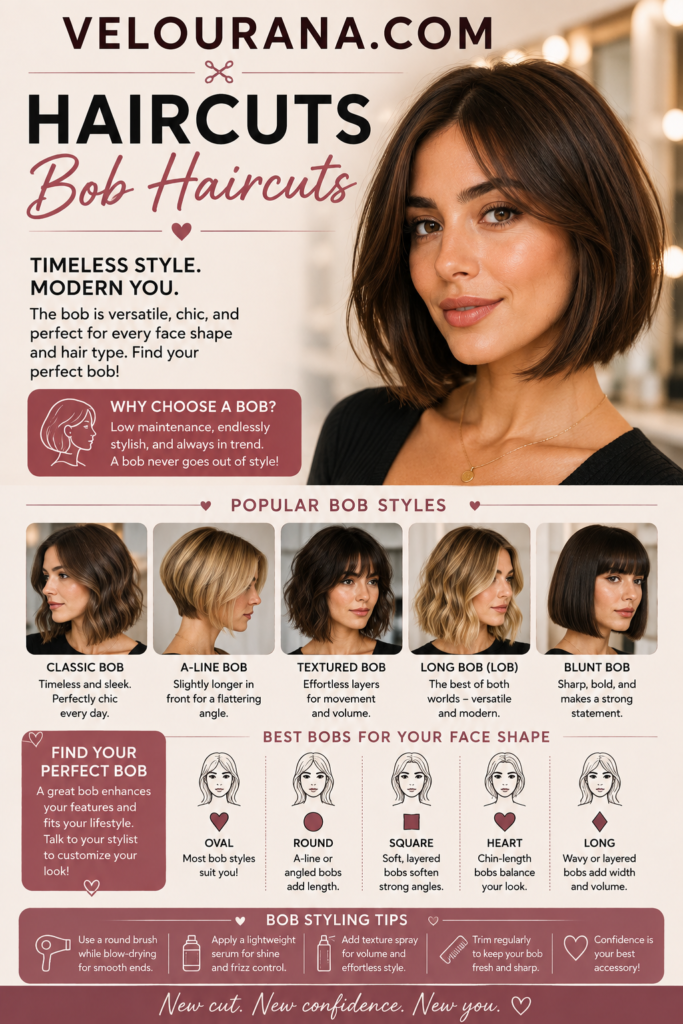
CATEGORY: Bob Haircuts
Some bobs are designed around precision. Their appeal comes from a perfectly controlled perimeter, a sleek finish and a silhouette that barely moves. The Italian bob approaches short hair differently. It retains the confidence and structure of a bob, but it allows more fullness, movement and sensuality into the shape.
The result is a haircut that can feel glamorous without appearing overly constructed.
Typically sitting somewhere around the chin or lower jaw, the Italian bob has enough length and weight to create a substantial silhouette. The ends often look full rather than heavily thinned, while the interior of the haircut can contain enough movement to prevent that fullness from becoming rigid. It can be worn with a center part for a balanced appearance, pushed dramatically to one side for instant volume, tucked behind the ears, styled sleekly or allowed to fall into soft bends and waves.
This flexibility is central to its appeal.
Rather than depending on one exact arrangement, the haircut can change according to how the hair is moved. A casual sweep of the hand can alter the parting. One side can fall forward while the other sits behind the ear. The ends can curve inward one day and move more freely the next.
It is still recognizably a bob, but it does not behave like a hairstyle that must remain frozen in one position.
That quality makes the Italian bob particularly interesting for anyone who wants to cut their hair shorter without losing the feeling of abundance normally associated with longer hair.
The Importance of Keeping Weight in the Hair
The Italian bob is often characterized by its fullness, and much of that impression comes from preserving enough density through the lower part of the haircut.
This does not mean every strand needs to remain exactly one length.
Internal shaping can be used where necessary, particularly with very thick hair, but the visible perimeter usually retains enough substance to look rich rather than feathered or sparse.
This distinction is important.
A heavily layered bob can create wonderful movement, but it distributes density throughout many different lengths. The Italian bob generally keeps more visual weight concentrated around the lower silhouette.
That weight gives the haircut its presence.
When the head moves, the hair moves as a substantial shape rather than as numerous disconnected pieces.
For fine hair, this can be particularly attractive because a strong perimeter can create the appearance of greater density. Long, weakened ends can be removed and the remaining hair concentrated at a level where it appears fuller.
For thick hair, the natural density provides an excellent foundation, although the interior may need thoughtful management so the haircut does not become excessively bulky.
The objective is fullness with mobility.
The hair should look abundant without feeling trapped inside an unnecessarily heavy shape.
Length Determines Whether the Cut Feels Sharp or Luxurious
An Italian bob is generally short enough to expose the neck but long enough to retain movement.
Exactly where that balance occurs varies from person to person.
A version ending around the jaw feels stronger and more compact. The relationship between the perimeter and facial structure becomes immediately visible.
Allow the hair to fall slightly lower and the silhouette becomes softer. There is more room for the ends to move, more flexibility for changing the part and often more ability to tuck sections behind the ears.
Someone nervous about moving from long hair to a bob may find this slightly longer interpretation particularly appealing.
It provides the psychological and visual change of shorter hair without immediately removing every familiar styling option.
The exact position should also account for natural texture.
Straight hair may hang close to the measured cutting length.
Wavy hair can rise once its bends return.
Curly hair may contract considerably.
The final length should therefore be chosen according to where the hair actually sits when worn normally, not simply where it reaches when pulled straight.
The Haircut Should Move
Movement separates a luxurious bob from a solid block of hair.
Even when the perimeter remains relatively full, the hair should be able to shift around the head.
This may require subtle internal shaping.
On dense hair, carefully reducing selected areas of weight can prevent the haircut from expanding too heavily around the sides.
On finer hair, very little internal removal may be necessary because preserving density is more important.
The technique should therefore respond to the hair rather than to a rigid formula.
The finished cut may appear simple from the outside, yet considerable thought can exist beneath that simplicity.
This is one of the characteristics of successful short haircuts.
The technical work does not necessarily need to be visible.
What matters is how the hair behaves.
When someone turns their head, the bob should move.
When the part changes, the hair should settle into a new position.
When one side is tucked behind the ear, the remaining side should still retain an attractive shape.
The haircut is designed for movement rather than for one perfect photograph.
Straight Hair Can Create a Rich, Polished Version
Straight hair allows the density and perimeter of the Italian bob to become especially visible.
The ends can appear substantial, while the smooth surface gives the haircut a polished quality.
Unlike an extremely geometric blunt bob, however, the finish does not necessarily need to be perfectly flat or rigid.
A little root movement can create softness.
The ends can curve gently rather than forming a severe horizontal line.
The part can be moved slightly away from its usual position to introduce natural volume.
This makes the haircut useful for someone who likes polished hair but does not want it to look excessively strict.
Fine straight hair can benefit from keeping the lower edge strong. A lightweight styling routine can then preserve movement without flattening the strands.
Thicker straight hair may require more internal management because a short dense shape can become heavy quickly.
The surface can remain sleek while the hidden structure allows the hair to move more freely.
Wavy Hair Brings Out the Relaxed Glamour
Natural waves can make an Italian bob feel particularly luxurious because the density of the haircut gives the waves a substantial foundation.
Instead of becoming extremely fragmented, the bends move through a relatively full silhouette.
The result can feel soft and glamorous without requiring every wave to be identical.
In fact, slight irregularity often improves the style.
One side may curve more strongly.
A section near the face may turn outward.
Another may fall toward the jaw.
These differences create movement.
The stylist needs to understand how much the wave pattern changes after cutting. Removing long lengths reduces weight, and some waves become more pronounced as a result.
A bob that appears comfortably below the chin while wet can sit higher once dry.
Planning for that movement prevents the finished haircut from becoming unexpectedly short.
Layers can be used cautiously if needed, but excessive layering may remove the fullness that defines the style.
The goal is usually to encourage the waves without breaking the haircut into too many separate levels.
Curly Hair Can Create a Voluminous Interpretation
Curly hair can transform the Italian bob into a rich, three-dimensional shape.
The defining fullness is already naturally present.
The challenge is distributing it.
If dense curls accumulate heavily at the bottom, the haircut can become extremely wide around the jaw. This may be exactly the desired silhouette, or it may require some adjustment depending on personal preference.
Strategic shaping can distribute volume more evenly without removing the abundance that makes the haircut attractive.
Shrinkage remains crucial.
The hair should be evaluated according to where the curls settle naturally.
A small amount of additional cutting can produce a significant difference once the curl contracts.
This is particularly important around the face, where a few centimeters can determine whether a curl falls beside the cheek, jaw or ear.
A curly Italian bob does not need to mimic the smooth versions seen on straight hair.
The concept can be translated rather than copied.
Fullness, movement and a compact silhouette remain the essential qualities.
The Side Part Is One of the Cut's Greatest Styling Tools
One of the most characteristic ways to wear a fuller bob is to move the part dramatically to one side.
This instantly redistributes the hair.
One side becomes lighter and more exposed, while the opposite side gains additional volume.
The transformation can be substantial despite requiring no cutting and very little styling.
Hair that normally sits in the center can be pushed sideways with the fingers for a more relaxed effect. A more deliberate side part creates stronger asymmetry.
This flexibility is particularly attractive because the hairstyle can change throughout the day.
The hair does not necessarily need to remain committed to one precise line.
Someone may begin with a center part and later push the front section sideways.
The haircut should still work.
Natural growth patterns influence how easily this happens.
A strong cowlick may favor one direction. Hair that has been worn in the same part for years may initially resist movement.
Styling the roots while damp can help create greater flexibility.
The Center Part Creates a Completely Different Mood
Return the hair to the center and the same bob becomes more balanced and symmetrical.
The fullness is distributed more evenly on both sides of the face.
This can make the perimeter appear stronger and bring greater attention to the overall shape.
With straight hair, the result can feel clean and sophisticated.
With waves, the symmetry of the part contrasts with the irregular movement of the texture.
The ability to move between these two moods is one of the haircut's strengths.
A hairstyle does not need to be redesigned every time a different appearance is wanted.
Sometimes moving the part is enough.
The Tucked-Behind-the-Ear Look Changes the Silhouette Again
Short hair interacts with the ears in a way long hair often does not.
Tucking one side of an Italian bob behind the ear immediately exposes more of the face and creates asymmetry.
The opposite side can remain full, producing a contrast between openness and volume.
Tucking both sides creates a cleaner, more compact appearance.
Earrings become more visible.
The jaw and neck become more exposed.
The haircut suddenly feels different even though the hair has not been restyled extensively.
This is another reason the exact length matters.
The front sections need enough length to sit comfortably behind the ear if this is an important styling option.
A bob cut too short around the front may repeatedly fall forward.
Someone who loves wearing their hair tucked should mention this during the consultation.
Fine Hair Can Benefit From the Full Perimeter
The Italian bob can be particularly useful for fine hair when the objective is to create the appearance of more substantial ends.
Long fine hair sometimes becomes increasingly transparent toward the bottom.
Cutting the perimeter higher removes some of those sparse lengths.
The remaining ends collect around one level, creating a stronger visual boundary.
Preserving that boundary is important.
Too many layers can reduce the effect by removing hair from the perimeter again.
This does not mean fine hair must remain completely blunt.
Subtle internal movement may prevent the cut from looking flat.
The difference is that density remains the priority.
Styling products should generally remain lightweight.
A small amount of root lift can enhance the shape, while excessive oils and creams can cause the hair to collapse.
The goal is not artificial volume.
It is allowing the haircut to display the density that already exists as effectively as possible.
Thick Hair Creates Natural Luxury but Needs Balance
Thick hair seems almost made for a full bob because the density immediately gives the haircut substance.
Yet the same abundance can create practical problems once the hair is shortened.
Long hair carries its own weight.
When that weight is removed, thick hair may expand outward.
The bob can become much wider than anticipated.
This is not necessarily undesirable. A broad, voluminous silhouette can be striking.
But if the intended result is a softer, more mobile bob, some internal adjustment may be necessary.
The perimeter can remain visually dense while selected bulk is reduced inside.
This allows the hair to move without sacrificing its richness.
The aim should never be to punish thick hair for being thick.
Its abundance is one of the reasons the haircut can look so luxurious.
The cutting technique should simply decide where that abundance is most useful.
Bangs Are Optional, Not Essential
Unlike some short bob styles strongly associated with a fringe, the Italian bob works beautifully with an open forehead.
This allows the changing part to become a major styling feature.
Adding bangs creates a different effect.
Long curtain bangs can connect naturally with the volume around the sides.
A sweeping fringe can reinforce asymmetry.
Wispy bangs can soften the upper face while leaving much of the forehead visible.
A full blunt fringe creates a much stronger geometric statement and may move the haircut away from its relaxed character toward something more graphic.
None of these choices is wrong.
The question is what role the bangs should play.
If the freedom to change the part frequently is one of the main attractions of the haircut, very structured bangs may reduce that flexibility.
Longer face-framing pieces can provide movement without creating the same commitment.
Styling Should Enhance Fullness Without Creating Stiffness
A glamorous bob does not need to be saturated with styling product.
In fact, too much product can remove exactly the movement that makes the haircut appealing.
Fine hair may need little more than lightweight volume support and controlled drying.
Thicker hair may benefit from smoothing or conditioning products that reduce unwanted expansion without making the strands rigid.
Waves and curls may need definition and moisture according to their texture.
The finished hair should remain touchable.
If the part is moved, the hair should be able to follow.
If the head turns, the ends should respond.
If one side is tucked away, the other should settle naturally.
This mobility creates the impression of effortless glamour more effectively than a hairstyle that has been fixed into one position.
A Soft Blowout Can Emphasize the Shape
The Italian bob lends itself beautifully to a blowout because the full perimeter provides enough hair for movement through the ends.
The objective does not necessarily need to be enormous volume.
A controlled lift at the roots and gentle curvature through the lengths can be enough.
The ends may turn slightly inward or move away from the face depending on the desired style.
The front can be directed backward and allowed to fall naturally, creating a loose sweep rather than a rigid part.
Cooling the hair in its intended shape can help preserve movement.
The final result should look full rather than inflated.
There is an important difference.
Fullness comes from density and movement.
Excessive volume can make the haircut appear larger without necessarily making it more elegant.
Natural Texture Can Be Just as Glamorous
The Italian bob does not depend on a professional blowout.
One of its strengths is that natural texture can create an entirely different but equally attractive interpretation.
A wavy bob can be allowed to dry with its bends intact.
Curls can create their own volume.
Straight hair can fall with minimal manipulation.
The haircut provides the structure.
Texture supplies the personality.
This approach can dramatically reduce daily maintenance for someone whose natural hair already works well with the chosen shape.
It also makes the haircut more individual.
Instead of reproducing the exact surface texture of an inspiration photograph, the same silhouette is expressed through the wearer's own hair.
The Cut Can Work Beautifully With Mature Hair
Hair can change in density, texture and behavior over time.
Some people notice that previously thick hair becomes finer. Others develop more wave or irregular texture. Grey hair may have a different feel from pigmented strands on the same head.
A full bob can adapt well to these changes because it does not depend on extreme length or complicated layering.
Removing weakened ends can create a stronger perimeter.
The shorter length can reduce the visual effect of sparse lower sections.
Natural silver or grey movement can become part of the texture rather than something that needs to be hidden.
There is no age at which a bob becomes inappropriate.
The relevant considerations are the same at every stage of life: hair condition, density, texture, desired appearance and maintenance.
Shorter Does Not Necessarily Mean Difficult
A common fear before cutting long hair is that short hair will require constant styling.
That depends far more on the relationship between the haircut and natural texture than on the length itself.
A well-designed Italian bob may be easier than long hair because there is less to dry, detangle and manage.
Someone with compatible natural waves may need very little styling.
Someone attempting to make naturally curly hair perfectly straight every morning will naturally have a more demanding routine.
The haircut should therefore be chosen according to the appearance the wearer actually plans to maintain.
A salon photograph is only useful if its everyday requirements are understood.
Maintenance Depends on How Much You Love the Exact Length
A bob changes gradually as it grows.
The Italian bob is relatively forgiving because its character does not depend on one razor-sharp geometric line.
A chin-length version can become slightly longer without immediately losing its identity.
Eventually it approaches the shoulders and begins behaving more like a long bob.
Someone who loves the compact original silhouette will want regular trims.
Someone comfortable allowing the haircut to evolve can wait longer.
The important thing is recognizing that the relationship between the perimeter and the neck changes over time.
The haircut can remain beautiful while still becoming different.
Growing It Out Can Be Surprisingly Graceful
Because the Italian bob generally preserves substantial density through the perimeter, it can transition into longer hair relatively smoothly.
The ends move downward while remaining full.
The haircut becomes a lob.
Later it reaches the shoulders.
The most awkward point may occur when the ends begin contacting the shoulders and flipping outward.
Even this stage can be incorporated into styling rather than treated as a problem.
Periodic trims can maintain healthy ends and adjust the shape while allowing overall length to increase.
Face-framing pieces can also be introduced or modified during the process.
Growing out the haircut therefore does not require abandoning it.
The bob simply evolves.
Why This Bob Feels Luxurious
Luxury in hair does not necessarily come from complexity.
Sometimes it comes from abundance, movement and the impression that the hair is comfortable in its own shape.
The Italian bob captures that idea particularly well.
The perimeter is substantial.
The hair can move.
The part can change.
The texture does not need to be perfect.
One side can be tucked behind the ear while the other falls forward.
The haircut can look polished with a blowout and equally convincing when worn more naturally.
That versatility prevents the style from becoming precious.
It is glamorous hair that can still be touched.
A Bob Designed to Be Lived In
The most useful interpretation of the Italian bob is not a rigid set of measurements copied from a trend photograph.
It is an approach to short hair.
Keep enough weight to create richness.
Choose a length that allows movement.
Manage internal bulk where necessary without destroying density.
Allow natural texture to contribute.
Create enough flexibility that the part can move and the hairstyle can change.
The result should not depend on recreating exactly the same finish every morning.
That is what gives this bob its distinctive confidence.
It has structure without looking constrained by structure.
It can be elegant without becoming formal and voluminous without becoming exaggerated.
For someone who wants shorter hair but fears losing the softness, movement and glamour associated with longer lengths, that balance can make the Italian bob an especially compelling choice.
The haircut removes length.
It does not remove possibility.
The End
Velourana.
 Discover More From Our Family of Websites
 ZodiacBearing (Astrology, Tarot, Numerology, Angel Numbers & Spiritual Guidance)
 Velourana (Beauty, Makeup, Hair Care, Skincare & Beauty Tips)
 HavenBearing (Home, Living, Organization, Décor & Everyday Inspiration)
 PawBearing (Pet Care, Dog Breeds, Animal Health, Training & Pet Products)
 PsyCatherine (Notes From the Journal of a Psychologist on Real Life)

