
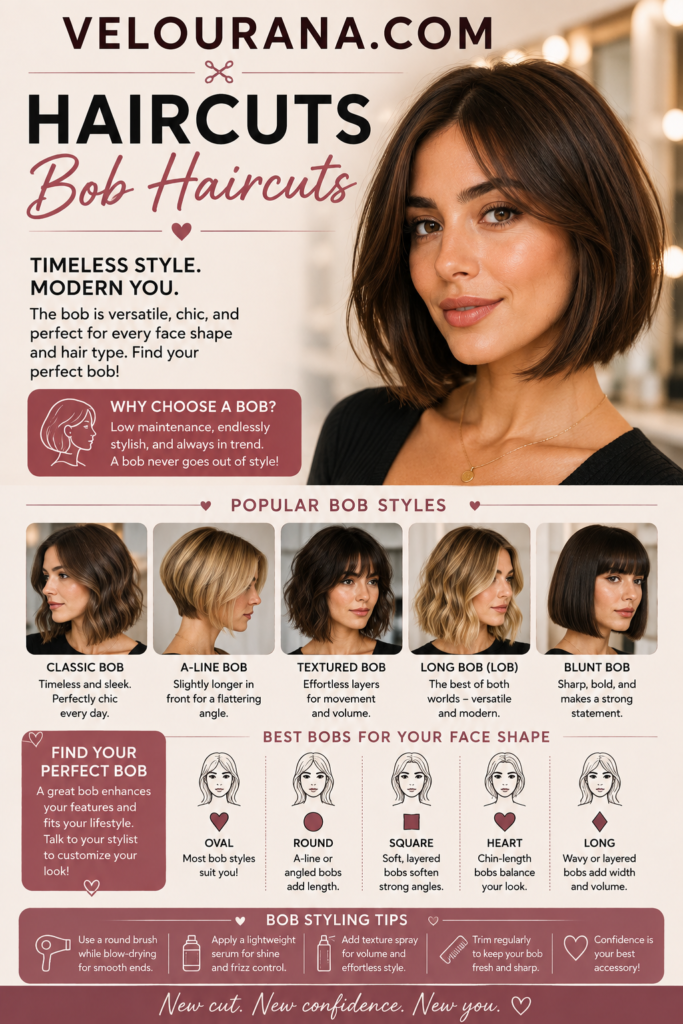
CATEGORY: Bob Haircuts
The French bob has become one of those hairstyles that seems instantly recognizable even though no two versions look exactly alike. It is usually short, often somewhere between the jaw and chin, frequently accompanied by bangs, and commonly styled with enough natural movement to prevent the haircut from feeling rigid. Yet none of those characteristics alone explains its appeal.
What makes the French bob distinctive is the relationship between structure and apparent effortlessness.
There is clearly a haircut underneath. The perimeter has been deliberately chosen, the proportions around the face matter and the length is short enough to create a recognizable silhouette. At the same time, the finished hair does not necessarily look as though every strand has been forced into position.
A slight wave can remain imperfect. The ends may turn in different directions. A fringe can separate naturally rather than sitting as an immaculate curtain across the forehead. Texture is allowed to show.
This gives the French bob a quality that many people want from shorter hair: it looks intentional without appearing overworked.
That apparent ease, however, does not mean the haircut itself can be careless. In fact, a bob that is intended to work with minimal styling often needs particularly thoughtful cutting. The length has to cooperate with the natural texture. The density needs to be distributed properly. The fringe, if there is one, must work with the hairline. The silhouette has to remain attractive even when the hair is not professionally blow-dried.
The goal is not to make the hair look unfinished.
It is to make it look naturally finished.
What Actually Makes a Bob Feel French?
Haircut terminology changes quickly, and labels are often applied broadly. A short bob with bangs may be called French even when its structure differs considerably from another haircut carrying the same name.
Rather than searching for one strict technical definition, it is more useful to understand the aesthetic.
The French bob is generally compact.
It tends to sit relatively close to the face rather than extending all the way to the shoulders. Jaw and chin lengths are common because they expose the neck and give the haircut a decisive silhouette.
The perimeter can be strong, but it is not always aggressively geometric.
Some versions are relatively blunt. Others contain enough texture to soften the edge.
Bangs frequently accompany the haircut, although they are not compulsory. A full fringe can create a classic appearance, while wispy or slightly irregular bangs make the style feel lighter. Curtain pieces can create a more open interpretation.
Natural movement is often part of the finish.
Rather than attempting to make every strand perfectly straight or every wave identical, the hairstyle can allow variation.
This combination of a clear haircut and relaxed styling is what creates much of the character.
The Short Length Changes More Than the Hair
Cutting a bob around the jaw or chin exposes areas that longer hair normally covers.
The neck becomes more visible.
The jaw becomes more connected to the perimeter.
Earrings may suddenly become more noticeable.
The neckline of clothing becomes part of the overall appearance in a way it may not have been when the hair extended over the shoulders.
This is one reason a short bob can feel like a much larger transformation than the number of centimeters removed might suggest.
Long hair creates a vertical frame extending beyond the face. A short French bob concentrates almost the entire hairstyle around the head and upper neck.
The exact stopping point therefore deserves careful consideration.
A bob ending directly at the jaw creates a different effect from one falling several centimeters below it.
A shorter perimeter may feel more graphic and expose more of the neck. A slightly longer version can feel softer and provide additional movement.
There is no universal ideal position.
The correct length is the one that creates the silhouette the wearer wants while accommodating the behavior of the hair.
Why the Hair Should Be Considered in Its Natural State
The French bob is often most attractive when natural texture contributes to the finished style.
That makes it particularly important to understand what the hair does without extensive manipulation.
Someone with almost straight hair may discover a subtle bend once the weight of longer lengths is removed.
Wavy hair can become noticeably more active.
Curls may spring considerably higher.
Thick hair may expand outward.
Fine hair may gain the appearance of density when weak ends are removed.
These changes can make a short haircut surprising.
A stylist needs to anticipate them before deciding where the final perimeter should sit.
If naturally wavy hair is stretched completely straight during the cutting process without accounting for its dry movement, the finished bob may become considerably shorter than expected.
Curly hair requires even greater attention to shrinkage.
Someone who intends to wear the bob naturally should therefore make that clear during the consultation. The haircut should be designed for the texture that will appear most days rather than for a temporary salon finish.
Straight Hair Creates a Cleaner Interpretation
The French bob is often photographed with waves, but straight hair can create an equally convincing version.
The effect simply changes.
On straight hair, the perimeter becomes more visible. The haircut can appear cleaner and more minimal, particularly when the length sits around the jaw.
The challenge is avoiding a finish that feels too rigid if softness is the objective.
Subtle texturing can help the ends move without destroying the strength of the perimeter. A slight bend can also prevent the hair from hanging completely flat.
Fine straight hair may benefit particularly from keeping the lower edge relatively substantial. A dense-looking perimeter can make the hair appear fuller.
The styling does not need to become elaborate.
A controlled blow-dry may be enough to establish the direction, after which the hair can be allowed to move naturally.
The important distinction is between polished and immobile.
Straight hair can look beautifully polished while still retaining enough movement to preserve the relaxed personality of the haircut.
Wavy Hair Naturally Supports the Style
Natural waves can make a French bob feel immediately at home.
Once excess length is removed, the wave pattern may become more visible because there is less weight stretching the hair downward.
This can create volume and irregular movement around the jaw and cheeks.
A wave that turns inward on one side and slightly outward on the other does not necessarily need correcting.
Perfect symmetry is not essential to the style.
In fact, attempting to make every wave identical can remove some of the character that makes a short textured bob appealing.
The haircut still needs balance.
There is a difference between natural irregularity and an unintentionally uneven silhouette.
A good cut establishes the overall shape while allowing the texture inside it to behave freely.
Product can support that movement without making the hair stiff. The objective is generally definition and control rather than creating a fixed arrangement.
For someone whose waves respond well to air-drying, this can become a relatively uncomplicated short haircut.
Curly Hair Can Create a Beautifully Individual French Bob
Curly interpretations demonstrate how flexible the French bob concept can be.
The perimeter may no longer appear as a perfectly visible horizontal line because individual curls contract to different lengths. Instead, the haircut becomes a compact overall shape around the face and neck.
Volume becomes part of the design.
A curly bob can be rounded and full or more elongated depending on layering, density and curl pattern.
Shrinkage is crucial.
The shorter the intended haircut, the more significant an unexpected amount of shrinkage becomes. Removing only a few additional centimeters can dramatically change where the curls sit around the face.
This makes cautious cutting particularly valuable.
The stylist can always remove more length.
Restoring it is impossible.
A curly French bob can also work beautifully with a curly fringe. Rather than straightening the front section into a conventional bang, individual curls can fall naturally around the forehead.
The result feels cohesive because the same texture continues throughout the haircut.
Bangs Can Define the Entire Look
Although a French bob does not absolutely require bangs, the combination is strongly associated with the style because the fringe concentrates even more attention around the face.
A relatively full fringe creates a classic interpretation.
When it finishes around the brows, the eyes become strongly framed while the short perimeter defines the jaw and neck.
A wispy fringe creates a lighter version.
The forehead remains partially visible, and the haircut feels less enclosed.
Shorter bangs can make the style more graphic and unconventional, while longer curtain pieces create softness and flexibility.
The fringe should suit the natural hairline.
A strong cowlick may make a dense straight-across fringe difficult to maintain without regular styling. A natural center separation may work better with softer curtain pieces.
This is where adapting the inspiration becomes important.
The goal should be to preserve the character of the haircut without creating unnecessary daily conflict with the hair.
The Perimeter Can Be Strong Without Looking Severe
A short bob needs enough structure to remain recognizable.
If the entire lower portion is excessively thinned or fragmented, the haircut can lose the compact shape that gives it character.
At the same time, a perfectly solid perimeter may become too heavy on certain hair types.
The solution is often controlled softness.
The visible edge can remain substantial while some internal weight is adjusted.
On thick hair, this may prevent the sides from expanding excessively.
On wavy hair, it can give the natural bends more freedom.
On fine hair, the perimeter may need to remain considerably more intact to preserve fullness.
This illustrates why the same external haircut can require different internal techniques.
The final appearance should guide the cutting method rather than forcing every head of hair through one standardized procedure.
Texture Should Look Deliberate, Not Neglected
The word “effortless” causes considerable confusion in beauty.
An effortless-looking hairstyle is not necessarily one that receives no attention.
The French bob may appear relaxed, but there is usually an underlying structure preventing the hair from simply looking unkempt.
Ends are maintained.
The perimeter has a deliberate position.
The fringe has a recognizable shape.
Texture is encouraged rather than uncontrolled.
This distinction becomes particularly important with tousled styling.
Randomly roughening the hair does not automatically create attractive texture. The movement should still complement the haircut.
Natural waves may need only a suitable styling product and gentle manipulation.
Straight hair may require a few bends to create separation.
Curly hair may need definition and moisture to keep the silhouette clear.
The objective is controlled freedom.
The hair should be allowed to move, but the haircut underneath provides the boundaries.
The French Bob Can Make Fine Hair Feel More Substantial
Fine hair often benefits from losing length when the ends have become sparse.
A short bob moves the perimeter upward to an area where the hair may have greater density.
This can make the ends look considerably stronger.
Keeping the baseline relatively full reinforces the effect.
Excessive layering can undermine it by removing too much hair from the perimeter.
That does not mean fine hair must remain completely one length.
Subtle movement can prevent the cut from feeling flat, particularly around the face.
Styling should remain lightweight.
A short fine bob can lose its natural movement quickly beneath heavy oils or creams. Products should support texture without causing the strands to collapse together.
A little root lift can also change the appearance dramatically.
Because the haircut is compact, even modest volume can make the entire silhouette feel fuller.
Thick Hair Can Give the Cut Luxurious Weight
Thick hair creates an entirely different French bob.
The abundance of hair can make the short silhouette feel rich and substantial, particularly when enough weight remains through the ends.
But cutting thick hair shorter can also release volume.
Long lengths may have been pulling the hair downward. Once they disappear, the sides can expand considerably.
This should be anticipated before the first major cut.
Internal weight management may be necessary to maintain movement.
The goal is not to remove the richness of thick hair. It is to prevent that richness from collecting in places that distort the intended shape.
Someone who enjoys volume may deliberately keep more width.
Someone wanting a compact silhouette may need more strategic internal work.
The desired result should be discussed rather than assuming that all thick hair needs to be made smaller.
A Little Imperfection Can Improve the Haircut
One of the most attractive qualities of this bob is that it does not always need to remain identical throughout the day.
The hair can move.
The part can shift slightly.
One side can tuck behind the ear.
A wave can change direction.
A few strands of the fringe can separate.
These changes do not necessarily destroy the hairstyle.
They can make it feel more personal.
This is very different from a haircut whose success depends on maintaining an exact geometric arrangement.
The underlying structure provides enough discipline that the surface can remain relaxed.
That balance can make the style particularly enjoyable for someone who likes polished hair but does not want to spend the day checking whether every strand is still in place.
The Parting Can Change the Mood Instantly
A center part gives a short bob a relatively symmetrical appearance and can make the haircut feel modern and minimal.
Moving the hair slightly to one side introduces softness.
A deeper side part can create noticeable volume and a more dramatic shape.
Because the hair is short, these changes can have a surprisingly large visual effect.
The natural growth direction determines how easily the part moves.
Someone with flexible hair may switch from one side to another with little difficulty. A strong cowlick may make one position much more practical.
If versatility is important, the haircut can be designed so it does not depend completely on one fixed part.
This allows the wearer to change the style without changing the cut.
Styling Can Be Surprisingly Simple
For someone whose natural texture cooperates with the haircut, daily styling can be relatively minimal.
Wavy hair may need only product distribution and air-drying.
Curly hair may be shaped while wet and then allowed to form naturally.
Straight hair may benefit from a quick blow-dry to establish direction.
The difficulty increases when the desired finish differs significantly from the natural texture.
Someone with strong curls who wants a perfectly sleek French bob every day will naturally spend more time styling than someone who intends to wear the curls.
The same principle applies to every haircut.
Low maintenance does not come from choosing a particular length.
It comes from choosing an appearance reasonably close to what the hair naturally wants to do.
The Short Length Makes Regular Trims More Noticeable
A French bob derives much of its personality from being compact.
As the hair grows, that proportion changes.
A jaw-length bob gradually reaches the chin.
Then it moves toward the neck.
The haircut may remain attractive throughout, but it will not remain the same haircut indefinitely.
Someone who loves the precise short silhouette will therefore need periodic trims.
Bangs may require attention even sooner.
This maintenance should be considered part of choosing the style.
A person who visits the salon rarely may prefer starting slightly longer or choosing a shape that transitions gracefully as it grows.
The haircut can then evolve rather than appearing to lose its identity immediately.
Growing It Out Does Not Have to Be Difficult
A short bob provides a relatively straightforward route toward longer hair.
The perimeter gradually moves downward while the overall shape remains recognizable.
The most significant behavioral change often occurs when the hair reaches the shoulders.
Before that point, the ends hang relatively freely.
Once they touch the shoulders, they may begin turning outward or sitting differently.
Periodic reshaping can guide the haircut through this stage.
If bangs were included, they can gradually become curtain bangs, then face-framing layers.
The entire style can therefore evolve naturally from a French bob into a longer bob and eventually into medium-length layered hair.
Growing it out does not require abandoning style for a year.
The Haircut Should Work on an Ordinary Day
The best test of a French bob is not how it looks immediately after a professional blow-dry.
It is how it behaves two weeks later on an ordinary morning.
Can you recreate a version you like?
Does the natural texture contribute rather than constantly fight the cut?
Does the fringe fall reasonably well?
Does the density sit in the right places?
Does the length work with your routine?
If the answer is yes, the haircut has succeeded.
It may never look exactly the same two days in a row, but that does not undermine the style.
Variation is part of its character.
Why the French Bob Continues to Feel Modern
The French bob has historical associations, but its continuing appeal is not based simply on nostalgia.
It reflects a very contemporary desire for hair that looks intentional without looking excessively manufactured.
The haircut is visible.
The personality is clear.
Yet natural texture can remain.
A strand can move.
A wave can be imperfect.
The fringe can separate.
The wearer does not need to look as though they have spent an hour constructing their hair before leaving home.
This balance gives the style longevity.
Trends may change the preferred length, fringe or finish, but the underlying idea remains attractive: a compact haircut with enough structure to look polished and enough freedom to look alive.
When the length suits the wearer, the density is handled thoughtfully and the natural texture is allowed to participate, the French bob becomes more than a fashionable short haircut.
It becomes a reminder that sophistication does not always require perfection.
Sometimes the most convincing hairstyle is the one that looks better after it has moved a little.
The End
Velourana.
 Discover More From Our Family of Websites
 ZodiacBearing (Astrology, Tarot, Numerology, Angel Numbers & Spiritual Guidance)
 Velourana (Beauty, Makeup, Hair Care, Skincare & Beauty Tips)
 HavenBearing (Home, Living, Organization, Décor & Everyday Inspiration)
 PawBearing (Pet Care, Dog Breeds, Animal Health, Training & Pet Products)
 PsyCatherine (Notes From the Journal of a Psychologist on Real Life)

