
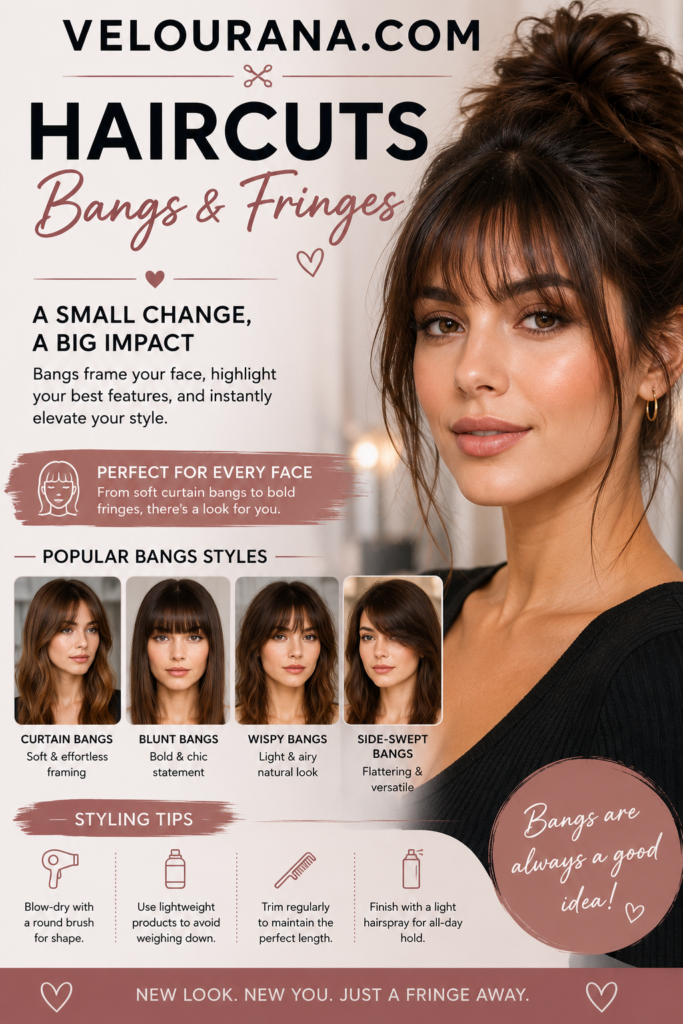
CATEGORY: Bangs & Fringes
There is something particularly appealing about a fringe that does not look too deliberate. Instead of forming a solid line across the forehead, wispy bangs allow small spaces between the strands. They move when you walk, separate naturally around the eyes and soften the front of a haircut without hiding the face behind a heavy curtain of hair.
That apparent simplicity is deceptive.
A successful wispy fringe depends on careful decisions about density, length and placement. Too much hair brought forward and the fringe becomes heavy. Too little and it may look accidental rather than intentionally delicate. Excessive thinning can leave weak, stringy ends, while a fringe cut without considering the natural hairline can separate in places where separation was never intended.
When the balance is right, however, wispy bangs can be one of the most adaptable ways to change a hairstyle.
They can introduce softness to a bob, movement to long hair, delicacy to a layered haircut or a slightly undone quality to an otherwise polished style. They can sit close to the brows, fall around the eyelashes, separate through the center or gradually become longer toward the temples.
They also offer an appealing middle ground for someone attracted to bangs but hesitant about committing to a dense full fringe.
The forehead remains partially visible. The haircut changes noticeably, but the bangs do not necessarily dominate it. And because the fringe can often be blended into longer pieces around the face, the transition into the rest of the hairstyle can feel natural rather than abrupt.
What Actually Makes a Fringe Wispy
Wispy bangs are defined less by one exact length than by the way density is distributed.
A traditional full fringe usually contains enough hair to create relatively continuous coverage across the forehead. A wispy fringe deliberately allows separation. Individual pieces or small groups of strands remain visible rather than merging into one solid shape.
This does not mean the ends should simply be thinned until very little hair remains.
The initial section chosen for the fringe matters enormously. If too much hair is brought forward and then aggressively thinned, the result can contain numerous short internal pieces while still feeling bulky near the roots. The ends may appear fragile while the top remains heavy.
A more refined approach begins by controlling how much hair enters the fringe in the first place.
The stylist can then shape the edge so that some pieces are subtly different in length, creating movement and natural separation without destroying density.
The precise balance depends on the hair.
On fine hair, a small amount of carefully positioned hair may be enough to create a visible fringe. On very thick hair, more internal weight may need to be managed so the bangs do not immediately collapse into a dense block.
Texture changes the interpretation as well. Straight wispy bangs may create clearly separated strands across the forehead, while wavy or curly versions can form soft groups and bends rather than fine individual pieces.
The objective is not mathematical uniformity.
It is lightness.
Why Wispy Bangs Can Feel Less Severe Than a Full Fringe
A full fringe changes the visible proportions of the face immediately because it creates a relatively strong boundary across the forehead.
Wispy bangs allow the forehead to remain part of the composition.
Skin remains visible between the strands, which reduces the visual weight of the fringe. The eye can still perceive the full height of the forehead while simultaneously seeing hair around it.
This makes the transformation softer.
The effect can be particularly attractive when someone wants to emphasize the eyes without creating the dramatic impact of dense eyebrow-length bangs.
Length can shift the emphasis.
A fringe ending near the brows draws attention toward the eyes and brow shape. Slightly longer pieces can create a more relaxed appearance around the upper face. Longer side sections can move toward the cheekbones and connect the fringe with face-framing layers.
Because the overall density is lighter, these changes can occur without the fringe appearing to take over the entire haircut.
This is one reason wispy bangs can work beautifully with relatively simple hairstyles.
Long, nearly one-length hair can suddenly gain detail around the face.
A blunt bob can become softer without losing its strong perimeter.
A layered haircut can use the fringe as the shortest point in a continuous sequence of movement.
The bangs provide interest while allowing the underlying haircut to remain visible.
Fine Hair and the Importance of Protecting Density
Wispy bangs may seem like an obvious choice for fine hair because they require less density than a heavy fringe, but the section still needs to be planned carefully.
Fine hair has fewer visual resources to redistribute.
If a large triangular section is taken from the front to create bangs, the remaining hair around the temples and sides may look noticeably thinner. This can be particularly obvious when the overall haircut is already relatively fine.
A shallow fringe section can preserve more of the surrounding density.
The stylist can use the hair that naturally falls toward the forehead rather than pulling substantial amounts forward from farther back on the head.
This often creates a more believable result because the fringe behaves according to the hair's natural distribution.
Fine hair can also lose volume quickly when oils accumulate. Because wispy bangs depend on separation and movement, they may begin grouping together when oily, making the fringe appear much thinner than it actually is.
Lightweight styling becomes important.
Heavy creams and oils can overwhelm short, fine pieces. A small amount of suitable styling product, gentle root lift or carefully used dry shampoo may provide enough control without removing movement.
The goal should not be to make fine hair behave like thick hair.
Its natural delicacy can actually be an advantage with this style.
Thick Hair Needs Restraint Rather Than Simply More Thinning
With thick hair, creating a wispy fringe involves a different challenge.
There is plenty of density available, sometimes too much.
If a deep section is brought forward, the fringe may immediately become fuller than intended. Attempting to correct this by aggressively thinning the ends can create an uneven structure in which the roots remain dense while the lower portion looks sparse.
Instead, controlling the initial section allows the stylist to build lightness into the fringe from the beginning.
Weight can then be removed selectively where necessary.
Thick hair may also have enough strength to resist the soft, separated movement associated with wispy bangs. The strands may naturally fall together into a heavier shape.
Strategic texturing can encourage separation, while styling can help individual sections move independently.
The surrounding haircut matters too.
If the rest of the hair is extremely dense and blunt, a very delicate fringe may feel disconnected. Introducing subtle face-framing movement around the sides can help the lighter front section transition into the heavier lengths.
The objective is harmony rather than making every part of the haircut equally dense.
Straight Hair Makes Every Detail Visible
Straight hair can produce an exceptionally clean wispy fringe because individual pieces are easy to see.
It can also expose every cutting decision.
When hair falls relatively straight, irregularities in length or density may be more obvious than they would be within curls or waves. This makes deliberate softness important.
The fringe should not look as though random strands were simply cut shorter.
Even when the edge appears slightly irregular, there should be an underlying shape.
The center may be subtly shorter, with the sides becoming longer. Alternatively, the fringe may remain relatively level across the forehead while varying gently in density.
Straight hair can also become flat at the roots, particularly when fine. A little root movement can prevent the fringe from sticking closely to the forehead.
The styling does not necessarily require a round, voluminous blowout.
Often the most attractive wispy bangs are relatively flat and natural, with only enough movement to keep them from looking rigid.
A blow-dryer used while the fringe is damp can help control direction. Moving the hair gently from side to side while drying can prevent a strong unwanted part from forming before the fringe is allowed to fall into place.
The ends can then be shaped minimally.
Too much curvature can remove the airy quality that made the fringe attractive in the first place.
Waves Give Wispy Bangs a Different Kind of Softness
Wavy hair can make a wispy fringe look almost effortless because the natural texture creates separation automatically.
Instead of every strand falling vertically, some pieces curve toward the face while others move away. The result can feel relaxed and slightly irregular in a way that suits the lightness of the style.
The important issue is length.
A wave shortens the apparent length of the hair once it forms. Bangs cut to the perfect position while stretched may rise considerably after drying.
The stylist therefore needs to consider the natural pattern rather than treating the hair as though it will remain straight.
Some people with wavy hair prefer allowing their fringe to air-dry naturally. Others control the roots with a blow-dryer and allow the waves to develop through the ends.
Both approaches can work.
What matters is that the haircut supports the routine the wearer actually intends to follow.
If someone never straightens their hair, cutting bangs that only look correct when straightened creates unnecessary maintenance.
The natural wave should be part of the design rather than a problem to correct.
Curly Wispy Bangs Can Be Soft Without Being Sparse
On curly hair, the word “wispy” needs a slightly different interpretation.
Individual curls naturally group strands together, so the fringe may not create the fine feather-like separation seen on straight hair. Instead, a small number of carefully positioned curls can provide the same visual lightness.
The forehead remains partially visible.
Some curls fall forward while others sit toward the sides.
The fringe has movement without becoming a dense wall of hair.
Shrinkage is particularly important.
Curly hair can become significantly shorter when dry, and individual sections may shrink differently. Cutting too much length while the hair is stretched can create a fringe far shorter than intended.
Evaluating the natural curl pattern allows the stylist to decide which curls should participate in the fringe and where they are likely to settle.
A curly wispy fringe can be especially effective when the surrounding haircut contains layers. The shorter curls around the forehead can transition gradually into longer curls around the temples and cheeks, making the fringe feel integrated rather than separate.
There is no requirement for both sides to behave identically.
Natural asymmetry can be part of the beauty of textured bangs.
Cowlicks Can Become Part of the Design
The front hairline has a strong influence on every type of fringe, but wispy bangs can sometimes accommodate growth patterns more easily than a dense straight-across style.
Because the fringe is already intended to separate, a natural split does not necessarily destroy the shape.
A cowlick near the center may encourage a small opening. Instead of fighting it constantly, the stylist can sometimes position the fringe around it.
A growth pattern toward one side may lead naturally into a slightly asymmetric wispy fringe.
There are still situations where styling will be required. If a section lifts dramatically away from the forehead or travels in the opposite direction from the intended design, controlling the roots while the hair is damp can make a considerable difference.
The important thing is to examine the hairline before cutting.
Hair that has already been blow-dried into position can hide its natural behavior. A stylist who understands how the roots grow can design the fringe accordingly.
This is another reason copying an inspiration photograph exactly can be unrealistic.
Two people can have similar hair texture and density but completely different hairlines.
Their best versions of the same fringe may therefore require different cutting patterns.
Wispy Bangs and Face Shape
The lightness of wispy bangs makes them highly adaptable because they do not impose a heavy geometric shape on the face.
A longer face can wear them with more coverage across the forehead if that creates the desired balance.
A rounder face may use longer side pieces to introduce vertical and diagonal movement.
A square or angular face may look beautiful with a soft, irregular fringe that contrasts with stronger facial lines.
A heart-shaped face may use the fringe to bring attention toward the eyes while allowing longer pieces to frame the cheekbones.
These are possibilities rather than rules.
The width and height of the forehead, position of the brows, cheekbone structure, jawline and overall haircut often matter more than the broad face-shape category.
Personal preference matters most of all.
Some people enjoy emphasizing the characteristics that conventional advice tells them to minimize. A strong jaw does not necessarily need to be softened. A round face does not need to be made visually longer.
Haircuts can express features rather than constantly attempting to correct them.
Wispy bangs provide enough flexibility to do either.
Styling Should Preserve Movement
A wispy fringe can lose its character when too much product is applied.
Strong gels, heavy creams and excessive hairspray can cause the strands to join together, turning a light fringe into several stiff sections.
The ideal styling approach usually uses the minimum amount necessary to control direction and texture.
For straight or slightly wavy hair, much of the work can happen during drying.
The roots are directed into position while the hair is damp. Once the fringe has dried, a small amount of lightweight product may be enough to define individual pieces.
For textured hair, a suitable curl or wave product can help maintain natural shape without making the fringe rigid.
The fringe should still be able to move.
That movement is part of what makes wispy bangs feel relaxed rather than architectural.
This also means perfection is unnecessary.
If every strand is arranged into exactly the same position each morning, the result can become more formal than the haircut requires.
A few pieces moving differently throughout the day often improve the effect rather than ruining it.
Skincare, Sunscreen and the Forehead Can Affect the Fringe
Bangs live directly against one of the areas where many people apply the greatest number of skincare products.
Moisturizer, sunscreen, foundation and natural skin oils can all transfer onto the fringe.
Wispy bangs can show this transfer quickly because their light density makes any grouping of strands more noticeable.
Allowing skincare products to settle before styling the fringe can help.
Someone using a particularly rich moisturizer may also find that avoiding unnecessary application into the hairline reduces transfer.
This should never mean reducing the amount of sunscreen needed for proper protection. Instead, choosing compatible formulas and giving products time to settle can make the skincare and hairstyle coexist more comfortably.
The fringe itself may occasionally need washing even when the rest of the hair does not.
This is one of the easiest maintenance tricks for anyone with bangs.
The small front section can be shampooed at the sink, rinsed and restyled within minutes. The remaining hair can stay completely dry.
For people whose bangs become oily quickly, this can extend the life of the overall hairstyle considerably.
Trimming Wispy Bangs Requires Care
Because wispy bangs are light, a few millimeters can make a noticeable difference.
As they grow, pieces that once sat around the brows may begin falling into the eyes. The fringe can lose its intended separation as longer strands start joining the sides.
Regular professional reshaping can preserve the design without allowing the section to become progressively heavier or more irregular.
Home trimming can be tempting because the fringe is directly visible in the mirror and appears simple.
The danger is that each correction encourages another correction.
One side is shortened.
Then the other needs matching.
Then the center appears too long.
Before long, considerably more hair has been removed than intended.
Hair also behaves differently when wet, stretched or held under tension. Cutting it in that state without understanding how it will return to its natural position can result in an unexpectedly short fringe.
If the intended shape matters, professional trimming is generally the safer option.
The lighter the fringe, the more every individual piece contributes to the result.
Growing Out a Wispy Fringe Is Usually Manageable
One of the advantages of wispy bangs is that the growing-out stage can be relatively forgiving.
Because the fringe contains less density, it can gradually be incorporated into the surrounding hair without creating a large, heavy section at an awkward intermediate length.
As the bangs reach the eyes and cheekbones, they can be separated through the center.
They can become short curtain bangs.
Later, they can transition into longer curtain pieces or ordinary face-framing layers.
A side part can redirect them during another stage of growth.
Pins, clips and headbands provide temporary options when the hair needs to be kept away from the face.
The process can therefore feel less like waiting for bangs to disappear and more like allowing the haircut to evolve.
This makes wispy bangs particularly attractive to someone who enjoys changing their hairstyle periodically.
The initial commitment is real, but the route out of the fringe is relatively flexible.
The Difference Between Delicate and Insignificant
There is a point at which a fringe can become so light that it no longer contributes meaningfully to the haircut.
This is why “wispy” should not automatically mean “as little hair as possible.”
The fringe still needs enough presence to frame the face.
From normal conversational distance, it should look intentional rather than like a few broken hairs around the forehead.
The correct density depends on the person.
Someone with extremely fine hair may need only a small section to create the effect. Someone with thick, dark hair may require more hair simply because a handful of strands would look disproportionately sparse against the rest of the hairstyle.
Hair color can influence visual density too. Strong contrast between the hair and skin can make a relatively light fringe appear more substantial, while lower contrast may create a softer effect.
This is why the final decision should be visual rather than based on a fixed measurement.
When Wispy Bangs Are the Right Kind of Change
There are times when someone wants a completely different haircut.
They are ready to lose substantial length, change the silhouette and walk out of the salon looking dramatically transformed.
Wispy bangs can provide another kind of change.
The hair can remain long.
The bob can remain a bob.
The layers can remain almost untouched.
Yet the relationship between the hair and face changes immediately.
The eyes become framed differently.
The forehead gains movement.
A ponytail looks different because soft pieces remain around the face.
An updo becomes less severe.
Loose hair gains detail at the front.
That ability to transform without overwhelming is the real strength of a wispy fringe.
It is not merely a less committed version of full bangs. It has its own aesthetic: light, mobile, deliberately imperfect and adaptable to an enormous range of hairstyles.
The best version respects the natural density of the hair instead of removing too much. It considers texture instead of forcing every strand straight. It works with the hairline where possible. It connects naturally with the surrounding haircut and requires a level of styling the wearer can realistically maintain.
When those elements are balanced, the fringe does not need to be heavy to make a difference.
Sometimes a few carefully placed pieces around the face can change the entire feeling of a haircut.
The End
Velourana.
 Discover More From Our Family of Websites
 ZodiacBearing (Astrology, Tarot, Numerology, Angel Numbers & Spiritual Guidance)
 Velourana (Beauty, Makeup, Hair Care, Skincare & Beauty Tips)
 HavenBearing (Home, Living, Organization, Décor & Everyday Inspiration)
 PawBearing (Pet Care, Dog Breeds, Animal Health, Training & Pet Products)
 PsyCatherine (Notes From the Journal of a Psychologist on Real Life)

