
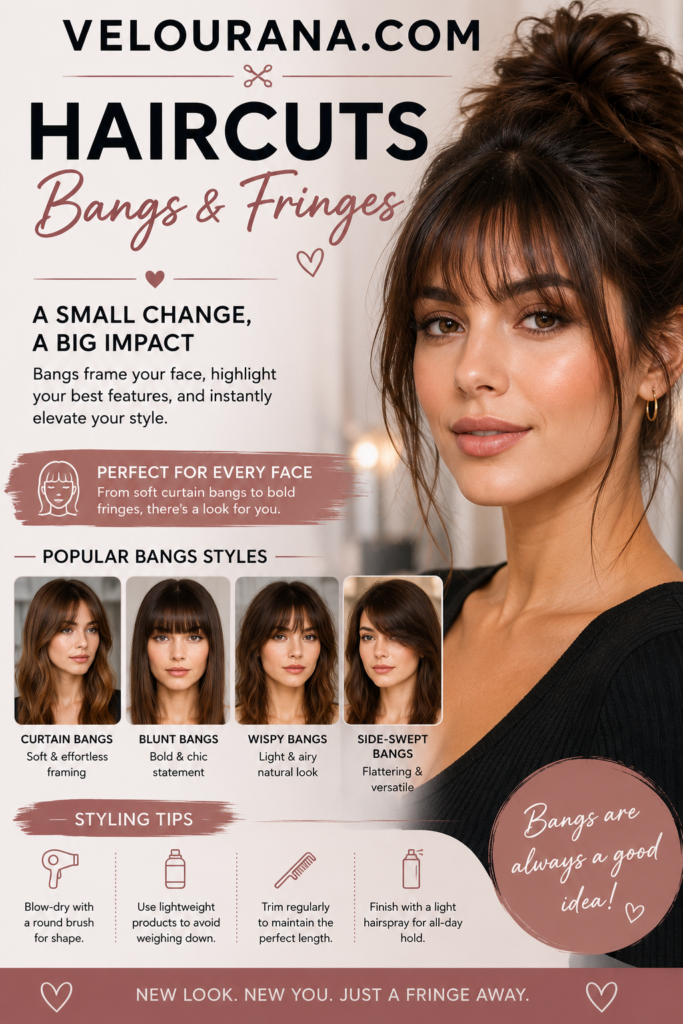
CATEGORY: Bangs & Fringes
Curtain bangs have an unusual ability to change a haircut without making the change feel severe. They introduce movement around the forehead, bring attention toward the eyes and cheekbones, and create a softer transition between the face and the rest of the hair. Yet unlike a traditional full fringe, they do not necessarily cover the forehead completely or create a strong horizontal line across the face.
That balance is a large part of their appeal.
A well-cut curtain fringe can look deliberately styled when the hair is polished and almost effortless when the hair is worn naturally. It can accompany long layers, shoulder-length hair, a bob, a shag, waves, curls or relatively straight hair. Depending on its length and density, it can become the defining feature of the haircut or remain subtle enough to resemble ordinary face-framing layers.
There is also enormous variation hidden beneath the name. Some curtain bangs are relatively short in the center, beginning around eyebrow level before sweeping toward the temples. Others start around the cheekbones and barely qualify as conventional bangs at all. Some are full and glamorous, while others consist of only a few soft pieces.
This means asking a stylist for “curtain bangs” is only the beginning of the conversation.
The real decisions concern where the shortest pieces should fall, how quickly the fringe should become longer toward the sides, how much hair should be included, and how the shape should connect with the rest of the haircut. Those details determine whether the finished fringe feels natural on your hair or like a trend copied from somebody else.
Why the Curtain Shape Works So Well Around the Face
Traditional straight-across bangs introduce a strong horizontal element. Curtain bangs create diagonal and curved lines instead.
The center is generally shorter, while the sides become progressively longer. When the fringe separates, these longer sections travel outward and downward around the face.
That direction can create a beautiful framing effect.
Shorter curtain bangs can emphasize the eyes and brows because the central pieces sit relatively close to them. When the sides reach the cheekbones, attention can be drawn toward the middle of the face. Longer versions can visually connect the cheekbones and jaw with the surrounding haircut.
The visible forehead also changes the overall effect.
A full fringe may conceal most of it. Curtain bangs normally leave at least some central space open, which keeps the face from feeling completely enclosed by hair.
How much space remains visible depends on the styling and cut. A narrow opening creates a fuller, more dramatic fringe. A wider opening makes the bangs feel lighter and closer to face-framing layers.
Neither approach is inherently better.
The most attractive version is usually the one that balances the person's features while cooperating with their natural hair.
The Length Determines More Than the Style
A few centimeters can completely change the personality of curtain bangs.
Shorter versions create a more obvious fringe. If the center falls around the brows or upper eye area, the bangs remain visually present even when they are swept outward. This can produce a glamorous, retro-inspired effect, particularly when the hair has volume and movement.
Medium-length curtain bangs often begin around the eyes or upper cheekbones. They provide noticeable framing while remaining relatively easy to push away from the face.
Long curtain bangs may begin around the cheekbones and extend toward the jaw. At this point, the distinction between bangs and face-framing layers becomes increasingly subtle.
Longer versions are often appealing to someone who wants a change without feeling committed to a conventional fringe.
They also provide more flexibility.
The hair can be tucked behind the ears, incorporated into a ponytail more easily as it grows, swept to one side or blended into the surrounding layers.
Shorter curtain bangs create more immediate impact but generally demand more attention to styling and trimming.
The decision therefore involves both appearance and lifestyle.
Someone who wants a visible transformation may find a very long curtain fringe too cautious. Someone nervous about having hair across the forehead may find the same length ideal.
A good stylist can begin conservatively and shorten gradually. Once hair has been cut too short, there is no equivalent adjustment in the opposite direction.
Hair Density Changes the Character of Curtain Bangs
The amount of hair brought forward into the fringe has almost as much influence as length.
A shallow section creates airy bangs with plenty of separation. More forehead remains visible, and the fringe moves easily into the rest of the hairstyle.
A deeper section creates a denser curtain. This can produce a luxurious, dramatic appearance, particularly on thick hair, but it also places more hair around the face.
Fine hair requires thoughtful planning.
It is entirely possible to have curtain bangs with fine hair, but taking a very large section from the front may reduce the apparent density of the surrounding hairstyle. A lighter fringe can preserve more fullness through the lengths.
Fine hair can also benefit from strategic layering and root movement because a completely flat fringe may separate more visibly.
Thick hair presents different considerations.
There may be enough density to create a substantial fringe without affecting the rest of the haircut, but excessive weight can make the bangs difficult to move. Carefully removing bulk can help them sweep away from the face rather than falling forward as a heavy block.
The objective is not simply to make thick hair thinner or fine hair fuller.
It is to distribute the available density in a way that supports the intended shape.
Straight Hair Can Make the Shape Look Particularly Precise
On relatively straight hair, the graduated shape of curtain bangs can be very visible.
This makes the quality of the cut important. The transition from the shorter center toward the longer sides should appear intentional rather than looking like several disconnected lengths.
Straight hair can create an elegant, polished curtain fringe, particularly when the ends have enough movement to sweep away from the face.
The challenge is that naturally straight hair may also fall directly downward.
If the desired look involves the dramatic outward curve often seen in styled photographs, some heat styling may be necessary.
A round brush and blow-dryer are common tools for creating this movement. The goal is generally to encourage lift at the roots and a soft outward bend rather than creating a tightly curled fringe.
Too much curvature can make the bangs look artificially rounded.
The most contemporary versions tend to retain movement and softness, allowing the hair to fall naturally around the face rather than remaining frozen in a perfect shape.
Wavy Hair Can Make Curtain Bangs Look Naturally Effortless
Wavy hair and curtain bangs can work beautifully together because the natural bends already provide some of the movement the fringe is designed to create.
Instead of forcing the hair into a perfectly symmetrical shape, the haircut can allow the waves to form their own interpretation of the curtain.
One side may curve slightly differently from the other.
That does not necessarily need correcting.
Natural texture often looks most convincing when it is allowed some variation.
The stylist should consider where the waves naturally bend when deciding the length. A section that looks ideal when stretched straight may sit much higher once it returns to its natural pattern.
Humidity and styling methods will also affect the result.
Someone who normally air-dries wavy hair may want curtain bangs designed to work with that routine rather than requiring a full blowout every morning.
A small amount of styling around the front can still be useful. The roots can be directed while damp, after which the natural wave can develop through the lengths.
This creates control without removing the character of the hair.
Curly Curtain Bangs Do Not Need to Imitate Straight Ones
Curly hair can create some of the most distinctive curtain fringes because each curl contributes its own shape around the face.
The key is respecting shrinkage.
Curly hair can appear substantially longer when wet or stretched than it does when dry. Cutting without accounting for this movement can result in bangs that become much shorter than intended.
Different curls may also shrink by different amounts.
This is why evaluating the fringe in its natural state is so valuable.
The finished shape does not need to form two perfectly identical wings. A curly curtain fringe can have a softer central opening with individual curls falling around the forehead and cheekbones.
The transition into the rest of the haircut can be particularly attractive when layers continue through the sides.
Instead of treating the fringe as a separate section, the entire front of the haircut becomes a sequence of progressively longer curls.
The result can feel natural because it follows the texture rather than attempting to suppress it.
Your Hairline Can Decide How Much Styling You Need
Curtain bangs are often described as low-maintenance, but that description depends heavily on the hairline.
Someone whose hair naturally separates near the center may find the style remarkably easy.
The roots already want to travel in approximately the correct directions. A little drying and shaping may be enough.
A strong cowlick can change the situation.
One side may lift away from the forehead while the other falls forward. The center may separate much wider than intended. Hair may insist on travelling toward one side regardless of where the part has been placed.
These characteristics do not necessarily prevent curtain bangs.
In fact, a natural central separation can sometimes make them easier than full bangs.
But the stylist should see the natural growth pattern before cutting.
Styling technique can then be designed around it.
Controlling the roots while the hair is damp is often more effective than trying to correct the ends after everything has dried.
A blow-dryer can temporarily redirect the roots, after which the lengths can be shaped into the desired sweep.
This is one reason bangs may look effortless while still requiring a few deliberate minutes after washing.
Curtain Bangs Can Be Adapted Rather Than Matched to a Face-Shape Rule
Hair advice often attempts to assign one fringe to each face shape.
Round face: one type.
Square face: another.
Heart-shaped face: another.
Long face: another.
These guidelines can provide inspiration, but they become restrictive when treated as rules.
Faces are more complex than geometric categories.
Two people described as having round faces may have completely different forehead heights, cheekbone structures, jawlines and facial proportions. Hair density, texture and overall haircut also change the visual result.
With curtain bangs, adjusting the shortest point and the width of the opening can create very different effects.
A shorter central section places more hair around the upper face.
A longer fringe exposes more forehead and brings the framing lower toward the cheekbones.
A narrow opening creates greater coverage.
A wider opening leaves the face more exposed.
The sides can finish around the cheekbones, jaw or even lower.
These variables provide far more useful customization than simply asking whether a particular face shape is “allowed” to wear curtain bangs.
The Rest of the Haircut Determines Whether the Fringe Feels Connected
Curtain bangs rarely exist successfully in isolation.
Their defining characteristic is the gradual movement from short hair near the center toward longer hair at the sides. That movement needs somewhere to go.
Long layers provide a natural continuation. The fringe can move into cheekbone-length pieces, then jaw-length layers and eventually the full length of the hair.
This creates the flowing shape commonly associated with voluminous layered haircuts.
A bob creates a different relationship.
Curtain bangs may connect directly into the sides of the bob, producing a compact but soft frame around the face.
With a shag, the fringe can become part of a much more textured system of layers, making the distinction between bangs and the rest of the haircut intentionally blurred.
Even hair that is mostly one length can accommodate curtain bangs, but some subtle connection around the face often prevents the fringe from looking detached.
This is worth discussing during the haircut consultation.
Sometimes the best result requires changing more than the fringe itself, even if the overall length remains untouched.
Styling Curtain Bangs Does Not Need to Become a Full Blowout
The dramatic curtain bangs seen in photographs are often styled with considerable volume.
That does not mean everyday styling needs to reproduce a salon blowout.
For many people, the most important step is simply controlling the root direction.
After washing, allowing short front pieces to dry randomly can make them much harder to reshape later. Styling them while damp provides more control.
A blow-dryer can direct the roots forward initially and then encourage the sections to separate toward each side. A round brush can introduce a gentle bend and lift.
Some people prefer using a roller after blow-drying to allow the fringe to cool in a curved shape.
Others achieve enough movement with fingers and a dryer.
The appropriate technique depends on the hair.
Fine hair may need light root lift without too much product. Thick hair may require stronger direction while drying. Wavy or curly hair may need far less manipulation because the natural texture provides movement already.
The finished fringe should still feel connected to the rest of the hairstyle.
If the bangs are extremely polished while the remaining hair is naturally tousled, they can look separate. Allowing a little imperfection often makes the entire style more believable.
The Fringe Can Become Oily Before the Rest of the Hair
Curtain bangs have one practical disadvantage in common with almost every other fringe: they spend a great deal of time close to the forehead.
Skin oils, moisturizer, sunscreen and perspiration can transfer onto the hair.
Because bangs are shorter and often deliberately separated into soft pieces, even a relatively small amount of oil can alter their appearance.
This does not necessarily require washing all of the hair.
The front section can be washed separately between full wash days. Because the amount of hair is small, it can be cleaned, dried and restyled relatively quickly.
Dry shampoo can also help when used appropriately, particularly at the roots.
The morning skincare routine can make a difference too.
Allowing moisturizer and sunscreen to settle before placing the bangs against the forehead can reduce immediate transfer. Heavy products used around the hairline may also need to be applied thoughtfully.
Repeatedly touching the fringe is another source of oil.
Curtain bangs invite adjustment because they sit directly within the field of vision. The more often they are pushed and rearranged, the faster they may lose their fresh appearance.
Sometimes the best styling technique is simply leaving them alone once they are sitting correctly.
Trimming Changes the Shape Gradually
Curtain bangs are often more forgiving during growth than a short blunt fringe.
As they become longer, they naturally move toward face-framing layers.
That does not mean their shape remains unchanged indefinitely.
The shortest central pieces gradually fall lower. The opening becomes wider or heavier depending on the hair. The sides may lose the deliberate progression that originally created the curtain shape.
Regular reshaping keeps the fringe recognizable.
How frequently this is necessary depends on the starting length, growth rate and desired precision.
Someone wearing short curtain bangs around the brows may notice growth relatively quickly. A person wearing long cheekbone-length bangs may be comfortable allowing them to grow for considerably longer.
This flexibility is one of the style's advantages.
There is no single point at which slightly overgrown curtain bangs suddenly become unusable. They simply begin moving toward another type of face frame.
Growing Them Out Is Relatively Straightforward
Every fringe eventually raises the question of what happens when you no longer want it.
Curtain bangs have an advantage because their shape already contains multiple lengths.
As the central pieces grow, they can be swept farther toward the sides. The stylist can gradually connect them into the longer face-framing sections until the fringe essentially disappears into the haircut.
Changing the part can help during this transition.
An off-center or side part can redirect pieces that have reached an awkward intermediate length. Clips and pins provide another option, particularly when exercising or wearing the hair tied back.
The growing-out process can also become an opportunity to reshape the haircut.
Short curtain bangs can become long curtain bangs.
Long curtain bangs can become cheekbone layers.
Those layers can eventually reach the jaw and merge with longer layers.
Rather than experiencing one long awkward stage, the hair moves through several usable shapes.
Knowing Whether Curtain Bangs Fit Your Routine
Curtain bangs have acquired a reputation for being universally easy because they are softer than many traditional fringes.
They are certainly flexible, but no haircut is maintenance-free for everyone.
Before cutting them, consider your normal relationship with your hair.
If you air-dry every day and dislike using styling tools, the fringe should be designed around your natural texture.
If your hairline has strong growth patterns, expect some root styling.
If your hair becomes oily quickly, occasional fringe washing may become part of the routine.
If you frequently wear your hair in a tight ponytail, very short pieces will remain outside it.
If you want almost no commitment, begin with a longer version.
If you want the haircut to look noticeably different, longer pieces may not create enough change and a shorter central fringe could be more satisfying.
The style can be adjusted around these preferences rather than forcing everyone into the same version.
Why Curtain Bangs Continue to Work Beyond a Single Trend
Hairstyles move through cycles, and the terminology surrounding them changes constantly. Curtain bangs may be presented as a current trend, a revival of a previous decade or part of a particular celebrity-inspired haircut.
The underlying design, however, is much more enduring than the trend label suggests.
Hair that becomes gradually longer as it moves away from the center of the face is a fundamental form of face framing.
It works because it creates movement.
It connects short pieces with long ones.
It allows the forehead to remain partially visible.
It can be adjusted to emphasize different parts of the face.
It can be light or dense, polished or textured, short or long.
Most importantly, it can be adapted to the person wearing it.
That adaptability is why curtain bangs can look completely different from one haircut to another while still sharing the same basic idea.
The best version does not announce itself as a copied trend.
It looks as though the haircut was always intended to move that way around the face.
When the length respects the features, the density respects the hair, the shape works with the natural texture and the maintenance fits everyday life, curtain bangs can provide one of the most effective transformations possible without sacrificing the rest of the hairstyle.
Sometimes changing the entire impression of your hair does not require changing its length.
It only requires changing the way the hair meets your face.
The End
Velourana.
 Discover More From Our Family of Websites
 ZodiacBearing (Astrology, Tarot, Numerology, Angel Numbers & Spiritual Guidance)
 Velourana (Beauty, Makeup, Hair Care, Skincare & Beauty Tips)
 HavenBearing (Home, Living, Organization, Décor & Everyday Inspiration)
 PawBearing (Pet Care, Dog Breeds, Animal Health, Training & Pet Products)
 PsyCatherine (Notes From the Journal of a Psychologist on Real Life)

