
CATEGORY: UVA Protection
When most people think about sun protection, they think first about sunburn. A red nose after a day at the beach, shoulders that feel hot after an afternoon outdoors, or skin that begins to peel several days later are obvious reminders that ultraviolet radiation can damage the skin. Yet sunburn tells only part of the story. Another important form of ultraviolet radiation, UVA, can affect the skin without producing the same immediate warning signs.
UVA protection therefore deserves attention not only during summer holidays but as part of everyday skincare. UVA radiation is associated with photoaging and contributes to skin damage over time. It can reach the skin during ordinary activities such as walking through the city, driving, sitting near certain windows, eating outdoors, gardening, travelling, or spending a cloudy afternoon outside. Because its effects are often less immediately visible than sunburn, it can be easy to underestimate.
This is why a sunscreen routine should involve more than choosing a high SPF number. SPF is important, but understanding broad-spectrum protection, UVA labeling, application quantity, reapplication, clothing, shade, and daily exposure provides a much more complete picture of how sunscreen protects the skin.
Understanding UVA and UVB
Sunlight contains different forms of ultraviolet radiation, and UVA and UVB are the two most relevant to everyday skin protection. Both can affect the skin, but they do not behave in exactly the same way.
UVB is strongly associated with sunburn and plays an important role in the development of skin cancer. Its intensity varies with factors including season, latitude, altitude, time of day, and environmental conditions. When someone spends too long in strong sunlight and develops obvious redness, UVB is an important part of that experience.
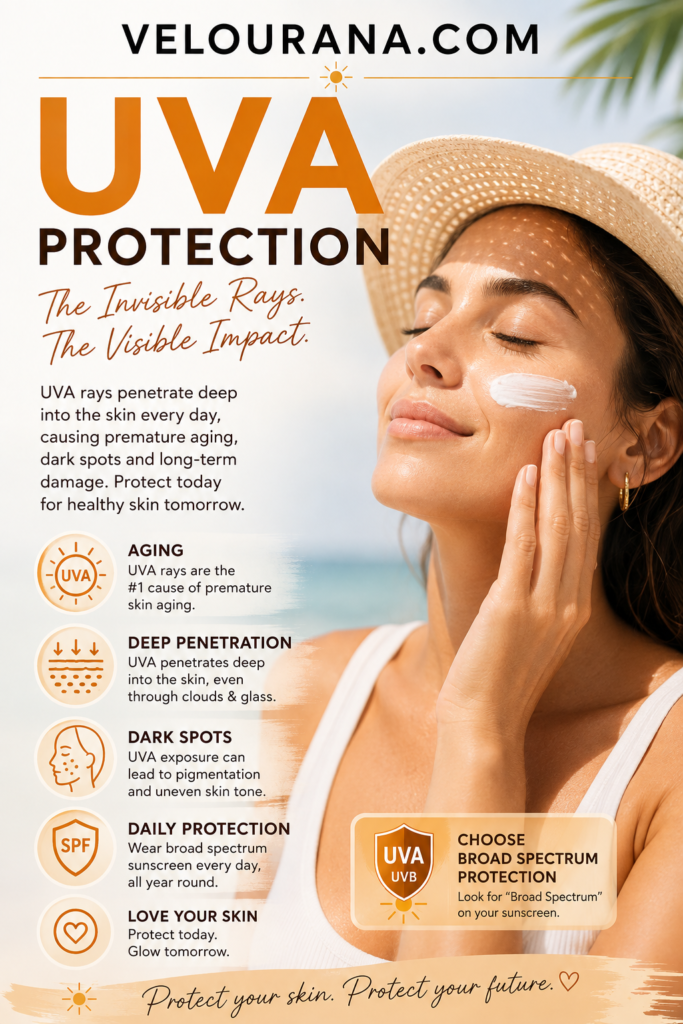
UVA is different. It penetrates more deeply into the skin and is strongly associated with photoaging, including changes in collagen and elastin that contribute over time to wrinkles, loss of firmness, uneven pigmentation, and other visible signs of accumulated sun exposure. UVA also contributes to skin cancer risk.
The absence of sunburn therefore does not necessarily mean that ultraviolet exposure has been harmless.
This distinction is especially important in beauty and skincare. Someone may carefully invest in moisturizers, antioxidants, retinoids, exfoliants, brightening products, and treatments intended to improve texture or pigmentation while paying relatively little attention to UVA protection. Yet reducing ongoing UV exposure is one of the most important ways to support many of those skincare goals.
A sophisticated skincare routine and inconsistent sun protection can work against each other.
Why SPF Alone Does Not Tell the Entire Story
SPF stands for Sun Protection Factor. It is primarily a measure related to protection against UVB radiation and sunburn under standardized testing conditions.
A high SPF is valuable, but the number alone does not fully describe UVA protection.
This is why broad-spectrum labeling and UVA-specific information matter. Depending on the country and regulatory system, sunscreen packaging may communicate UVA performance in different ways. Consumers may see terms such as broad spectrum, a UVA symbol, a UVA protection factor, or other standardized markings.
Rather than choosing sunscreen solely because the front of the bottle displays the largest SPF number, look at the complete protection information provided by the manufacturer.
A sunscreen intended for comprehensive daily protection should provide both UVB and UVA protection.
This becomes particularly relevant when comparing products that otherwise appear similar. Two sunscreens may both display SPF 50, yet their packaging may communicate UVA protection differently according to the standards under which they are sold. Understanding the labels available in your market allows you to make a more informed choice.
The goal is not to turn sunscreen shopping into a technical examination. It is simply to recognize that SPF is one part of the protection profile rather than the entire story.
UVA Protection and the Visible Signs of Skin Aging
Many of the changes people describe collectively as “aging skin” are influenced by a combination of intrinsic aging and environmental exposure. Ultraviolet radiation is a major environmental contributor.
Repeated exposure can contribute to uneven pigmentation, rougher texture, changes in elasticity, fine lines, wrinkles, and visible alterations in the skin's overall appearance. These changes develop gradually, which is one reason everyday exposure is easy to dismiss.
A single ten-minute walk may not produce a visible difference. Neither may an afternoon sitting beside a sunny window. But skincare is often about cumulative habits, and ultraviolet exposure is cumulative as well.
This makes UVA protection particularly relevant for people whose skincare goals include maintaining an even complexion, supporting firmness, reducing the appearance of premature photoaging, or managing pigmentation concerns.
It also changes the way sunscreen can be viewed. Instead of seeing it only as something that prevents a painful burn during summer, sunscreen becomes part of a long-term skincare strategy.
The moisturizer may make the skin feel comfortable today. A serum may improve the appearance of a particular concern over time. Sunscreen has another role: helping reduce ongoing ultraviolet exposure that can contribute to future damage.
That preventive role is less dramatic than the instant effect of a cosmetic product, but it is extremely important.
UVA Exposure Is Not Limited to Hot Summer Days
One of the most persistent misunderstandings about sun protection is the assumption that ultraviolet exposure follows temperature.
It does not.
A cold day can still involve meaningful UV exposure, while a hot evening may have relatively little. The warmth you feel on your skin comes largely from infrared radiation rather than serving as a direct measurement of ultraviolet intensity.
This is why relying on temperature can be misleading.
Clouds can also create false confidence. A grey sky may make the day feel protected from the sun, yet ultraviolet radiation can still reach the ground. The amount varies with cloud conditions, but cloudy weather should not automatically be interpreted as zero UV exposure.
The UV Index is a much more useful source of information than simply looking at the temperature or deciding whether the sky appears sunny enough.
Season matters, location matters, altitude matters, and the amount of time spent outdoors matters.
For someone interested in consistent UVA protection, the objective is not to become anxious every time daylight appears. It is to stop using heat and visible sunshine as the only signals for whether sun protection deserves attention.
UVA Through Windows
Windows create another important distinction between UVA and UVB.
Ordinary glass generally blocks much of UVB radiation, but UVA can pass through glass to varying degrees depending on the type of glass, coatings, films, and other characteristics.
This does not mean everyone sitting anywhere inside a building needs to behave as though they are lying on a beach. Distance from the window, duration of exposure, direction of sunlight, glazing, and the characteristics of the building all matter.
Someone working eight hours in an interior office far from windows has a different exposure pattern from someone whose desk sits directly beside a large sunny window.
The same principle applies to driving.
Vehicle glass provides varying degrees of ultraviolet protection. The windshield and side windows may not behave identically, and specifications vary between vehicles. People who spend substantial amounts of time driving can therefore consider broad-spectrum sunscreen on exposed areas as part of their routine.
The face, hands, and forearms are particularly relevant because they may remain exposed repeatedly.
Physical solutions can also help. Window treatments and UV-control films may reduce exposure in appropriate settings, while clothing provides straightforward protection for covered skin.
The important point is context. UVA protection should be based on realistic exposure rather than the simplistic idea that being indoors always means no exposure or, at the opposite extreme, that every indoor environment requires constant sunscreen reapplication.
Choosing a Sunscreen for Reliable UVA Protection
The best sunscreen is not simply the product with the most impressive packaging. It needs to provide appropriate protection and also be something you can apply correctly and consistently.
Look for a broad-spectrum sunscreen or the relevant UVA protection labeling used in your market. Choose an SPF appropriate for your exposure and follow local public-health guidance.
Then consider the formulation.
Someone with oily skin may prefer a lightweight fluid or gel. Someone with dry skin may enjoy a richer cream. Sensitive skin may require careful selection of filters and supporting ingredients. People who wear makeup may want a sunscreen that settles smoothly without pilling. Those with deeper skin tones may prioritize formulations that do not leave an obvious white cast.
These cosmetic considerations are not superficial.
If a sunscreen feels so unpleasant that you use only a tiny amount, avoid applying it to the neck, or stop using it altogether, its theoretical performance becomes much less useful in everyday life.
A sunscreen you can comfortably apply in an adequate quantity has an important practical advantage.
For the same reason, it can make sense to use different sunscreens for different situations. A lightweight facial sunscreen may work beautifully for an office day, while a water-resistant lotion may be more appropriate for the beach or outdoor sport. A larger, economical body sunscreen may make generous application easier when the arms and legs are exposed.
There is no requirement that one sunscreen solve every possible situation.
Application Is as Important as Selection
Even excellent UVA protection depends on correct application.
Sunscreen testing is performed using standardized quantities. If considerably less product is applied in real life, the protection achieved may be lower than expected.
This is why spreading a tiny amount of high-SPF sunscreen across the entire face is not equivalent to applying it adequately.
Coverage also matters.
The center of the face is rarely the only area exposed. The hairline, temples, ears, jaw, neck, and upper chest are commonly missed. During summer, the shoulders, arms, hands, legs, ankles, and feet may also require protection.
A systematic application method can make complete coverage easier.
Apply sunscreen as its own layer rather than mixing it directly with moisturizer or foundation. Mixing products changes the original sunscreen formulation and does not create a mixture with predictable tested protection.
Complete your necessary skincare, allow products to settle as appropriate, apply sunscreen evenly, and then proceed with makeup if desired.
For people using foundation, concealer, bronzer, or other cosmetics, allowing the sunscreen to settle before makeup can also improve the final appearance.
UVA Protection and Makeup
Makeup and sun protection can coexist successfully, but makeup should not create false confidence.
Some foundations, tinted moisturizers, powders, and other cosmetics contain SPF. This can provide supplementary protection, but most people do not apply foundation in the same quantity used when dedicated sunscreen products are tested.
For that reason, makeup with SPF is generally better viewed as an additional layer rather than the primary sunscreen strategy.
SPF values also do not simply add together. SPF 50 sunscreen underneath SPF 30 foundation does not become SPF 80.
The practical approach is straightforward: apply a dedicated broad-spectrum sunscreen properly, allow it to settle, and then apply makeup.
If pigmentation is an important concern, tinted sunscreens may be particularly interesting. Certain tinted formulations contain iron oxides that can provide protection against portions of visible light as well as ultraviolet radiation. This can be relevant for some pigmentation disorders, although individual treatment needs should be discussed with a dermatologist.
The beauty advantage is that modern tinted sunscreens can also help even the appearance of the complexion, sometimes reducing the amount of foundation needed.
Maintaining UVA Protection During the Day
Sunscreen does not become permanently attached to the skin after the morning application.
Water, perspiration, washing, toweling, rubbing, and prolonged outdoor activity can disturb the protective film. Reapplication therefore becomes important when meaningful exposure continues.
During sustained outdoor exposure, regular reapplication is commonly recommended. Product-specific directions should be followed, particularly for water-resistant sunscreens.
Swimming deserves special attention. Water-resistant sunscreen is designed to maintain protection for a defined period under specified testing conditions; it does not mean unlimited waterproof protection. After swimming and towel drying, sunscreen should be reapplied according to the product instructions.
Exercise creates similar challenges. Heavy perspiration and repeatedly wiping the face can remove sunscreen. For running, cycling, hiking, outdoor sport, or physical work, a water-resistant formulation may be more appropriate.
Everyday indoor life is different.
If you apply sunscreen in the morning, commute to an office, spend most of the day away from meaningful sunlight, and then leave later, it can be practical to think about reapplication in relation to your next period of exposure. If UV levels remain significant and you are about to walk outdoors for an extended period, refreshing sunscreen before leaving may make sense.
This approach keeps sunscreen practical rather than turning reapplication into an inflexible ritual disconnected from actual exposure.
UVA Protection When You Have Pigmentation Concerns
For people concerned about uneven pigmentation, post-inflammatory marks, melasma, or other forms of discoloration, consistent sun protection can be particularly important.
Pigmentation is complex and can have many causes. Sunscreen is not a complete treatment for every pigmentation problem, but reducing ongoing ultraviolet exposure is often an important part of a broader skincare or dermatological strategy.
This is one reason inconsistent protection can be frustrating. Someone may use brightening ingredients for months while continuing to receive substantial unprotected exposure during commuting, outdoor lunches, travel, or weekends.
The skincare routine is attempting to improve the appearance of pigmentation while environmental exposure may continue to encourage it.
A more coherent approach combines appropriate treatment with reliable protection.
For persistent or changing pigmentation, professional dermatological assessment is important, particularly because not every dark mark should be assumed to be a cosmetic pigmentation issue.
UVA Protection and Anti-Aging Skincare
Sunscreen is sometimes treated as separate from anti-aging skincare, but the two subjects are closely connected.
A person may use retinoids, vitamin C, peptides, exfoliating acids, moisturizers, and other products intended to improve the appearance of the skin. Yet if the objective includes reducing visible photoaging, protection from ongoing ultraviolet exposure deserves a central place in the routine.
This does not mean sunscreen replaces every other skincare ingredient.
It means prevention and treatment work together.
Antioxidant products may complement sunscreen but do not replace it. Moisturizer supports the skin barrier but does not automatically provide UV protection. Retinoids can improve several signs of photoaging, but they do not create a sunscreen shield.
Each product has its own role.
A well-designed routine therefore does not need to contain endless layers. A gentle cleanser, appropriate treatment products, moisturizer where necessary, and reliable broad-spectrum sunscreen can form a strong foundation.
Consistency usually matters more than accumulating products.
Sunscreen Is Only One Part of UVA Protection
Effective sun protection does not depend entirely on sunscreen.
Clothing can cover large areas continuously. Long sleeves, trousers, and purpose-designed UPF garments can be particularly useful during prolonged outdoor activity.
A broad-brimmed hat can shade the scalp, face, ears, and neck. Sunglasses protect the eyes and also provide some shade to the surrounding skin.
Shade can dramatically reduce direct exposure and is particularly useful when UV levels are strong. Choosing a shaded café table, walking on the shaded side of a street, using a beach umbrella, or taking breaks beneath cover can all contribute to a sensible protection strategy.
These measures also reduce the practical burden of sunscreen.
If your shoulders and arms are covered by appropriate clothing, you do not need to repeatedly apply sunscreen across those covered surfaces. If a hat shades the scalp, managing exposed hair parts becomes easier.
Sun protection works best as a combination of measures rather than a competition to see whether sunscreen alone can handle every situation.
Building UVA Protection Into Normal Life
The most effective skincare habits are often the ones that become ordinary.
Keep facial sunscreen with the products you already use every morning. Apply it as part of the routine rather than waiting until you suddenly remember the sun.
If you regularly spend time outdoors after work, keep a portable sunscreen in your bag or at your workplace. If you exercise outdoors, keep suitable sunscreen with your sports equipment. If weekends involve gardening or walking, make a hat and sunscreen part of the preparation.
These small environmental cues reduce the amount of conscious effort required.
It is also useful to adapt protection to the day rather than expecting one routine to suit everything.
An office day may require a straightforward morning application and attention before later outdoor exposure.
A sightseeing day may require sunscreen in your bag and regular maintenance.
A beach day requires water resistance, generous body application, reapplication, shade, and protective clothing.
A mountain day may involve high altitude, strong exposure, cool temperatures, and reflective snow.
The principles remain consistent even though the routine changes.
Avoiding the Extremes
Good UVA protection should not create either complacency or unnecessary anxiety.
The first extreme is assuming that because the skin did not burn, there was no meaningful ultraviolet exposure. This overlooks UVA and the cumulative nature of photodamage.
The opposite extreme is treating every moment of daylight as dangerous and sunscreen as something that must be obsessively reapplied regardless of actual exposure.
Neither approach is particularly useful.
The objective is informed protection.
Understand your environment.
Use the UV Index.
Consider how long you will be outdoors.
Use broad-spectrum sunscreen correctly.
Maintain it during meaningful exposure.
Use clothing, shade, hats, and sunglasses.
Then continue with your life.
Sun protection should enable normal outdoor activity more safely, not make ordinary daylight something to fear.
Making UVA Protection a Long-Term Skincare Habit
The benefits of daily skincare are usually created through repetition.
One application of moisturizer does not permanently solve dry skin. One night of using a treatment does not transform the complexion. In the same way, UVA protection is most meaningful as a long-term habit rather than an occasional response to extremely sunny weather.
A reliable routine can be surprisingly simple.
Choose a broad-spectrum sunscreen that works with your skin.
Apply enough to exposed areas.
Do not forget the ears and neck.
Reapply appropriately when substantial exposure continues or the sunscreen has been disturbed.
Use physical protection whenever practical.
Pay attention to UV conditions rather than temperature alone.
Over time, these actions become ordinary rather than inconvenient.
For someone interested in maintaining healthy-looking skin, reducing premature photoaging, supporting an even complexion, and protecting the skin from ultraviolet damage, that consistency matters far more than chasing a theoretically perfect sunscreen routine for a few weeks.
UVA protection is not merely an extra specification printed on the back of a sunscreen bottle. It is an essential part of understanding what comprehensive sun protection actually means.
Sunburn may be the most immediate and memorable consequence of excessive sunlight, but visible redness is not the only reason to protect the skin.
Broad-spectrum sunscreen recognizes that reality.
When combined with sensible exposure habits, adequate application, appropriate reapplication, clothing, hats, sunglasses, and shade, it creates a much more complete approach to protecting the skin—not just during a summer holiday, but throughout everyday life.
The End
Velourana.
 Discover More From Our Family of Websites
 ZodiacBearing (Astrology, Tarot, Numerology, Angel Numbers & Spiritual Guidance)
 Velourana (Beauty, Makeup, Hair Care, Skincare & Beauty Tips)
 HavenBearing (Home, Living, Organization, Décor & Everyday Inspiration)
 PawBearing (Pet Care, Dog Breeds, Animal Health, Training & Pet Products)
 PsyCatherine (Notes From the Journal of a Psychologist on Real Life)

