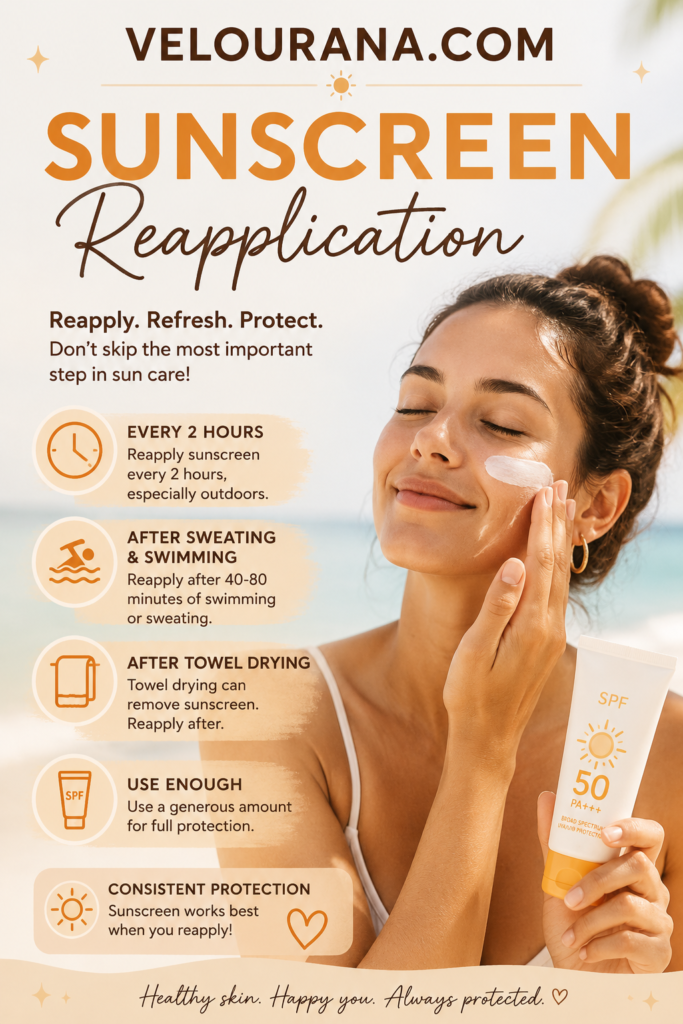
CATEGORY: Sunscreen Reapplication
For people who wear makeup, sunscreen reapplication can seem straightforward in theory and surprisingly difficult in practice.
The morning routine is usually simple.
Skincare is applied.
Sunscreen follows.
The sunscreen settles.
Foundation, concealer, blush, bronzer, powder, and other cosmetics are applied over it.
Several hours later, however, the situation is different. The face is fully made up, the original sunscreen has been exposed to normal movement and environmental conditions, and another period outdoors may be approaching.
Applying a generous layer of sunscreen cream directly over finished makeup can disturb everything underneath.
Foundation can move.
Powder can become patchy.
Blush can disappear.
Mascara can smudge.
The skin can become excessively shiny.
This practical problem sometimes leads makeup wearers to abandon sunscreen reapplication entirely.
Fortunately, reapplication does not have to mean destroying your makeup.
Different sunscreen formats and application techniques can make maintaining protection considerably easier.
The important point is understanding what each method can realistically achieve.
Begin With a Strong Morning Sunscreen Application
Reapplication works best when it begins with a properly applied sunscreen base.
Do not deliberately use less sunscreen in the morning because makeup will be placed over it.
Your first application should provide complete, even coverage.
Apply Sunscreen Before Makeup
Complete your normal skincare first.
Apply moisturizer if needed.
Allow underlying products to settle.
Then apply sunscreen as the final skincare protection layer before makeup.
Do Not Mix Sunscreen Into Foundation
Mixing sunscreen with foundation may appear to simplify the routine.
It does not provide a reliable way to maintain the labeled SPF.
The sunscreen has been formulated and tested as a finished product.
Mixing it with another cosmetic changes that formulation.
Layer Instead of Mixing
Apply sunscreen separately.
Allow it to settle.
Then apply foundation over it.
This preserves the sunscreen as its own layer.
Allow Sunscreen to Set Before Makeup
Immediately applying makeup over wet sunscreen can make both products more difficult to manage.
Give the sunscreen an opportunity to settle according to the product's characteristics and directions.
Some lightweight fluids settle quickly.
Richer creams may need more time.
Avoid Aggressive Rubbing
Once sunscreen has been applied, excessive rubbing can disturb the protective film.
Makeup application should therefore be controlled rather than aggressive.
Pressing Foundation Can Be Helpful
Some people find that gently pressing foundation onto sunscreen works better than repeatedly buffing it with a dense brush.
A damp makeup sponge can also provide a controlled application technique, depending on the products involved.
The objective is to minimize unnecessary movement of the sunscreen underneath.
Makeup With SPF Is Useful but Not Enough by Itself
Foundation, tinted moisturizer, concealer, and powder may contain SPF.
This can contribute supplementary protection.
However, cosmetics are usually applied in smaller amounts than sunscreen testing quantities.
Do Not Add SPF Numbers Together
SPF 50 sunscreen beneath SPF 30 foundation does not equal SPF 80.
SPF ratings cannot simply be added.
Treat your dedicated sunscreen as the primary protective layer.
Why Reapplication Over Makeup Is Difficult
A normal sunscreen application involves spreading a substantial amount of product evenly across the skin.
Finished makeup makes this harder.
The sunscreen must reach the entire exposed surface without creating gaps while disturbing the cosmetics as little as possible.
This is why technique matters.
Decide Whether Reapplication Is Actually Needed
Your circumstances matter.
Someone who applies sunscreen at 8 a.m., spends the day in an interior office, and returns home after UV levels have become minimal has different needs from someone spending lunch outdoors and walking around the city all afternoon.
Reapplication should reflect meaningful exposure.
Continuous Outdoor Exposure Requires More Attention
If you are outdoors for prolonged periods, maintaining sunscreen becomes much more important.
This includes sightseeing, festivals, outdoor events, sports, beach activities, outdoor dining, and long walking days.
Check the UV Index
The UV Index can help provide context.
If significant UV exposure is expected during the afternoon, refreshing protection before going outside can be sensible.
Fluid Sunscreen Can Be Reapplied Over Makeup
A lightweight sunscreen fluid can sometimes be applied carefully over finished makeup.
The technique is different from the morning application.
Rather than rubbing aggressively, work gradually.
Use Controlled Amounts
Apply sunscreen to one area at a time.
Forehead.
Cheeks.
Nose.
Chin.
Temples.
This gives you more control over both coverage and makeup.
Press Rather Than Drag
Gently pressing sunscreen onto the skin can reduce movement of foundation underneath.
Repeated sweeping motions may disturb makeup more significantly.
A Makeup Sponge Can Help
A clean makeup sponge can be used to press sunscreen carefully onto the face.
The sunscreen can be placed onto the sponge or skin according to the technique that works best with the particular product.
Be Aware of Product Absorption Into the Sponge
A sponge can absorb some sunscreen.
This means enough product must still reach the skin.
Do not assume that because a large amount went onto the sponge, the same amount reached your face.
Work in Thin Controlled Passes
Applying a large quantity all at once may overwhelm the makeup.
Dividing the application into controlled passes can make the process easier.
The goal remains adequate total coverage.
Let Each Area Settle
Give the sunscreen time to settle before deciding whether makeup needs touching up.
Some initial shine may reduce after a few minutes.
Touch Up Makeup Afterwards
If sunscreen slightly reduces blush or bronzer, those cosmetics can be refreshed after the sunscreen settles.
Protection should take priority over maintaining every cosmetic detail perfectly.
Sunscreen Sticks Can Be Convenient
Sunscreen sticks are popular for reapplication because they are compact and relatively clean.
They can be carried easily in a handbag.
They are particularly useful for targeted areas.
Sticks Are Useful Around the Nose
The nose receives substantial exposure and is easy to reach with a stick.
Apply according to the manufacturer's directions.
Sticks Are Useful on the Cheeks
Repeated overlapping passes can provide controlled coverage.
Avoid assuming one quick swipe is sufficient.
Sticks Can Help Around the Forehead
A stick can be applied carefully along the forehead and hairline without requiring liquid sunscreen on the fingers.
Remember the Temples
When using a stick, it is easy to focus only on central facial areas.
Include the temples.
Remember the Ears
If the ears are exposed, they require protection too.
A stick can make ear reapplication particularly convenient.
One Swipe Is Not Necessarily Enough
The convenience of a stick can create underapplication.
A very light pass may deposit only a small amount of sunscreen.
Follow the product instructions and use multiple passes where appropriate.
Sticks Can Move Makeup
Dragging a solid stick across foundation can remove or redistribute cosmetics.
Use light controlled pressure.
Some makeup transfer onto the stick may occur.
Consider Hygiene
If foundation and skin oils transfer onto the sunscreen stick, keep the product clean according to appropriate hygiene practices.
Avoid sharing personal facial sunscreen sticks.
Cushion Sunscreens Can Work Well With Makeup
Cushion formats allow sunscreen to be pressed onto the face.
This application style can be particularly compatible with makeup.
Use a Patting Motion
Press the applicator gently against the skin.
Avoid dragging it across the face.
Work systematically to avoid missed areas.
Do Not Confuse Cosmetic Convenience With Adequate Quantity
A cushion can feel effortless to use.
You still need sufficient product to maintain meaningful protection.
Follow the manufacturer's instructions.
Sunscreen Sprays Offer Another Option
Some sunscreen sprays are designed specifically for facial use or application over makeup.
They can be convenient when used correctly.
Read the Spray Instructions Carefully
Different products have different application methods.
Do not assume every body sunscreen spray is suitable for direct facial spraying.
Protect the Eyes
Never casually spray sunscreen toward open eyes.
Follow the manufacturer's facial application directions.
Avoid Inhaling Spray
Use spray products carefully and in an appropriate environment.
The goal is to place sunscreen on the skin, not create a cloud around the face.
Wind Can Reduce Spray Coverage
Outdoor wind can carry spray away before it reaches the skin.
Move to a sheltered area for application when possible.
A Fine Mist Can Be Deceptive
A pleasant cooling mist may feel as though the entire face has been covered.
The quantity reaching the skin may be much smaller than expected.
Apply according to the product directions.
Powder Sunscreen Is Extremely Convenient
SPF powders appeal strongly to makeup wearers because they can be brushed over foundation.
They can also reduce shine.
This makes them useful for daytime touch-ups.
Powder Has a Quantity Challenge
The main limitation is obtaining enough powder evenly across the skin to reproduce the labeled protection.
A tiny cosmetic dusting may provide much less coverage than expected.
Use Powder as Supplementary Protection
Powder SPF can be useful as an additional layer or touch-up method.
During intense prolonged exposure, it should not automatically be assumed to replace a thorough sunscreen application.
Pay Attention to the Hairline With Powder
Brush sunscreen carefully toward the hairline.
This area can otherwise remain exposed.
Pay Attention to the Nose
The contours around the nose can be difficult to cover evenly with powder.
Apply carefully.
Do Not Forget the Ears
Facial powder routines rarely include the ears.
Sunscreen routines should.
Setting Sprays With SPF
Some cosmetic setting sprays include SPF claims.
These products can offer convenient supplementary protection.
As with other spray formats, adequate application and correct use remain important.
Read the Directions
A few casual sprays may not necessarily reproduce the tested protection.
Follow the product-specific instructions.
Reapplication Can Combine Formats
You do not have to use one format across the entire face.
A stick might work well on the nose and cheeks.
A fluid may work better on the forehead and neck.
A powder may help reduce shine afterward.
Do Not Try to Calculate the Combined SPF
Combining formats does not produce a simple mathematical SPF total.
The objective is restoring consistent coverage.
The Neck Is Easier Than the Face
Even when facial makeup complicates reapplication, the neck often has little or no makeup.
A normal sunscreen lotion or fluid can usually be reapplied there easily.
Do Not Forget the Neck Because You Are Concentrating on Makeup
The face receives cosmetic attention.
The exposed neck may receive just as much sunlight.
Restore protection there too.
Reapply to the Upper Chest
If the neckline exposes the chest, include it.
This area can usually be treated with ordinary sunscreen without interfering with makeup.
Reapply to the Ears
Ears are particularly easy to forget when the entire focus is preserving facial cosmetics.
Make them part of the routine.
Reapply to the Hands
Hands may have lost their morning sunscreen after repeated washing.
Apply again before prolonged outdoor exposure.
Makeup Does Not Protect the Rest of the Body
A perfectly maintained facial SPF routine does nothing for exposed shoulders, arms, chest, legs, or feet.
During outdoor events, remember all exposed skin.
Reapplication for an Outdoor Wedding
Outdoor weddings can involve several hours of exposure while makeup needs to remain presentable.
Apply sunscreen thoroughly beneath makeup.
Use shade whenever possible.
Carry a suitable reapplication product.
A stick, cushion, or compatible fluid can be useful.
Reapplication for Festivals
Festivals often involve long outdoor days.
Makeup may be elaborate, but UV exposure can also be substantial.
Prioritize protection.
Wear a hat where appropriate.
Carry portable sunscreen.
Reapplication During Sightseeing
Sightseeing can involve many hours outdoors.
Apply sunscreen properly before leaving.
Carry a portable format.
Refresh protection during the day.
Reapplication During Outdoor Dining
An outdoor lunch can create significant midday exposure.
Choose shade when available.
Refresh sunscreen beforehand if necessary.
Reapplication During a Shopping Day
Moving repeatedly between indoor and outdoor environments can create cumulative exposure.
If large portions of the day are spent outside, maintain protection accordingly.
Reapplication Before the Journey Home
If sunscreen was applied early in the morning and you are leaving work while UV levels remain substantial, consider refreshing exposed areas.
This can be particularly relevant for a long walk, bicycle ride, or drive.
Reapplication for Oily Makeup
Oily skin can become increasingly shiny as sunscreen and makeup accumulate.
Blotting can help.
Blot Before Adding More Product
Use blotting paper or another gentle method to remove excess surface oil.
Avoid aggressive wiping.
Then apply sunscreen carefully.
Do Not Remove the Entire Protective Layer
Blot gently.
The objective is to reduce excess oil rather than scrub the face.
Reapplication for Dry Makeup
Dry skin may become increasingly textured as products accumulate.
A moisturizing sunscreen fluid can sometimes reapply more comfortably than powder.
Avoid Excessive Powder Build-Up
Repeated powder application can emphasize dryness.
Choose the format according to your skin.
Reapplication for Combination Skin
Different areas may benefit from different techniques.
A lightweight fluid can be pressed onto dry areas.
Powder may be more comfortable across the oily T-zone.
Reapplication for Sensitive Skin
Sensitive skin may react to repeated layers or certain filters.
Choose a sunscreen you tolerate well.
If persistent irritation occurs, seek professional dermatological advice.
Reapplication for Acne-Prone Skin
Heavy product buildup can feel uncomfortable.
Lightweight non-heavy formulations may make reapplication easier.
Do not reduce protection simply because the original sunscreen is too rich.
Change the product instead.
Reapplication for Deeper Skin Tones
Repeated applications of a sunscreen with visible white cast can become increasingly noticeable.
Choose transparent or appropriately tinted formulations.
Tinted Sunscreen Over Makeup
Tinted sunscreen can work beautifully as both protection and cosmetic coverage.
However, repeated applications may intensify the color.
Choose a shade and formula that remain wearable when reapplied.
Transparent Sunscreen for Later Applications
One practical strategy is using tinted sunscreen in the morning and a transparent sunscreen for later reapplication.
This can reduce excessive pigment buildup.
Reapplication Around Concealer
The under-eye area often contains multiple cosmetic layers.
Apply sunscreen gently.
Avoid dragging concealer across the skin.
Sunglasses Can Reduce Exposure Around the Eyes
Appropriate UV-protective sunglasses add physical protection.
They are especially useful when sunscreen application close to the eyes is difficult.
Reapplication Around Eyebrows
Brows can trap sunscreen.
Apply carefully to the exposed skin around them.
Do not leave untreated gaps simply to preserve brow makeup.
Reapplication Around the Hairline
Hairline makeup, bronzer, and foundation can make this area complicated.
Use a controlled application method.
A stick or sponge may be useful.
Reapplication Around Lip Makeup
Lipstick and lip liner complicate lip SPF application.
Nevertheless, lips also need protection.
SPF Lip Balm Can Be Reapplied
An SPF lip product can be applied throughout the day.
Cosmetic lip color may need to be refreshed afterward.
Eating Removes Lip Products
After meals, drinks, or wiping the mouth, restore SPF lip protection when exposure continues.
Do Not Assume Dark Lipstick Provides SPF
Pigment does not automatically mean tested ultraviolet protection.
Use a product specifically labeled with SPF when protection is required.
Reapplication and Setting Powder
After sunscreen has settled, setting powder can be reapplied where necessary.
This can help reduce shine.
Do Not Immediately Powder Wet Sunscreen
Allow the sunscreen to settle first.
Otherwise, powder may clump and interfere with the finish.
Reapplication and Blush
Cream or powder blush may fade when sunscreen is reapplied.
Refresh it afterward if desired.
Reapplication and Bronzer
The same principle applies.
Protection first.
Cosmetic correction second.
Reapplication and Highlighter
Highlighter can be restored after sunscreen settles.
There is no need to sacrifice sun protection simply to preserve the original placement perfectly.
Keep Touch-Up Products Minimal
A reapplication kit does not need to contain your entire makeup collection.
A portable sunscreen.
Powder if needed.
Lip color.
Perhaps blush or concealer.
A small selection can restore the look quickly.
Create a Sunscreen Touch-Up Kit
Keeping the necessary products together saves time.
This is especially useful during travel, outdoor events, or long workdays.
Keep Sunscreen Accessible
If reapplication requires emptying your entire handbag, it is less likely to happen.
Choose a convenient location.
Do Not Leave Sunscreen in Extreme Heat
A handbag may be more appropriate than permanently storing sunscreen inside a very hot vehicle.
Follow manufacturer storage instructions.
Check Expiration Dates
Portable products can remain forgotten in handbags for months.
Check their expiration and period-after-opening information.
Replace Old Touch-Up Products
Do not depend indefinitely on an old sunscreen simply because it is convenient.
Reapplication Should Match Exposure
Someone spending the entire afternoon outdoors needs a stronger maintenance strategy than someone walking five minutes from an office to a car.
Context matters.
Use Shade to Protect Makeup and Skin
Shade reduces direct UV exposure and can also make makeup more comfortable in hot weather.
Whenever practical, choose shaded seating and walking routes.
Wear a Hat
A hat can significantly reduce direct exposure to the face.
It also reduces dependence on cosmetic sunscreen reapplication alone.
Choose the Hat Carefully
A broad brim generally provides more facial and neck shade than a narrow cap.
Physical protection can be particularly useful during long outdoor days.
Use Sunglasses
Sunglasses protect the eyes and can reduce exposure around the eye area.
Protective Clothing Helps the Body
Makeup may complicate facial sunscreen, but body protection can often be simplified through clothing.
Cover shoulders and arms where practical.
Do Not Let Makeup Create False Confidence
Foundation may physically cover the skin, but unless it carries tested UV protection and is applied appropriately, it should not be assumed to provide meaningful sunscreen protection.
Do Not Let Reapplication Become Cosmetic Only
A light powdering of SPF product may improve the appearance of the skin.
That does not necessarily mean the sunscreen layer has been fully restored.
Think about protection first.
Reapplication During High UV Exposure Deserves More Attention
If you are spending several hours outdoors under strong UV conditions, prioritize reliable sunscreen coverage over perfect makeup preservation.
Cosmetics can be repaired.
UV exposure cannot be undone afterward.
Sunscreen Does Not Repair Previous Exposure
Reapplying sunscreen protects against subsequent exposure.
It does not erase UV radiation already received.
This makes the morning application important even when you intend to reapply later.
Do Not Wait Until You Feel Burning
If the skin begins feeling hot or appears red, excessive exposure may already have occurred.
Reapply preventively.
Do Not Use Makeup as an Indicator
Foundation can hide early redness.
Do not depend on visible skin color to determine when protection needs attention.
Use Time and Activity as Practical Guides
Consider how long you have been exposed.
Consider whether you have perspired.
Consider whether you have wiped or touched the face repeatedly.
Consider whether another period outdoors is approaching.
Reapplication During Hot Weather
Heat can increase perspiration and oil production.
Choose sunscreen formats that remain practical under these conditions.
Reapplication During Humid Weather
Humidity can make repeated cream application feel heavy.
Lightweight fluids, gels, or suitable sticks may be easier to tolerate.
Reapplication During Cold Weather
Makeup wearers still need sun protection during meaningful winter exposure.
This is especially important during skiing and mountain travel.
Snow Reflection Can Increase Exposure
Do not allow cold temperatures to create false confidence.
Protect the face and lips carefully.
Reapplication at High Altitude
UV exposure can increase with altitude.
Carry portable sunscreen during mountain activities.
Reapplication Near Water
Water can reflect UV.
If you are attending an outdoor event near the sea, lake, or pool, consider the exposure environment even if you are not swimming.
Reapplication on a Boat
Boating can involve prolonged direct and reflected exposure.
Wind may keep the skin feeling cool.
Use strong broad-spectrum protection and physical shade where possible.
Do Not Use High SPF as Permission to Ignore Reapplication
SPF 50 and SPF 50+ still require appropriate maintenance during prolonged exposure.
Higher SPF does not make the sunscreen physically permanent.
Do Not Deliberately Apply Less to Preserve Makeup
A tiny amount may disturb makeup less.
It may also provide inadequate protection.
Choose an application method that allows meaningful coverage.
Test Your Technique at Home
Do not wait until an important outdoor event to discover that your sunscreen dissolves your foundation.
Experiment with combinations beforehand.
Test Different Sunscreen Textures
A fluid may work better than a cream.
A stick may work better for targeted areas.
A cushion may integrate better with your makeup.
Personal experimentation can improve consistency.
Test Your Foundation With Sunscreen
Some foundation and sunscreen combinations layer beautifully.
Others pill or separate.
Compatibility matters.
Simplify the Skincare Underneath
Too many skincare layers can increase pilling when sunscreen and makeup are added.
A simpler morning routine may improve the entire system.
Sunscreen Should Remain the Priority Layer
If one product has to be removed from an overloaded morning routine, sunscreen should generally not be the first candidate.
Simplify unnecessary cosmetic layers instead.
Reapplication Does Not Have to Look Perfect Immediately
Fresh sunscreen may initially appear shiny.
Give it time to settle.
Then make small cosmetic adjustments.
Protection Before Perfection
This is the central principle for makeup wearers.
The purpose of sunscreen is protection.
The purpose of makeup is appearance.
Both can coexist, but when they conflict during substantial UV exposure, protection should come first.
A Practical Morning Makeup Routine
Complete necessary skincare.
Apply an adequate amount of sunscreen.
Cover the hairline, temples, ears, jaw, and neck.
Allow sunscreen to settle.
Apply makeup gently.
Use makeup containing SPF as supplementary protection if desired.
A Practical Midday Touch-Up Routine
Assess your expected exposure.
Gently blot excess oil or perspiration if necessary.
Apply an appropriate sunscreen format.
Work systematically across the face.
Include the edges and ears.
Reapply to the neck and other exposed areas.
Allow sunscreen to settle.
Repair makeup where needed.
A Practical Outdoor Event Routine
Begin with strong sunscreen application.
Choose long-wearing compatible makeup.
Carry portable sunscreen.
Use shade whenever possible.
Wear sunglasses.
Consider a hat where appropriate.
Refresh sunscreen during prolonged exposure.
A Practical Travel Routine
Use a sunscreen that works well under makeup.
Carry a portable reapplication product.
Keep it easily accessible.
Refresh before long periods of sightseeing.
Protect the lips, ears, neck, and hands as well as the face.
The Most Important Makeup Reapplication Mistake
The biggest mistake is allowing the difficulty of preserving makeup to result in no reapplication during significant prolonged exposure.
The routine does not need to remain cosmetically flawless at every second.
It needs to remain protective.
The Final Principle
Reapplying sunscreen over makeup is more complicated than applying sunscreen to bare skin, but it is entirely manageable.
Begin with a generous, even sunscreen layer before makeup.
Allow it to settle.
Apply cosmetics gently.
When significant exposure continues later in the day, choose a reapplication method compatible with your routine.
A lightweight fluid can be pressed onto the skin.
A sunscreen stick can provide portable targeted coverage.
A cushion can make pressing sunscreen over makeup easier.
A suitable facial spray can offer convenience.
Powder SPF can provide supplementary protection and reduce shine.
No method should become an excuse for applying an insignificant amount.
Remember the edges of the face.
Remember the hairline.
Remember the ears.
Remember the neck.
Remember the hands and any exposed body areas.
Use shade, hats, sunglasses, and clothing to reduce the amount of UV reaching the skin.
And when necessary, repair your makeup after sunscreen rather than sacrificing sunscreen to preserve your makeup.
A beautiful makeup look and responsible sun protection do not have to compete.
The key is choosing products and techniques that make maintaining both realistic throughout the day.
The End
Velourana.
 Discover More From Our Family of Websites
 ZodiacBearing (Astrology, Tarot, Numerology, Angel Numbers & Spiritual Guidance)
 Velourana (Beauty, Makeup, Hair Care, Skincare & Beauty Tips)
 HavenBearing (Home, Living, Organization, Décor & Everyday Inspiration)
 PawBearing (Pet Care, Dog Breeds, Animal Health, Training & Pet Products)
 PsyCatherine (Notes From the Journal of a Psychologist on Real Life)