
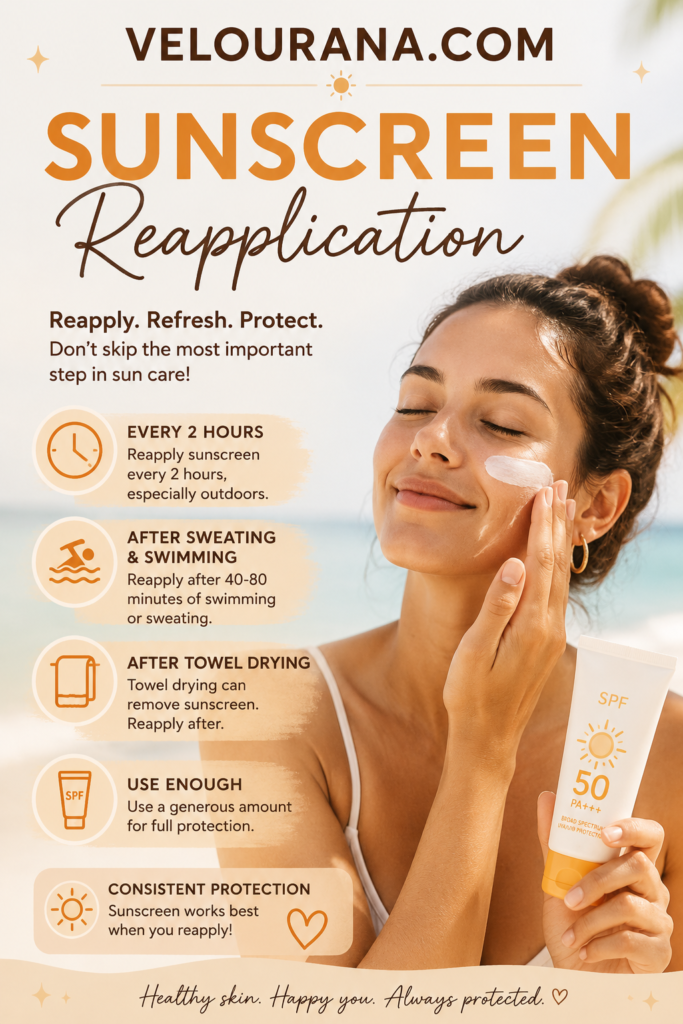
CATEGORY: Sunscreen Reapplication
Applying sunscreen in the morning is the foundation of a good sun-protection routine, but sunscreen is not an invisible shield that remains perfectly unchanged on the skin for the rest of the day.
The protective film can gradually become less uniform.
Water can affect it.
Perspiration can affect it.
Towels can remove it.
Hands can rub it away.
Clothing and straps can create friction.
Washing removes it from exposed areas.
Long periods outdoors also make maintaining reliable coverage increasingly important.
This is where sunscreen reapplication becomes essential.
Reapplication does not mean constantly covering yourself with sunscreen regardless of your circumstances. It means maintaining an adequate protective layer when meaningful ultraviolet exposure continues and restoring coverage when the original application has been disturbed.
Understanding when reapplication matters, what causes sunscreen to be removed, and how to make reapplication practical can transform sunscreen from a single morning skincare step into a reliable system of protection throughout the day.
Why Sunscreen Needs to Be Reapplied
Sunscreen works by forming a protective layer across the skin.
That layer exists in the real world.
It encounters movement, moisture, friction, clothing, hands, makeup, water, and perspiration.
Even an excellent sunscreen cannot protect an area effectively if much of the product has been removed from that area.
Reapplication restores coverage.
Reapplication Does Not Increase the SPF Number
If you apply SPF 50 in the morning and apply SPF 50 again later, you do not create SPF 100.
SPF values are not cumulative.
The second application restores the protective film rather than mathematically increasing its SPF.
Higher SPF Does Not Mean Longer Wear
A common misconception is that SPF 50 lasts considerably longer than SPF 30.
That is not what the SPF rating means.
SPF describes the tested level of protection primarily against UVB radiation under standardized conditions.
It is not a measurement of how many hours the product remains physically intact on your skin.
SPF Is Not a Timer
SPF 30 does not mean thirty minutes.
SPF 50 does not mean fifty minutes.
Nor should the number be converted into a personal calculation of how many hours you can safely remain in direct sunlight.
Real exposure changes according to UV intensity, location, altitude, time of day, activity, skin coverage, application quantity, and many other factors.
Follow the Product Instructions
Your sunscreen's label should always be an important reference for application and reapplication.
Different formulations can have different directions.
A daily facial sunscreen designed primarily for ordinary urban use may have different characteristics from a water-resistant sport sunscreen designed for swimming and heavy perspiration.
Use the product according to its intended purpose.
The Common Two-Hour Reapplication Guidance
During continuous outdoor exposure, sunscreen is commonly advised to be reapplied approximately every two hours.
This is a useful practical guideline, but it should not become the only rule you remember.
Certain activities can require attention sooner.
Swimming is an obvious example.
So is towel drying.
Heavy perspiration and repeated wiping can also disturb sunscreen before two hours have passed.
Reapply After Swimming
Water exposure is one of the clearest reasons to reconsider sunscreen coverage.
If you swim, follow the reapplication instructions on your sunscreen.
This applies even when the product is labeled water resistant.
Water-Resistant Sunscreen Is Not Permanent
Water resistance is valuable.
It means a sunscreen has demonstrated the ability to maintain specified protection during defined water exposure under testing conditions.
It does not mean the sunscreen remains unchanged through an entire day of swimming.
Waterproof Is Not the Right Mental Model
Thinking of sunscreen as permanently waterproof encourages people to ignore what happens after swimming.
A better approach is to think of water resistance as increased durability during water exposure.
Afterward, restore the protective layer according to the product instructions.
Reapply After Towel Drying
A towel does more than remove water.
It rubs against the skin.
That friction can remove sunscreen.
This makes towel drying one of the most important moments for reapplication during a beach or pool day.
Patting Instead of Rubbing Can Reduce Friction
Gently patting the skin dry may disturb sunscreen less than vigorous rubbing.
However, this should not be used as a reason to ignore the sunscreen's reapplication directions.
If continued exposure is expected, restore protection appropriately.
Reapply After Heavy Perspiration
Outdoor exercise can create substantial perspiration.
Running, cycling, hiking, tennis, football, gardening, and outdoor work can all challenge the sunscreen layer.
Choose a water-resistant sunscreen when heavy perspiration is expected.
Wiping Sweat Can Remove Sunscreen
Perspiration is only part of the issue.
People naturally wipe their faces with their hands, towels, sleeves, or wristbands.
Every wiping action can disturb the sunscreen film.
Outdoor Athletes Need a Practical System
A sunscreen that is excellent in your bathroom but impossible to carry during exercise may not be ideal for long outdoor activities.
Portable formats can make reapplication easier.
A small tube can fit into a running belt.
A stick can fit into a cycling pocket.
A compact sunscreen can remain in a hiking backpack.
Accessibility Encourages Reapplication
People are more likely to reapply sunscreen when it is easy to reach.
If the sunscreen is buried underneath clothing, food, cameras, and equipment at the bottom of a bag, reapplication becomes inconvenient.
Keep it accessible during long outdoor days.
Reapplication at the Beach
The beach creates almost every condition capable of disturbing sunscreen.
Water.
Perspiration.
Sand.
Towels.
Swimwear.
Long exposure.
Physical movement.
For this reason, beach sunscreen should be selected and used with reapplication in mind.
Apply Properly Before the Beach Exposure Begins
Do not depend on reapplication to compensate for a poor first application.
Begin with thorough coverage.
Use an adequate amount.
Cover every exposed area.
Follow the sunscreen's directions regarding application before exposure.
Bring the Sunscreen With You
This sounds obvious, but it is one of the most important practical rules.
A sunscreen left in the hotel room cannot be reapplied at the beach.
Bring Enough Sunscreen
A full-body application requires considerably more product than facial application.
Several people sharing one small bottle during an entire beach day may run out quickly.
Bring enough for repeated use.
Do Not Ration Sunscreen to Make the Bottle Last
Using half the necessary amount because the bottle is running low undermines protection.
If you expect prolonged exposure, plan your sunscreen supply accordingly.
Reapplication at the Swimming Pool
Pool environments create similar challenges.
Swimming repeatedly removes or disturbs sunscreen.
Towels create friction.
Deck areas may provide strong direct exposure.
Use appropriate water-resistant protection and reapply according to directions.
Reapplication During Water Sports
Surfing, kayaking, paddleboarding, sailing, snorkeling, and similar activities can involve extended exposure.
Water reflection can contribute additional UV exposure.
Protective clothing can be particularly useful in these situations.
Rash Guards Can Simplify Protection
A suitable protective top can cover the torso, shoulders, and upper arms.
This reduces the amount of skin that depends on repeatedly applied sunscreen.
Sunscreen can then be concentrated on the remaining exposed areas.
Reapplication While Running
For a short run, a thorough initial application may cover much of the activity depending on conditions.
Long-distance running is different.
Hours outdoors, heavy perspiration, and repeated wiping can significantly affect sunscreen.
Carry an appropriate product for extended sessions.
Remember the Ears When Running
Caps may shade part of the face but often leave the ears exposed.
Include them in both initial application and reapplication.
Remember the Back of the Neck
This area can receive prolonged sunlight during running and walking.
Apply deliberately.
Reapplication While Cycling
Cycling can involve several hours of exposure.
Wind makes the skin feel cooler, which can disguise the intensity of sunlight.
The face, ears, neck, arms, hands, and legs may remain exposed continuously.
Cycling Clothing Can Help
Longer sleeves and appropriate cycling clothing reduce exposed surface area.
This can make sunscreen maintenance easier during long rides.
Reapplication While Hiking
Hiking combines duration, perspiration, and sometimes altitude.
Higher altitude can increase UV exposure.
Carry sunscreen in an accessible pocket rather than deep inside your backpack.
Reapply During Rest Stops
Rest stops provide convenient opportunities to check exposed areas.
Face.
Ears.
Neck.
Hands.
Arms.
Legs.
If the sunscreen has been heavily disturbed, restore coverage.
Reapplication During Skiing
Snow and cold weather can create misleading conditions.
The air may feel freezing while ultraviolet exposure remains significant.
Snow can reflect UV, while altitude can increase exposure.
Facial sunscreen and SPF lip protection deserve particular attention.
Keep Sunscreen Accessible in Cold Conditions
A small facial sunscreen or stick can be easier to carry than a large bottle.
Protect exposed facial areas throughout prolonged mountain activity.
Reapplication While Gardening
Gardening frequently lasts longer than expected.
What begins as twenty minutes outside can become several hours.
If exposure continues, sunscreen may need to be refreshed.
Hands Need Special Attention in the Garden
Gardening gloves can provide physical protection.
When hands remain exposed, washing and contact with soil can remove sunscreen.
Restore protection when necessary.
Reapplication During Outdoor Work
People who work outside need a sunscreen routine designed around their working environment.
One morning application may not be sufficient for a full day of significant exposure.
Sunscreen should be available during breaks.
Protective clothing and hats can reduce the amount of exposed skin requiring repeated application.
Reapplication During Sightseeing
Travelers can accidentally spend enormous amounts of time outdoors.
Walking between attractions, sitting at cafés, waiting in queues, taking photographs, and exploring unfamiliar streets can create hours of cumulative exposure.
Carry sunscreen during sightseeing days.
A Small Travel Sunscreen Can Be Useful
A portable facial sunscreen makes it easier to refresh exposed areas without returning to accommodation.
For extensive body exposure, carry enough product for the larger surface area.
Reapplication While Driving
Driving presents a different pattern of exposure.
Vehicle glass can reduce UVB substantially, but UVA transmission can vary according to the type of glass.
People who drive frequently or for prolonged periods may want to maintain broad-spectrum protection on exposed areas.
Remember the Hands and Arms
The hands and forearms can receive repeated exposure during driving.
If sunscreen has been removed through washing, restore it before prolonged driving when appropriate.
Reapplication During an Office Day
Not every office worker needs to interrupt work repeatedly to apply sunscreen regardless of exposure.
Consider what actually happens during the day.
If you apply sunscreen in the morning, commute briefly, and spend the next several hours away from significant sunlight, the situation differs greatly from a beach day.
Reapply Before Meaningful Afternoon Exposure
Suppose you finish work while UV levels remain significant and plan to walk outdoors for an hour.
Refreshing sunscreen before leaving can be practical.
This connects reapplication to exposure rather than treating it as a meaningless clock-based ritual.
Reapplication Before an Outdoor Lunch
If your morning sunscreen has been on for several hours and you are about to spend significant time outside, consider refreshing protection.
This is especially relevant when UV levels are high.
Use the UV Index as Context
The UV Index can help you understand the environmental intensity of ultraviolet radiation.
Reapplication becomes particularly important during sustained exposure under higher UV conditions.
Reapplication Near Windows
Indoor exposure varies enormously.
Someone working in an interior room has different circumstances from someone sitting beside a large sunny window for many hours.
Broad-spectrum sunscreen is particularly relevant where UVA exposure through glass may occur.
Reapplication Over Makeup
This is where theory meets practical reality.
A generous layer of sunscreen is easy to apply to bare skin.
It becomes considerably more complicated when foundation, concealer, blush, bronzer, and powder are already in place.
Several approaches can help.
Reapplying Fluid Sunscreen Over Makeup
Some lightweight sunscreens can be pressed carefully over makeup.
The objective is to avoid aggressive rubbing.
Small amounts can be applied progressively until adequate coverage is achieved.
Cosmetic Compatibility Varies
Some combinations work beautifully.
Others cause foundation to separate.
Experiment with your particular sunscreen and makeup products before relying on the technique during an important day.
Sunscreen Sticks for Reapplication
Sticks are portable and convenient.
They can work particularly well on targeted areas such as the nose, cheeks, forehead, ears, and hands.
However, quantity remains important.
One Quick Swipe Is Usually Not the Goal
A light pass may deposit insufficient product.
Follow the manufacturer's instructions and use repeated overlapping passes where appropriate.
Sunscreen Cushions
Cushion-style sunscreen formats can be useful for makeup wearers.
The product can be pressed onto the skin rather than rubbed.
This may preserve makeup better than applying a traditional cream.
Sunscreen Sprays
Facial sprays can provide another convenient option when specifically designed for that use.
Follow the directions carefully.
Avoid spraying into the eyes.
Avoid inhaling aerosolized product.
Powder Sunscreen
Powder SPF products are attractive for reapplication because they resemble ordinary cosmetic powder.
They can reduce shine while providing supplementary protection.
However, adequate quantity can be difficult to achieve.
Do Not Depend on a Tiny Dusting
A very light cosmetic application may not reproduce the protection demonstrated during testing.
Powder sunscreen is often best treated as supplementary rather than the sole strategy during intense prolonged exposure.
Makeup With SPF
Foundation, tinted moisturizer, and powder may contain SPF.
This can contribute additional protection.
It should not be treated as a mathematical extension of the sunscreen underneath.
SPF Values Do Not Add
SPF 50 sunscreen plus SPF 30 foundation does not create SPF 80.
Layering can improve practical coverage, but the ratings cannot simply be added together.
Reapplication for Oily Skin
Repeated sunscreen application can feel difficult when the skin becomes oily during the day.
The answer is not necessarily to skip protection.
Choose formulations that make reapplication more comfortable.
Lightweight Fluids Can Help
Modern fluid sunscreens can provide high SPF without a heavy texture.
Some are designed specifically for oily or combination skin.
Blot Excess Oil Gently
If the face is very oily, gently blotting excess surface oil before reapplication can improve comfort.
Avoid aggressive rubbing that may disturb remaining sunscreen unnecessarily.
Reapplication for Dry Skin
Dry skin may tolerate moisturizing sunscreen particularly well.
A hydrating SPF can make repeated application more comfortable.
Reapplication for Sensitive Skin
If repeated sunscreen application causes irritation, the formulation may not suit your skin.
Try a different appropriate sunscreen.
Persistent sensitivity should be discussed with a dermatologist.
Reapplication for Acne-Prone Skin
Lightweight formulations can reduce the feeling of excessive product buildup.
Look for sunscreen that works comfortably with your skin rather than reducing the amount to an ineffective level.
Reapplication for Deeper Skin Tones
White cast can become increasingly visible after multiple applications.
Transparent or tinted formulations can make repeated use easier.
Tinted Sunscreen Can Build Color
Repeated layers of tinted sunscreen may deepen the visible shade.
If this becomes cosmetically difficult, consider using a transparent product for later applications.
Reapplication Around the Eyes
The eye area can be challenging, especially during exercise.
Perspiration may cause some sunscreens to migrate.
A suitable stick formulation may work better for certain users.
Sunglasses Provide Additional Help
Sunglasses protect the eyes and shade some surrounding skin.
They are an important complement to sunscreen.
Reapplication Around Facial Hair
Dense facial hair can make sunscreen application difficult.
Focus on exposed skin and areas where hair coverage is sparse.
Use hats and other physical protection where useful.
Reapplication on the Scalp
People with exposed hair parts, thinning hair, or shaved scalps should protect these areas.
Suitable sunscreen formats can be used.
A hat often provides the simplest solution.
Reapply to the Ears
The ears are frequently forgotten during reapplication.
Make them part of your standard facial sequence.
Reapply to the Neck
Do not refresh the face while leaving an exposed neck untreated.
The neck needs its own adequate application.
Reapply to the Upper Chest
If clothing exposes the upper chest, include it when maintaining protection.
Reapply to the Shoulders
Swimwear and sleeveless clothing can leave the shoulders exposed for hours.
Water, towels, and clothing straps can disturb sunscreen here.
Reapply to the Arms
During prolonged exposure, restore coverage around the entire exposed arm rather than concentrating only on the outer surface.
Reapply to the Hands
Hand washing is one of the most frequent reasons sunscreen disappears during everyday life.
Restore protection when meaningful exposure continues.
Reapply to the Legs
Beachgoers often remember their faces but neglect body reapplication.
Legs can remain exposed for many hours.
Cover fronts, sides, and backs.
Reapply to the Feet
Water, sand, towels, and footwear can all remove sunscreen from the feet.
Do not forget them.
Children and Sunscreen Reapplication
Children may spend hours moving between water, sand, grass, playgrounds, and towels.
Their sunscreen can be disturbed repeatedly.
Parents and caregivers should follow age-appropriate sunscreen guidance and product directions.
Protective Clothing Can Simplify Children's Sun Care
Hats, suitable swimwear, and protective clothing reduce the amount of skin requiring repeated sunscreen application.
Shade remains important as well.
Reapply After Children's Swimming
Do not assume a water-resistant sunscreen survives an entire afternoon of repeated swimming.
Follow the product instructions.
Sunscreen Reapplication and Photosensitivity
Certain medications and medical treatments can increase sensitivity to sunlight.
People affected may require particularly careful photoprotection.
Follow healthcare advice rather than relying only on general sunscreen guidance.
Reapplication After Cosmetic Procedures
Some dermatological and cosmetic procedures temporarily increase sun sensitivity.
Follow the specific aftercare instructions provided by the treating professional.
Reapplication and Hyperpigmentation
People concerned about pigmentation often benefit from maintaining consistent broad-spectrum protection.
UVA protection is important alongside the SPF rating.
Reapplication and Melasma
Melasma management can require particularly careful photoprotection.
Tinted sunscreens may be useful in some cases because certain formulations can provide additional protection from visible light.
Professional dermatological guidance can help determine an appropriate strategy.
Reapplication and Photoaging
Cumulative ultraviolet exposure contributes to visible photoaging.
Maintaining sunscreen protection during significant exposure helps reduce cumulative UV reaching the skin.
Do Not Wait for Redness
Sunburn means excessive exposure has already occurred.
Reapplication should be preventive.
Do not use redness as the signal that sunscreen needs attention.
Do Not Wait for Heat
UV intensity and temperature are different.
Cold wind can disguise strong exposure.
Water can cool the skin.
Mountain environments can feel freezing while UV remains significant.
Cloud Cover Can Be Misleading
Clouds do not necessarily eliminate UV radiation.
Consider the UV Index and duration of exposure rather than relying only on visible sunshine.
Shade Reduces the Burden on Sunscreen
Moving into shade reduces direct UV exposure.
This can be especially useful during periods of intense midday sunlight.
Clothing Provides Continuous Physical Coverage
Protective clothing does not need to be reapplied every two hours.
Covering large areas can make prolonged outdoor activity considerably easier to manage.
Hats Protect Commonly Missed Areas
A broad-brimmed hat can protect the scalp, ears, face, and neck.
These are precisely the areas that are often missed during sunscreen application.
Sunglasses Complete the Strategy
Sun protection includes the eyes as well as the skin.
Choose appropriate UV-protective sunglasses.
Reapplication Does Not Make Unlimited Exposure Safe
Repeatedly applying high-SPF sunscreen should not be interpreted as permission to remain indefinitely in intense direct sunlight.
Sunscreen reduces UV exposure.
It does not eliminate it.
High SPF Still Requires Reapplication
SPF 50 and SPF 50+ provide high UVB protection when used correctly.
They can still be removed.
They can still be disturbed.
They still require appropriate reapplication.
Do Not Deliberately Underapply During Reapplication
A symbolic dab of sunscreen may not restore meaningful coverage.
Use an adequate amount.
Reapplication Should Cover the Entire Exposed Area
Do not refresh only the nose and cheeks if the forehead, ears, neck, and other areas remain exposed.
Think in terms of complete coverage.
Reapplication Does Not Repair Earlier UV Exposure
If sunscreen was absent for several hours, applying it later does not erase the exposure that already occurred.
It protects against subsequent exposure.
This is why both the first application and later reapplications matter.
Do Not Use After-Sun Products as a Substitute
Cooling gels and moisturizers can make sun-exposed skin feel more comfortable.
They do not restore sunscreen protection.
They do not reverse previous UV exposure.
Sunscreen Reapplication and Self-Tanning
Self-tanning products can provide cosmetic color without deliberate UV tanning.
They generally do not replace sunscreen unless specifically formulated and tested to provide SPF.
Continue normal sun protection.
Check the Expiration Date
A sunscreen used for reapplication should still be within its appropriate usable period.
Do not keep an ancient travel sunscreen indefinitely simply because it remains in your handbag.
Consider Period After Opening
Some products indicate how long they should be used after opening.
Follow the manufacturer's information.
Store Sunscreen Properly
Avoid unnecessary prolonged exposure to extreme heat.
Follow the product's storage instructions.
Be Careful With Sunscreen Left in Cars
Vehicles can become extremely hot.
Keeping sunscreen permanently in a hot car may not be ideal.
A handbag, work bag, or sports bag may provide a better portable solution depending on conditions.
Purchase Sunscreen From Reliable Sources
Counterfeit sunscreen creates a serious problem because the SPF printed on the package may not represent tested protection.
Use reputable retailers and suppliers.
Do Not Create Homemade Reapplication Products
Mixing sunscreen into facial mist, moisturizer, or foundation does not create a reliable SPF product.
Use tested sunscreen formulations as intended.
Make Reapplication Convenient
The best theoretical routine is useless if it is too difficult to follow.
Choose products that suit the environment.
A tube for the beach.
A stick for hiking.
A lightweight fluid for the office.
A body lotion for large exposed areas.
Different formats can serve different purposes.
Create a Beach Reapplication Kit
Keep sunscreen together with the items you automatically take to the beach.
Hat.
Sunglasses.
Towel.
Protective clothing.
This makes forgetting sunscreen less likely.
Create a Sport Reapplication Habit
Keep portable sunscreen with sports equipment.
If it is always stored with your running belt, cycling equipment, or hiking bag, it becomes part of preparation rather than an additional task.
Create an Everyday Reapplication Habit
If you regularly leave work for an outdoor afternoon commute, keep sunscreen where you can use it before leaving.
Habit placement reduces the need to remember consciously.
Reapplication Can Be Adapted to Your Lifestyle
Someone working outdoors needs a different routine from someone working in an interior office.
A swimmer needs different product characteristics from someone wearing makeup throughout the day.
A hiker needs portability.
A family needs sufficient volume.
The underlying principle remains identical.
Maintain adequate protection during meaningful exposure.
A Simple Reapplication Decision
Consider what has happened since the sunscreen was applied.
Have you been outdoors continuously?
Have you been swimming?
Have you towel-dried?
Have you perspired heavily?
Have you wiped the skin repeatedly?
Have you washed the exposed area?
Has clothing rubbed against it?
Are you about to begin another significant period outdoors?
These questions make reapplication easier to understand.
A Simple Beach Routine
Apply thoroughly before significant exposure according to product directions.
Use water-resistant sunscreen.
Bring enough product.
Reapply as directed during prolonged exposure.
Restore protection after swimming and towel drying.
Use shade, clothing, hats, and sunglasses.
A Simple Outdoor Sport Routine
Apply before activity.
Use water resistance when appropriate.
Carry sunscreen.
Restore coverage after heavy perspiration or wiping.
Protect exposed areas with clothing where practical.
A Simple Office Routine
Apply sunscreen correctly in the morning.
Consider actual exposure during the day.
If you are about to spend substantial time outdoors later, refresh protection before leaving.
A Simple Travel Routine
Apply before sightseeing.
Carry a portable sunscreen.
Use hats and shade.
Refresh exposed areas during prolonged outdoor activity.
Remember the hands, ears, neck, and lips.
The Most Important Reapplication Principle
Sunscreen cannot protect an area effectively when the protective film is no longer adequately present.
Reapplication is simply the process of restoring that film.
The Final Principle
Sunscreen reapplication should not be understood as an inconvenient rule attached to a clock.
It is a practical response to what happens to sunscreen during real life.
Water removes and disturbs it.
Towels rub it away.
Perspiration affects it.
Hands touch it.
Clothing creates friction.
Washing removes it.
Long periods of outdoor exposure make maintaining consistent coverage increasingly important.
Begin every day or outdoor activity with a thorough first application.
Then maintain that protection according to your sunscreen's directions and the circumstances of your exposure.
During prolonged outdoor activity, regular reapplication is important. After swimming, towel drying, heavy perspiration, or other significant disruption, restore coverage appropriately.
Do not assume higher SPF eliminates the need.
Do not assume water resistance means permanent protection.
Do not concentrate only on the center of the face while forgetting the ears, neck, hands, shoulders, legs, and feet.
And do not make sunscreen carry the entire burden of sun protection alone.
Use shade.
Wear appropriate clothing.
Use a hat.
Protect the eyes with sunglasses.
When sunscreen reapplication is understood as maintaining coverage rather than mechanically following a number on a clock, it becomes easier to adapt to everyday life.
The goal is not endless application.
The goal is reliable protection for as long as meaningful ultraviolet exposure continues.
The End
Velourana.
 Discover More From Our Family of Websites
 ZodiacBearing (Astrology, Tarot, Numerology, Angel Numbers & Spiritual Guidance)
 Velourana (Beauty, Makeup, Hair Care, Skincare & Beauty Tips)
 HavenBearing (Home, Living, Organization, Décor & Everyday Inspiration)
 PawBearing (Pet Care, Dog Breeds, Animal Health, Training & Pet Products)
 PsyCatherine (Notes From the Journal of a Psychologist on Real Life)

