
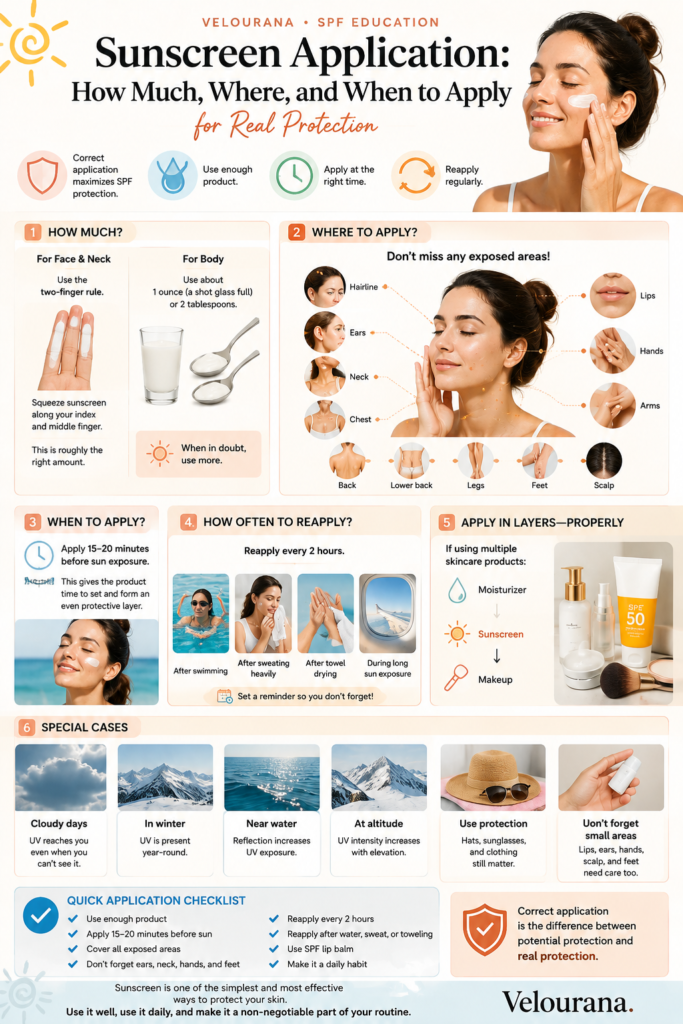
CATEGORY: Sunscreen Application
Sunscreen application becomes much easier when it is treated as a routine rather than a collection of individual decisions.
Instead of wondering every morning where sunscreen should go, how much should be used, whether the neck counts as part of the face, or which areas need attention at the beach, you can develop a consistent method that follows the same basic sequence each time.
The goal is complete coverage of exposed skin.
That sounds obvious, but incomplete coverage is one of the most common weaknesses in real-world sunscreen use. People naturally concentrate on the areas they can see most easily. The center of the face receives plenty of attention while the hairline, ears, neck, shoulders, hands, feet, and backs of the legs may receive considerably less.
A systematic application routine helps solve this problem.
It also makes sunscreen faster to apply.
Once the sequence becomes familiar, you no longer need to think about every individual area. You simply move through the routine.
Begin With the Skin That Will Actually Be Exposed
Before applying sunscreen, consider what you are wearing and what you will be doing.
An ordinary office day may expose only the face, neck, hands, and perhaps the forearms.
A summer dress may expose the shoulders, upper chest, arms, and legs.
Swimwear can expose most of the body.
A hiking outfit may cover the torso while leaving the face, neck, hands, and lower legs exposed.
Sunscreen application should reflect the actual exposed surface.
Clothing Is Part of Sun Protection
Skin covered effectively by suitable clothing does not require the same sunscreen attention as uncovered skin.
This is one reason clothing can make sun protection much easier.
Rather than repeatedly applying sunscreen across the entire body, you can physically cover larger areas and concentrate sunscreen on the remaining exposed skin.
Start With the Face
For many people, facial sunscreen is part of the normal morning skincare routine.
Complete any necessary skincare first.
If you use moisturizer, apply it before sunscreen.
Allow underlying products to settle sufficiently.
Then apply sunscreen as its own layer.
Do Not Mix Sunscreen With Other Skincare
Mixing sunscreen directly with moisturizer, serum, facial oil, or foundation changes the original formulation.
The resulting mixture has not been tested to provide the SPF displayed on the sunscreen.
Layer products instead.
Apply Enough to the Face
The sunscreen needs to create an even film across the entire facial surface.
Do not treat it like a concentrated serum requiring only a few drops.
Follow the manufacturer's application directions and use a practical quantity guide when useful.
Divide the Face Into Zones
A systematic method can improve coverage.
Begin with the forehead.
Move across both temples.
Cover each cheek.
Cover the nose.
Cover the area around the mouth.
Cover the chin.
Finish along the jawline.
This reduces the chance of leaving untreated gaps.
Cover the Forehead Completely
Work the sunscreen toward the hairline.
Do not stop several centimetres below it simply because you want to keep the hair clean.
A careful application can reach the skin without heavily coating the hair.
Pay Attention to the Temples
The temples are easy to overlook, particularly when glasses or sunglasses are worn.
Apply around them carefully.
Cover the Nose Deliberately
The nose should receive its own application attention.
Cover the bridge.
Cover the sides.
Cover the tip.
Do not assume sunscreen transferred from the cheeks provides adequate coverage.
Work Carefully Around the Eyes
The skin surrounding the eyes also receives UV exposure.
Use a facial sunscreen appropriate for the area and follow its directions.
Avoid getting sunscreen directly into the eyes.
Sunglasses Add Important Protection
Appropriate UV-protective sunglasses complement sunscreen.
They protect the eyes while also shading some of the surrounding skin.
If Sunscreen Irritates the Eyes
Eye irritation can make people avoid sunscreen around this area entirely.
Instead, consider trying another formulation.
Some people tolerate sunscreen sticks or mineral-based formulations around the eye area better.
Individual tolerance varies.
Cover the Cheeks to Their Edges
The central cheeks usually receive plenty of sunscreen.
The outer cheeks near the ears can be missed.
Blend all the way across.
Cover Around the Mouth
Apply sunscreen to exposed skin around the mouth while avoiding direct application to the lips unless the product is designed for them.
Use a suitable SPF lip product separately.
Cover the Chin
The chin is another projecting facial area that should receive deliberate coverage.
Include the underside when exposed.
Do Not Stop at the Jawline
The jaw is not a natural boundary for UV exposure.
Finish the face completely and then move to the neck.
Give the Neck Its Own Sunscreen
Do not depend solely on whatever product remains after facial application.
Dispense additional sunscreen.
Cover the front.
Cover the sides.
Cover the back if exposed.
Include the Area Behind the Ears
Depending on hairstyle and clothing, skin behind the ears can remain exposed.
Include it where necessary.
Apply Sunscreen to the Ears
The ears deserve deliberate protection.
Apply carefully across exposed surfaces.
This takes only a few seconds once it becomes part of the routine.
Remember That Hair Moves
Hair may cover the ears and neck in the morning.
Later it may be tied back.
Wind can move it.
Exercise can change the hairstyle.
Do not depend entirely on hair for predictable protection.
Protect the Scalp Where Necessary
People with shaved heads, thinning hair, or visible hair parts may have exposed scalp.
Suitable sunscreen can be applied according to product instructions.
A hat can provide particularly convenient physical protection.
Move to the Upper Chest
Look at the neckline of your clothing.
If the upper chest is exposed, apply sunscreen across the visible area.
Do not stop exactly where your morning facial skincare normally ends.
Consider Clothing Movement
Necklines can shift during the day.
Apply carefully around clothing boundaries when significant exposure is expected.
Protect the Shoulders
Sleeveless tops and swimwear expose the shoulders.
These areas can receive substantial direct sunlight.
Apply sunscreen across the entire shoulder rather than only the front.
Move Down the Arms
Apply sunscreen systematically around each arm.
Cover the upper arm.
Cover the elbow.
Cover the forearm.
Cover the wrist.
Do Not Apply Only to the Outside of the Arms
Inner arms can also become exposed depending on position and activity.
Work around the entire exposed limb.
Protect the Elbows
The shape and movement of the elbow can create missed areas.
Apply around the joint carefully.
Finish With the Hands
Apply sunscreen to the backs of the hands and exposed fingers.
Do not rely on accidental product transfer from body application.
Remember Hand Washing
Sunscreen on the hands is easily removed by washing.
If meaningful exposure continues afterward, restore protection as appropriate.
Consider Rings and Watches
Jewellery and watch straps can move.
Small exposed areas around them may receive sunlight.
Apply carefully around these boundaries during prolonged exposure.
Applying Sunscreen to the Torso
The amount of torso requiring sunscreen depends heavily on clothing.
At the beach or pool, much larger areas may be exposed.
Apply systematically rather than trying to cover everything randomly.
Cover the Chest
Spread sunscreen evenly across exposed skin.
Pay attention to swimsuit and clothing edges.
Cover the Abdomen
If exposed, the abdomen needs the same protection as other body areas.
Do not use progressively smaller amounts as you move away from the face.
The Back Requires Assistance
The back is difficult to reach completely.
If possible, ask someone to help.
This is more reliable than attempting to stretch your arms into positions that leave large untreated sections.
Spray Sunscreen Can Help With the Back
A spray format may make self-application easier.
However, it still needs to be applied in an adequate quantity.
Follow the manufacturer's instructions and make sure coverage is complete.
Do Not Spray Into the Air and Walk Through It
Sunscreen needs to reach the skin in sufficient quantity.
A cloud of mist around the body is not a reliable application method.
Move to the Legs
Legs have a large surface area and require substantial sunscreen when exposed.
Begin at the upper leg and work downward.
Cover the Front of the Thighs
Apply evenly rather than leaving isolated streaks.
Cover the Sides of the Thighs
These areas can easily be missed when application is performed while standing.
Cover the Backs of the Thighs
Turn around or use a mirror if necessary.
Beach and swimwear exposure makes these areas particularly relevant.
Protect the Knees
Apply around the entire knee.
Movement can create folds and missed areas.
Cover the Shins
The fronts of the lower legs are usually easy to reach.
Use enough sunscreen.
Cover the Calves
The backs of the lower legs are frequently forgotten.
Apply deliberately.
Finish With the Ankles
Clothing and footwear often create exposed strips around the ankles.
Include them.
Protect the Feet
Bare feet and open shoes expose skin that is normally covered.
Apply sunscreen to the tops of the feet.
Include exposed toes.
Consider Sandal Straps
Straps can shift as you walk.
Apply around them rather than treating the original strap position as a permanent boundary.
Applying Sunscreen Before Dressing
For beach days or extensive body exposure, some people find it easier to apply sunscreen before putting on swimwear or outdoor clothing.
This can make clothing boundaries easier to cover.
Avoid applying unnecessarily beneath areas that will remain completely protected, but make sure shifting edges do not create gaps.
Allow Sunscreen to Set Before Dressing
If practical, give the product time to settle before putting tight clothing over it.
This can reduce immediate transfer onto fabric.
Follow product-specific instructions.
Face and Body Sunscreen Can Be Different Products
There is no requirement to use one sunscreen everywhere.
Facial skin may benefit from a lighter or more cosmetically elegant formulation.
The body may be easier and more economical to cover with a larger lotion or spray.
Separate Products Can Improve Application
A facial sunscreen you enjoy using can encourage generous daily application.
An affordable body sunscreen can make it easier to cover large areas without worrying about cost.
The Best Sunscreen Is One You Can Use Properly
Protection depends not only on the label but on real behavior.
If a sunscreen is so uncomfortable that you apply almost none, its excellent specifications have limited practical value.
Oily Skin May Prefer Lightweight Facial Sunscreen
Fluids and gels can make adequate facial application more comfortable.
Do not automatically reduce quantity because the skin becomes shiny.
Choose a better texture instead.
Dry Skin May Prefer Creamier Formulas
A moisturizing sunscreen can sometimes replace a separate daytime moisturizer.
This can simplify the routine.
Sensitive Skin Needs Tolerable Formulations
If sunscreen repeatedly causes discomfort, try another appropriate product.
Persistent reactions should be discussed with a dermatologist.
Acne-Prone Skin Can Still Use High SPF
High SPF does not automatically mean a thick or pore-clogging formula.
Modern sunscreens are available in many textures.
Deeper Skin Tones May Prefer Transparent or Tinted Formulas
Visible white cast can make correct application difficult.
A formula that looks acceptable at an adequate quantity is preferable to a sunscreen that requires chronic underapplication to appear invisible.
Tinted Sunscreen Requires Full Application
Do not treat tinted sunscreen as ordinary foundation.
Its protective function depends on sufficient quantity.
If the correct amount creates an unsuitable color, find a better shade.
Applying Sunscreen Under Makeup
Complete sunscreen application before beginning makeup.
Allow the sunscreen to settle.
Then apply primer, foundation, concealer, and other cosmetics.
Use Gentle Makeup Techniques
Aggressive rubbing can disturb sunscreen.
Pressing or lightly blending makeup may preserve the underlying layer better.
Makeup SPF Is Additional, Not Additive
Foundation containing SPF can contribute protection.
It does not mathematically add to the sunscreen SPF.
SPF 50 underneath SPF 20 foundation is not SPF 70.
Do Not Mix Foundation Into Sunscreen
Keep the products separate.
The sunscreen needs to form its intended film.
Reapplication Is Part of the Complete Routine
The first application establishes protection.
Reapplication helps maintain it during prolonged exposure or after activities that disturb the sunscreen.
Reapply During Prolonged Outdoor Exposure
Follow the sunscreen's instructions.
Common guidance recommends regular reapplication during extended outdoor exposure.
Do not use SPF as a timer.
Reapply After Swimming
Water-resistant sunscreen is designed for water exposure, but it is not permanent.
Follow the stated reapplication directions.
Reapply After Towel Drying
A towel can physically remove sunscreen.
Restore protection before continuing prolonged exposure.
Reapply After Heavy Perspiration
Sport and hot conditions can disturb sunscreen.
Wiping sweat away can remove even more.
Use a suitable water-resistant product.
Reapply After Washing
If you wash an exposed area, the previous sunscreen layer may no longer be reliable.
Hands are the most common example.
Full-Body Reapplication Needs Enough Product
Do not turn a full-body reapplication into a few symbolic streaks.
If most of the body remains exposed, substantial sunscreen may be required again.
Bring Enough Sunscreen for the Day
This is particularly important at the beach.
One small bottle may be insufficient for several people requiring repeated applications.
Do Not Ration Sunscreen
If you begin applying less because you are afraid of running out, protection becomes compromised.
Bring adequate supplies.
Use Clothing to Make Reapplication Easier
A rash guard, long-sleeved shirt, or other protective clothing can dramatically reduce the amount of exposed skin.
This can make long outdoor days easier to manage.
Use a Hat
A broad-brimmed hat helps protect the scalp, ears, face, and neck.
It works alongside sunscreen rather than replacing it.
Use Sunglasses
Appropriate sunglasses provide UV protection for the eyes and surrounding area.
Seek Shade
Shade reduces direct UV exposure.
This is particularly valuable during periods of intense sunlight.
Application for an Ordinary Workday
A practical routine might involve facial sunscreen, neck coverage, exposed chest if necessary, and hands or arms according to clothing.
If most of the day is spent indoors, later reapplication should reflect actual exposure.
Application for an Outdoor Workday
Outdoor workers require more comprehensive protection.
Cover exposed skin thoroughly.
Use protective clothing where practical.
Keep sunscreen accessible for reapplication.
Application for a Beach Day
Use a high broad-spectrum sunscreen appropriate for strong exposure.
Choose water resistance.
Cover the entire exposed body.
Bring enough product.
Reapply according to directions after swimming and toweling.
Use shade and physical protection.
Application for Swimming
Apply a suitable water-resistant sunscreen before exposure according to the product directions.
Cover areas around swimwear carefully.
Restore protection after water exposure as directed.
Application for Running
Cover the face, ears, neck, arms, legs, and any other exposed areas.
Choose a product suitable for perspiration.
Carry sunscreen during long sessions.
Application for Cycling
Pay particular attention to the face, ears, neck, hands, arms, and legs.
Wind can make strong sunlight feel deceptively comfortable.
Application for Hiking
Use sunscreen on all exposed skin.
Protect the scalp with a hat.
Carry sunscreen where it is easily accessible.
Altitude may increase UV exposure.
Application for Skiing
Cold weather does not mean low UV.
Protect the face and lips carefully.
Snow reflection and altitude can increase exposure.
Application for Gardening
Gardening often lasts longer than expected.
Apply to the face, ears, neck, hands, forearms, and lower legs according to clothing.
A hat and protective clothing can simplify protection.
Application for Sightseeing
Travel can involve hours of walking outdoors.
Apply before leaving accommodation.
Carry sunscreen.
Wear a hat.
Use shade when possible.
Application While Driving
Broad-spectrum protection is useful for exposed areas during repeated or prolonged driving.
Face, hands, and arms deserve attention.
Application Near Windows
UVA can penetrate ordinary glass to varying degrees.
Someone sitting immediately beside a bright window for hours may have different exposure from someone deep inside a building.
Broad-spectrum protection is relevant when exposure is meaningful.
Application on Cloudy Days
Clouds can reduce some UV radiation but do not necessarily eliminate exposure.
Consider the UV Index rather than judging entirely by visible sunshine.
Application During Winter
Continue to protect exposed skin according to UV conditions.
Mountain environments deserve particular care.
Application at High Altitude
UV exposure can increase with altitude.
Use comprehensive protection when hiking, climbing, or skiing.
Application Around Water
Water can reflect UV and create demanding exposure conditions.
Boating, fishing, swimming, and waterside activities require careful protection.
Do Not Use Skin Temperature as a Guide
A cool breeze can make intense sunlight feel comfortable.
UV exposure is not determined by how warm your skin feels.
Check Your Application in a Mirror
A quick visual check can reveal missed areas.
Hairline.
Temples.
Ears.
Sides of the neck.
Shoulders.
Develop a Fixed Order
Consistency reduces mistakes.
Face.
Ears.
Neck.
Chest.
Shoulders.
Arms.
Hands.
Torso.
Legs.
Feet.
The exact sequence does not matter as long as exposed areas are covered.
Do Not Rush
Most missed areas occur because sunscreen is applied hurriedly.
Taking an additional minute can improve coverage substantially.
Prepare Before Leaving Home
Application is often easier in a clean, comfortable environment than after arriving at a hot, windy, sandy beach.
Make sunscreen part of preparation.
Keep Sunscreen Visible
Products hidden in cupboards are easier to forget.
Keep daily facial sunscreen near your normal morning skincare.
Keep Outdoor Sunscreen With Outdoor Equipment
Beach sunscreen can stay with beach supplies when storage conditions are appropriate.
Sport sunscreen can remain with exercise equipment.
Portable products can be kept ready for travel.
Check Expiration Dates
Do not assume an old sunscreen remains reliable indefinitely.
Follow expiration and period-after-opening information.
Store Sunscreen Correctly
Follow manufacturer instructions.
Avoid unnecessary prolonged exposure to extreme heat.
Purchase From Reliable Sources
Authenticity matters.
A counterfeit sunscreen can create dangerous false confidence.
Avoid Homemade Sunscreen
DIY formulas cannot reliably reproduce professionally tested SPF.
Sunscreen formulation involves much more than adding a UV-filtering ingredient to a cream.
Do Not Dilute Sunscreen
Adding moisturizer, oil, foundation, or serum changes the formulation.
Apply products separately.
Do Not Depend on After-Sun Products
After-sun moisturizers can soothe and hydrate the skin.
They do not replace preventive sunscreen application.
Do Not Wait for Sunburn
Redness means excessive exposure has already occurred.
Sunscreen should be applied preventively.
Do Not Use Sunscreen to Justify Excessive Exposure
High SPF is not permission to spend unlimited time deliberately in intense sunlight.
Combine sunscreen with sensible exposure behavior.
Complete Coverage Is More Important Than Cosmetic Perfection
Sunscreen may initially look slightly shiny or visible.
Allow it to settle.
If the appearance remains unacceptable, change products rather than reducing the amount drastically.
Comfort Supports Consistency
The right sunscreen should fit your skin, climate, clothing, makeup, and daily routine.
There is no universal perfect texture.
Simplicity Supports Consistency
A complicated routine is not automatically better.
If several skincare layers interfere with sunscreen application, simplify them.
Repetition Builds Accuracy
At first, remembering every exposed area may require conscious attention.
Eventually, the sequence becomes automatic.
You reach the ears without thinking.
You apply separately to the neck.
You remember the hands.
You check the feet before putting on sandals.
The Face Is Only the Beginning
Beauty routines often place almost all attention on facial sunscreen.
Complete sun protection follows exposed skin wherever it appears.
The neck matters.
The chest matters.
The shoulders matter.
The hands matter.
The legs matter.
The feet matter.
The Most Reliable Routine Is the One You Actually Follow
A technically sophisticated sunscreen plan has little value if it is too complicated to maintain.
Choose suitable products.
Keep them accessible.
Apply them adequately.
Develop a repeatable sequence.
The Final Principle
Complete sunscreen application is fundamentally about coverage.
Every exposed area needs an adequate protective layer.
The easiest way to achieve that is through a systematic routine.
Begin with the face and work carefully toward the hairline.
Include the temples and ears.
Apply separately to the neck.
Protect the upper chest according to clothing.
Move across the shoulders and around the arms.
Finish the hands.
Cover exposed torso areas.
Apply around the entire legs.
Remember the ankles, feet, and toes.
Protect exposed scalp and lips.
Use enough sunscreen rather than stretching a tiny quantity across increasingly large areas.
Maintain the protective layer during prolonged exposure through appropriate reapplication.
And reduce the amount of exposed skin with clothing, hats, shade, and sunglasses whenever practical.
Sunscreen application does not need to be perfect to become substantially better.
It needs to be deliberate, complete, and consistent.
Once complete coverage becomes a habit, sunscreen stops being something you merely put on your skin and becomes a reliable part of everyday sun protection.
The End
Velourana.
 Discover More From Our Family of Websites
 ZodiacBearing (Astrology, Tarot, Numerology, Angel Numbers & Spiritual Guidance)
 Velourana (Beauty, Makeup, Hair Care, Skincare & Beauty Tips)
 HavenBearing (Home, Living, Organization, Décor & Everyday Inspiration)
 PawBearing (Pet Care, Dog Breeds, Animal Health, Training & Pet Products)
 PsyCatherine (Notes From the Journal of a Psychologist on Real Life)

