CATEGORY: Sunscreen Application
Choosing a sunscreen with an appropriate SPF and broad-spectrum protection is important, but there is another factor that has an enormous influence on real-world protection: the amount of sunscreen actually applied.
Many people use considerably less sunscreen than they realize.
A few small dots are placed across the face.
A tiny amount is stretched from the forehead all the way down the neck.
Body sunscreen is applied quickly to the shoulders and arms while other exposed areas receive only a thin trace.
The skin may feel as though sunscreen has been applied, yet the quantity may be insufficient to provide the level of protection represented by the SPF rating.
Understanding sunscreen quantity does not require turning your morning routine into a laboratory experiment.
It requires understanding why quantity matters, learning practical ways to achieve good coverage, and recognizing the areas where people commonly spread the product too thinly.
Why Sunscreen Quantity Matters
Sunscreen SPF ratings are established using standardized testing methods.
The product is applied at a defined amount during testing.
The SPF printed on the package therefore represents performance under those controlled conditions.
If substantially less sunscreen is used in everyday life, the resulting protection may be considerably lower.
This is why an SPF 50 sunscreen applied extremely thinly should not automatically be assumed to provide SPF 50 protection on the skin.
More Is Not About Creating a Thick White Mask
Adequate application does not mean leaving enormous visible piles of sunscreen on the skin.
The objective is an even protective film.
Modern sunscreen formulas are designed to spread across the skin.
A suitable amount should be distributed carefully rather than concentrated in one area.
The Standard Testing Quantity
SPF testing generally uses sunscreen at approximately 2 milligrams per square centimetre of skin.
This laboratory measurement is useful for understanding why sunscreen quantity matters.
It is less convenient when standing in front of a bathroom mirror.
Most people are not going to weigh their sunscreen every morning.
Practical application methods therefore become useful.
The Face Requires More Than a Tiny Dot
Sunscreen is sometimes treated like an expensive eye cream.
A small drop is placed on one fingertip and stretched as far as possible.
This is not the best approach.
The face has a substantial surface area.
The forehead, cheeks, nose, chin, temples, and sides of the face all require coverage.
Do Not Forget That the Neck Is a Separate Area
One of the easiest ways to underapply sunscreen is to use an amount intended for the face and then stretch the leftovers down the neck.
The neck adds significant surface area.
If it is exposed, it needs adequate sunscreen too.
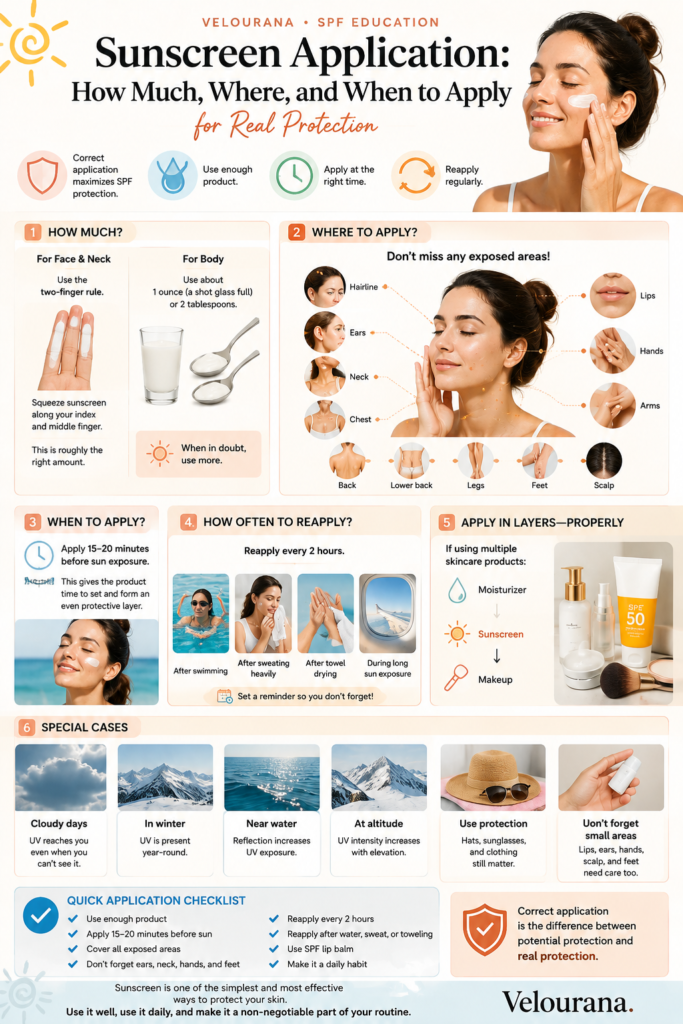
The Two-Finger Method
One popular practical guide is the two-finger method.
Sunscreen is dispensed in lines along two fingers as a visual guide for the face and neck.
This can be useful because it reminds people that a tiny pea-sized amount may be insufficient.
However, the two-finger method should not be treated as an exact universal scientific measurement.
Why the Two-Finger Method Is Approximate
People have different finger lengths and widths.
Sunscreen nozzles dispense different widths of product.
A thick cream creates a different line from a watery fluid.
Some people include the ears and upper chest.
Others apply only to the face and neck.
For these reasons, the method is best viewed as a practical reminder rather than an exact measurement.
Manufacturer Instructions Still Matter
Always consider the directions supplied with the sunscreen.
Some products provide specific application guidance.
Sprays, sticks, fluids, and creams require different techniques.
The manufacturer knows the format and dispensing system of the particular product.
Applying Sunscreen in Two Layers
If the correct amount feels difficult to spread at once, divide the application.
Apply approximately half.
Spread it evenly.
Allow it to begin settling.
Then apply the remainder.
This can make generous application more comfortable.
Two Layers Do Not Double the SPF
Applying SPF 50 in two passes does not create SPF 100.
The purpose of the second pass is improved quantity and coverage.
It can also help catch missed areas.
Dotting Sunscreen Across the Face
Another useful technique is distributing sunscreen before spreading it.
Place product across the forehead, cheeks, nose, chin, and sides of the face.
Then blend the areas together.
This can prevent one section from absorbing most of the sunscreen before other areas are reached.
Start With Enough Product
Trying to stretch a visibly inadequate quantity across a large area almost guarantees a thin layer.
Dispense enough from the beginning.
If necessary, add more.
Do Not Ration Sunscreen Because It Is Expensive
Premium facial sunscreens can be costly.
This sometimes encourages people to use extremely small amounts.
Unfortunately, sunscreen cannot provide its intended protection if it is rationed excessively.
If a product is too expensive to use adequately every day, a more affordable sunscreen may be a better practical choice.
Affordable Sunscreen Can Be Excellent Sunscreen
Price does not determine SPF effectiveness.
A properly tested affordable SPF 50 can provide excellent protection.
Luxury products may offer more elegant textures, packaging, or skincare ingredients, but adequate application remains essential at every price level.
How Much for the Face?
There is no single household measurement that perfectly suits every face and every formulation.
The key principle is that the entire facial surface should receive an adequate, uniform layer.
Manufacturer instructions and practical quantity guides can help.
Include the Forehead
The forehead represents a large portion of the facial surface.
Do not concentrate sunscreen only on the cheeks and nose.
Spread the product all the way toward the hairline.
Include the Hairline
People often stop application early because they do not want sunscreen in their hair.
This can leave an exposed strip around the forehead.
Apply carefully up to the hairline.
Include the Temples
The temples are easy to miss.
Glasses and sunglasses can make application more awkward.
Apply around these areas carefully.
Include the Nose
The nose projects outward and can receive significant exposure.
Cover the bridge, tip, and sides.
Do not rely only on whatever sunscreen reaches the nose while blending the cheeks.
Include Around the Mouth
Apply carefully around the mouth while avoiding the lips unless the sunscreen is intended for them.
Use an appropriate SPF lip product separately.
Include the Jawline
Blend sunscreen all the way to the edge of the face.
Do not leave an untreated border around the jaw.
How Much for the Neck?
The neck needs its own adequate coverage.
Apply to the front.
Apply to the sides.
If the back of the neck is exposed, protect it too.
Long Hair Does Not Always Protect the Neck
Hair moves.
It can be tied up later.
Wind can expose the neck.
Do not assume hair provides reliable protection throughout the day.
How Much for the Ears?
The ears require a relatively small quantity compared with the face, but they should still receive deliberate application.
Cover exposed surfaces carefully.
Do not forget behind the ears when that area is exposed.
How Much for the Upper Chest?
The amount depends on how much skin clothing leaves exposed.
A high-neck top may cover almost everything.
A lower neckline may expose a substantial area.
Apply according to the actual exposed surface.
Body Sunscreen Requires Much More Product
The body has a far larger surface area than the face.
A small bottle can disappear surprisingly quickly when sunscreen is used correctly across exposed arms, legs, shoulders, torso, and feet.
This is normal.
Sunscreen is a consumable protective product.
A Common Adult Body Guide
A frequently used general guide for an average adult wearing swimwear is approximately one ounce, or around 30 millilitres, for the exposed body.
This is often compared with the volume of a small shot glass.
It is an approximate practical guide rather than a perfect measurement for every person.
Body size and the amount of exposed skin vary.
Why Body Size Matters
A larger adult has more skin surface than a smaller adult.
Someone wearing a long-sleeved rash guard has less exposed skin than someone wearing swimwear.
The quantity required therefore changes with the person and clothing.
Clothing Reduces the Amount of Skin Requiring Sunscreen
This is one advantage of physical protection.
A long-sleeved UPF garment can cover a large area without requiring sunscreen application across the covered skin.
This can make outdoor protection easier and reduce sunscreen consumption.
Arms Need Complete Coverage
Apply around the entire arm.
People often cover the outer forearms and shoulders but neglect the inner arms.
If exposed, all sides require protection.
Shoulders Need Particular Attention
Shoulders receive strong direct exposure during many outdoor activities.
Swimwear and sleeveless clothing leave them uncovered.
Apply generously.
Elbows Are Easy to Miss
The shape of the elbow can create uneven application.
Straighten and bend the arm while applying if necessary to ensure complete coverage.
Hands Need Deliberate Application
Do not rely only on sunscreen transferred from your palms while applying it elsewhere.
Apply to the backs of the hands and exposed fingers.
Hand Washing Removes Sunscreen
Hands are unique because they are washed frequently.
After washing, sunscreen protection can be reduced or removed.
If significant outdoor exposure continues, restore sunscreen as appropriate.
Legs Require More Than a Few Streaks
Legs have a large surface area.
Apply sunscreen around the entire leg.
Front.
Sides.
Back.
Do not concentrate only on the shins.
Knees Need Coverage
Knees can be missed during quick application.
Cover around the entire joint.
Calves Are Frequently Forgotten
The backs of the lower legs receive substantial exposure when walking or standing.
Apply deliberately.
Protect the Backs of the Thighs
Beachgoers often cover the fronts of their legs while forgetting the backs.
This becomes particularly noticeable when lying face down or walking for extended periods.
Feet Need Sunscreen Too
Bare feet and sandals expose areas that are normally covered.
The tops of the feet can burn easily.
Apply sunscreen across exposed skin and around sandal straps.
Toes Can Be Exposed
Open footwear can leave the toes exposed.
Include them when necessary.
The Back Is Difficult to Apply Alone
The back presents an obvious practical problem.
It is difficult to reach evenly.
Ask another person for help when possible.
A suitable spray can make self-application easier, but adequate coverage is still necessary.
Do Not Assume Spray Automatically Solves the Quantity Problem
Sprays make it easier to reach large areas.
They also make it difficult to judge quantity.
A brief mist may look like coverage while depositing very little product.
Apply according to the instructions.
Spray Until Coverage Is Adequate
Follow the product-specific directions.
Some sprays instruct users to apply generously and spread the product after spraying.
Do not assume that simply seeing droplets on the skin means enough sunscreen has been applied.
Avoid Wind During Spray Application
Wind can carry a significant amount of spray away.
Apply in a sheltered environment when possible.
Sunscreen Sticks Have Their Own Quantity Challenge
Sticks are convenient and portable.
However, one swipe can leave a very thin layer.
Multiple passes are often necessary.
Follow the product directions.
Apply Stick Sunscreen Systematically
Use overlapping passes.
Make sure there are no untreated strips between them.
Blend if the manufacturer recommends doing so.
Do Not Treat Powder SPF Like Loose Face Powder
Powder sunscreen requires enough product to provide protection.
A very light cosmetic dusting may not reproduce the labeled SPF.
Powders are often most practical as supplementary protection rather than the primary sunscreen layer.
Quantity Around the Eyes
The eye area requires careful application.
Use a facial sunscreen suitable for this area.
Apply around the orbital area without putting sunscreen directly into the eyes.
Sunglasses add valuable physical protection.
If Sunscreen Stings the Eyes
Do not simply stop protecting the area.
Try a different formulation.
Some people prefer mineral formulas or sticks around the eyes.
Individual tolerance varies.
Quantity and White Cast
Mineral sunscreens can sometimes produce visible white cast, particularly when applied adequately.
This can tempt users to reduce the amount.
That is not a good solution.
Choose a formulation better suited to your skin tone.
Tinted Sunscreen Can Help
Tinted formulations can reduce the appearance of white cast.
They can be particularly useful for deeper skin tones or people who want cosmetic coverage.
The same quantity principles still apply.
Do Not Use Less Tinted Sunscreen Because of the Color
A tinted sunscreen may begin looking like foundation.
This can encourage people to use a smaller cosmetic amount.
Remember that it is still sunscreen.
If the correct amount looks too dark or too light, choose a better shade.
Quantity Under Makeup
Adequate sunscreen application may initially look more noticeable than a tiny amount.
Allow the product to settle.
Many modern sunscreens become much less visible after a few minutes.
Then apply makeup gently.
Do Not Remove Sunscreen While Applying Foundation
Heavy rubbing can move the sunscreen around.
Use application techniques that preserve the layer underneath.
Quantity and Pilling
Sometimes adequate sunscreen appears to pill.
This does not mean you should automatically reduce the sunscreen amount.
The problem may be excessive skincare underneath.
Simplify the Morning Routine
If pilling occurs, try reducing unnecessary layers.
Use lighter moisturizer.
Allow products to settle.
Avoid excessive amounts of serum.
Then apply sunscreen.
Sunscreen Should Remain the Priority
If the choice is between six morning skincare layers and sunscreen that applies properly, simplify the routine.
Sun protection deserves priority.
Quantity and Reapplication
Reapplication does not mean touching the face with a microscopic amount of product.
The objective is to restore meaningful coverage.
During prolonged exposure, use enough sunscreen to replace the protective layer that has been disturbed.
Reapply After Swimming
Swimming can reduce sunscreen coverage even when the product is water resistant.
Follow the manufacturer's reapplication directions.
Reapply After Towel Drying
Towels physically remove sunscreen.
Restore the layer before continued exposure.
Reapply After Heavy Sweating
Perspiration and repeated wiping can disturb coverage.
Outdoor sport requires particular attention.
Do Not Assume SPF 50 Requires Less Product
SPF 50 needs adequate application just like SPF 30.
The higher number does not mean the product can be spread more thinly.
SPF 100 Also Requires Adequate Application
Extremely high SPF does not change the basic rule.
Underapplication reduces real-world protection.
Higher SPF Can Provide Additional Margin
Using a higher SPF can provide greater UVB protection.
But it should complement good application rather than compensate deliberately for bad application.
Quantity on Cloudy Days
Clouds do not change the amount of sunscreen required to achieve its labeled SPF.
If sunscreen is needed for the expected UV exposure, apply it properly.
Do not use a deliberately thinner layer because the sky looks grey.
Quantity in Winter
The same principle applies in winter.
If you are using sunscreen, use it correctly.
High-altitude snow activities can involve substantial UV exposure.
Quantity at High Altitude
Hiking, climbing, and skiing may involve stronger UV conditions.
Apply thoroughly.
Carry sunscreen for reapplication.
Protect the lips.
Use sunglasses and hats.
Quantity at the Beach
Beach days are among the easiest situations in which to underapply.
Large body areas are exposed.
Swimming removes product.
Sand makes reapplication inconvenient.
Towels rub sunscreen away.
Prepare before exposure and bring enough sunscreen for repeated use.
Take Enough Sunscreen With You
A tiny travel bottle may not contain enough product for several people spending an entire day at the beach.
Plan according to the number of users and expected exposure.
Running out of sunscreen halfway through the day creates an avoidable problem.
Families Need Larger Quantities
When several people share one bottle, sunscreen can disappear quickly.
This is expected when large body areas are covered properly.
Bring sufficient supply.
Children's Sunscreen Quantity
Children also require adequate coverage appropriate to their exposed skin.
Parents and caregivers should follow pediatric guidance and the product directions.
Do not assume that a very small amount is sufficient simply because the child is smaller.
Make Application Visible and Systematic
For children, applying in sections can help prevent missed areas.
One arm.
The other arm.
One leg.
The other leg.
Torso.
Back.
Face and ears.
A routine reduces gaps.
Sunscreen Quantity for Daily Commuting
Daily facial sunscreen does not need to feel like beach preparation.
But the face and exposed neck still need adequate coverage.
Choose a formulation comfortable enough for proper daily use.
Sunscreen Quantity While Driving
Apply adequate broad-spectrum sunscreen to exposed skin.
Hands and arms may need attention in addition to the face.
Sunscreen Quantity for Outdoor Workers
Outdoor workers may require repeated full applications during the day.
Protective clothing can reduce the amount of exposed skin and make the routine more manageable.
Sunscreen Quantity for Runners
Runners should cover all exposed areas before beginning.
Pay particular attention to the ears, neck, shoulders, face, arms, and legs.
Choose a water-resistant product appropriate for perspiration.
Sunscreen Quantity for Cyclists
Cyclists often have large areas of exposed arms and legs.
Apply around the entire limb rather than only the surfaces visible when standing in front of a mirror.
Sunscreen Quantity for Swimmers
Use a water-resistant sunscreen and apply thoroughly before entering the water according to product directions.
Restore coverage after swimming as instructed.
Sunscreen Quantity for Gardening
Gardening can involve hours of unexpected exposure.
Face.
Ears.
Neck.
Hands.
Forearms.
Lower legs.
These areas are commonly exposed.
The Amount You Need Changes With Clothing
There is no reason to apply body sunscreen beneath fully protective clothing simply to meet an arbitrary quantity target.
Apply according to the exposed surface.
Protective clothing is itself part of sun protection.
UPF Clothing Can Simplify Application
Purpose-designed UPF garments can provide reliable coverage across large areas.
This is particularly useful for children, outdoor workers, athletes, and people spending long periods in intense sun.
A Hat Reduces Exposed Scalp
Instead of trying to apply large quantities of sunscreen through dense hair, a suitable hat can provide practical protection.
Apply sunscreen to exposed scalp areas when necessary.
Quantity Is Only One Part of Correct Application
Enough sunscreen applied unevenly can still leave vulnerable areas.
Quantity and distribution work together.
Check Your Coverage
After applying, look at the areas people commonly miss.
Hairline.
Temples.
Sides of the face.
Ears.
Jawline.
Neck.
Hands.
Feet.
Shoulders.
Ask for Help With Difficult Areas
There is nothing wrong with asking another person to apply sunscreen to the back.
It is better than pretending an unreachable area has been covered.
Use a Mirror
A mirror can help with facial edges, ears, neck, shoulders, and upper chest.
For body application, a full-length mirror can reveal obvious missed areas.
Do Not Forget Skin Exposed by Movement
Clothing shifts.
Sleeves move.
Shorts ride upward.
Swimwear changes position.
Apply carefully around clothing boundaries during prolonged exposure.
Do Not Depend on Leftover Sunscreen
This is one of the simplest rules for improving quantity.
The neck should not receive leftovers from the face.
The hands should not receive leftovers from the arms.
The ears should not receive whatever remains on one fingertip.
Apply deliberately to each exposed area.
Quantity and Sunscreen Cost
If you consistently hesitate to use enough because of price, consider separating facial and body sunscreen.
Use a cosmetically elegant facial product where texture matters most.
Use a larger, affordable body sunscreen for the neck, chest, arms, and other exposed areas.
Separate Face and Body Products Can Save Money
There is no requirement to use an expensive facial sunscreen across the entire body.
A dedicated body sunscreen can make generous application more affordable.
Larger Bottles Can Be Practical
For families or frequent outdoor use, larger sunscreen containers may offer better value.
Check expiration and storage instructions.
Do Not Stockpile Beyond What You Can Use
Buying in bulk only saves money if the sunscreen is used within its appropriate shelf life.
Balance quantity and consumption.
Expired Sunscreen Should Be Replaced
Applying a generous amount of an unreliable expired product does not guarantee protection.
Use sunscreen within its stated usable period.
Storage Matters
Protect sunscreen from prolonged extreme heat according to manufacturer instructions.
Do not leave it unnecessarily in direct sunlight.
Authenticity Matters More Than Quantity
A counterfeit sunscreen may provide unknown protection regardless of how generously it is applied.
Purchase from reputable sources.
Never Estimate Homemade SPF
DIY sunscreen does not provide a reliable SPF rating.
Adding a measured amount of zinc oxide to a cream does not allow you to calculate protection accurately.
Use professionally formulated and tested products.
Avoid Becoming Obsessed With Perfect Measurements
Sunscreen quantity matters, but the goal is not to make daily skincare stressful.
You do not need laboratory scales in the bathroom.
Use practical guidance.
Follow product instructions.
Apply generously and evenly.
Pay attention to coverage.
Consistency Is More Valuable Than Occasional Precision
A perfectly measured application once a week is less useful than a reliable daily routine when protection is needed.
Develop habits that are easy to repeat.
Learn How Your Sunscreen Dispenses
After using the same product repeatedly, you will become familiar with how much comes from the pump or nozzle.
This makes consistent application easier.
Pumps Can Improve Repeatability
A pump dispenser can make quantity easier to reproduce from day to day.
If the manufacturer provides a recommended number of pumps, follow that guidance.
Fluids Can Be Deceptive
Very watery sunscreens can spread extremely far.
This can create the impression that only a few drops are needed.
Remember that spreadability does not determine protective quantity.
Thick Creams Can Also Be Deceptive
A thick sunscreen may feel as though a small amount is substantial.
Again, texture does not determine the amount required for tested protection.
The Best Formula Makes Correct Quantity Comfortable
A good daily sunscreen should allow you to use an adequate amount without feeling that your face is covered in an intolerable layer.
This is where formulation choice becomes important.
If the Correct Amount Feels Terrible, Change Sunscreen
Do not spend months forcing yourself to use a product you dislike.
There are many formulations available.
Find one compatible with your skin and routine.
Sunscreen Application Should Become Automatic
Over time, quantity becomes intuitive.
You learn how much your face needs.
You remember the ears.
You stop stretching leftovers down the neck.
You automatically protect the hands.
This is the goal.
A Simple Face Routine
Apply your normal necessary skincare.
Dispense an adequate amount of sunscreen.
Distribute it across the face.
Cover the hairline and temples.
Cover the ears.
Apply separately to the neck.
Allow the product to settle.
Apply makeup if desired.
A Simple Body Routine
Identify exposed areas.
Apply sunscreen systematically from one section to another.
Cover every side of the limbs.
Include shoulders, hands, feet, and clothing edges.
Ask for help with the back.
Reapply when necessary.
A Simple Beach Routine
Bring enough sunscreen.
Apply before significant exposure according to directions.
Use water-resistant protection.
Cover all exposed areas.
Reapply after swimming.
Reapply after towel drying.
Use shade and protective clothing.
The Quantity Rule Worth Remembering
If you are trying to make one tiny amount of sunscreen cover an enormous area, you are probably using too little.
Sunscreen should be applied as a protective product, not as a scarce cosmetic sample.
The Final Principle
The SPF rating on a sunscreen bottle represents tested protection under standardized application conditions.
That number cannot deliver its full potential if the product is spread extremely thinly across the skin.
Correct quantity is therefore fundamental to sunscreen application.
Use enough product.
Distribute it evenly.
Give the neck its own application.
Remember the ears.
Protect the hands.
Cover every exposed body area.
Use additional product after swimming, towel drying, or heavy perspiration when reapplication is required.
Choose affordable formulas if cost is causing you to ration sunscreen.
Choose cosmetically elegant formulas if texture is causing you to underapply.
And use clothing, hats, sunglasses, and shade to reduce the amount of exposed skin that sunscreen needs to protect.
You do not need to measure every application with laboratory precision.
You simply need to stop treating sunscreen as a product that should be stretched as thinly as possible.
Adequate quantity transforms the SPF number from a promise printed on a bottle into meaningful protection on the skin.
The End
Velourana.
 Discover More From Our Family of Websites
 ZodiacBearing (Astrology, Tarot, Numerology, Angel Numbers & Spiritual Guidance)
 Velourana (Beauty, Makeup, Hair Care, Skincare & Beauty Tips)
 HavenBearing (Home, Living, Organization, Décor & Everyday Inspiration)
 PawBearing (Pet Care, Dog Breeds, Animal Health, Training & Pet Products)
 PsyCatherine (Notes From the Journal of a Psychologist on Real Life)