
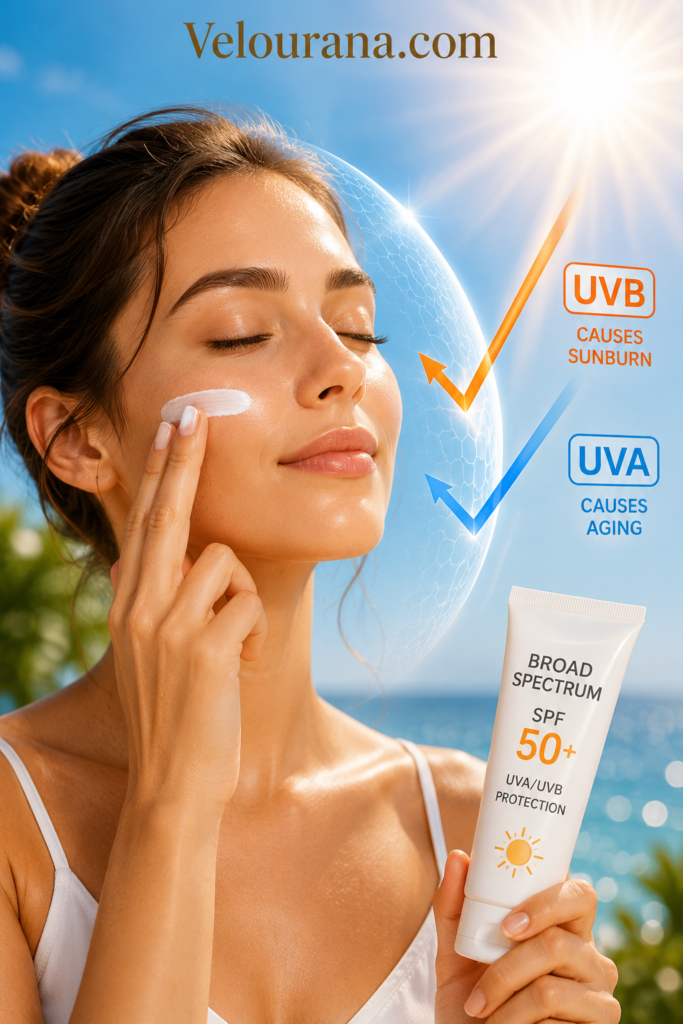
CATEGORY: Broad-Spectrum Protection
Broad-spectrum sunscreen is designed to protect the skin against both UVA and UVB radiation, but even an excellent sunscreen can provide less protection than expected when it is applied incorrectly, used too sparingly, forgotten on exposed areas, or relied upon as the only form of sun protection.
Many sunscreen mistakes are not dramatic.
They are small habits.
Applying too little.
Missing the ears.
Using makeup with SPF instead of proper sunscreen.
Applying sunscreen once in the morning and assuming it remains unchanged until evening.
Forgetting to reapply after swimming.
Mixing sunscreen into moisturizer.
Using an old bottle that has been stored in extreme heat.
None of these errors means that sunscreen is ineffective.
They mean that real-world protection depends on how the product is used.
Understanding the most common mistakes makes broad-spectrum protection much easier to use correctly.
Mistake One: Looking Only at the SPF Number
SPF is important.
It primarily reflects protection against UVB-associated sunburn under standardized testing conditions.
However, UVB is only part of the ultraviolet spectrum that affects the skin.
UVA also matters.
A complete sunscreen decision should therefore include information about broad-spectrum or UVA protection rather than focusing only on the largest number printed on the front of the package.
Mistake Two: Assuming SPF Measures UVA Protection Directly
SPF should not be interpreted as a complete measure of UVA protection.
Different labeling systems communicate UVA coverage separately.
Depending on the market, this may appear as broad-spectrum labeling, a UVA symbol, PA ratings, or another regulated system.
The practical lesson is simple.
Read SPF and UVA information together.
Mistake Three: Believing Higher SPF Means Unlimited Time in the Sun
A high SPF can provide strong UVB protection.
It does not create an unlimited safe-exposure window.
SPF 50 should not be interpreted as permission to stay outdoors indefinitely.
No sunscreen blocks all ultraviolet radiation.
Shade, clothing, hats, sunglasses, and sensible exposure habits remain important.
Mistake Four: Treating SPF Like a Clock
SPF does not translate neatly into a fixed number of minutes.
Real-world UV exposure varies.
The intensity of sunlight changes.
People apply different amounts.
Water, sweat, rubbing, and clothing can remove sunscreen.
Using SPF as a simple mathematical timer ignores these variables.
Mistake Five: Applying Too Little
This is one of the most important sunscreen mistakes.
Sunscreen testing uses standardized application amounts.
Many consumers apply considerably less in daily life.
A thin, uneven layer may not provide the protection indicated on the label.
Follow the product instructions and cover exposed skin thoroughly.
Mistake Six: Stretching a Tiny Amount Across Too Much Skin
A small amount may appear to spread across the face, neck, ears, and chest.
That does not mean each area receives adequate coverage.
Sunscreen should be applied generously enough to create an even protective layer.
Do not treat a tiny amount as though it can protect an unlimited surface area.
Mistake Seven: Missing the Hairline
The hairline is frequently forgotten.
Small exposed areas near the forehead and temples can receive repeated sunlight.
Apply sunscreen carefully around these edges.
Mistake Eight: Missing the Ears
The ears are one of the most commonly overlooked areas.
Hair may cover them sometimes and expose them at other times.
When the ears are uncovered, they should be included in the sunscreen routine.
Mistake Nine: Stopping at the Jawline
Facial sunscreen should not automatically stop at the jaw.
The neck can receive substantial exposure.
So can the upper chest.
Extend sunscreen to all exposed areas.
Mistake Ten: Forgetting the Back of the Neck
The back of the neck is particularly easy to miss.
This area can receive direct sunlight while walking, gardening, exercising, or spending time at the beach.
A hat with adequate coverage can help, but exposed skin still needs consideration.
Mistake Eleven: Forgetting the Hands
Hands receive repeated sunlight and are also washed frequently.
A morning application may be removed after several hand washes.
If significant outdoor exposure continues, reapply as appropriate.
Mistake Twelve: Forgetting the Lips
The lips also require sun protection.
Use a lip product with appropriate SPF during outdoor exposure.
Reapply after eating, drinking, swimming, or wiping the lips.
Mistake Thirteen: Forgetting the Scalp
People with shaved heads, thinning hair, or exposed hair parts can receive substantial scalp exposure.
Hats are especially useful.
Suitable sunscreen can also be used on exposed scalp areas according to product directions.
Mistake Fourteen: Applying Sunscreen After Exposure Has Already Begun
Sunscreen works best as a preventive measure.
Follow the product instructions regarding when it should be applied before exposure.
Do not wait until the skin already feels hot or begins to redden.
Mistake Fifteen: Applying Sunscreen Only When the Weather Feels Hot
Temperature and ultraviolet exposure are different.
A cool spring day can still involve meaningful UV.
A windy mountain day can involve substantial exposure.
Do not use heat as the only indicator of whether sun protection is needed.
Mistake Sixteen: Assuming Cloudy Means Safe
Clouds can reduce some ultraviolet radiation, but they do not necessarily eliminate it.
A grey sky is not proof of zero UV exposure.
Consider the actual UV conditions rather than visible sunshine alone.
Mistake Seventeen: Ignoring the UV Index
The UV Index provides information specifically about ultraviolet radiation levels.
It can be more useful than temperature for planning protection.
Ignoring it means relying on environmental cues that may be misleading.
Mistake Eighteen: Assuming Shade Provides Complete Protection
Shade is valuable.
It reduces direct sunlight.
However, ultraviolet radiation can be reflected from surrounding surfaces.
Water, sand, snow, walls, and other surfaces can contribute to indirect exposure.
Shade and sunscreen work better together.
Mistake Nineteen: Assuming Windows Block All UV
Ordinary glass blocks much of UVB but can allow more UVA to pass through.
People sitting close to bright windows or driving for long periods may still receive UVA exposure.
The exact amount depends on the type of glass and environment.
Mistake Twenty: Forgetting Protection While Driving
Long journeys can create repeated exposure to the face, hands, and arms.
The car may feel cool because of air conditioning, but UV exposure can still occur.
Broad-spectrum sunscreen can be relevant during prolonged driving.
Mistake Twenty-One: Using Makeup With SPF as the Only Protection
Foundation and tinted products may provide SPF.
The challenge is that makeup is often applied much more thinly than sunscreen is applied during testing.
This can make it difficult to achieve the labeled protection.
A dedicated broad-spectrum sunscreen beneath makeup is often a more reliable approach.
Mistake Twenty-Two: Assuming Powder SPF Is Enough by Itself
Powder sunscreens can be useful for touch-ups.
However, achieving a sufficiently thick and even layer across the entire face may be difficult.
They are often better viewed as supplementary products rather than replacements for a properly applied base sunscreen.
Mistake Twenty-Three: Using a Sunscreen Stick With One Quick Swipe
Sunscreen sticks are convenient.
A single light swipe may not deposit enough product.
Follow the manufacturer's directions and use enough passes to create adequate coverage.
Mistake Twenty-Four: Spraying Sunscreen Too Lightly
Sprays can make body application easier.
They can also create uneven coverage if the spray is too brief.
Make sure enough product reaches the skin and that all exposed areas are covered.
Mistake Twenty-Five: Applying Spray Sunscreen in the Wind
Wind can carry spray away from the skin.
This may result in much less product reaching the intended area.
Apply according to the product instructions and avoid situations where most of the spray disappears into the air.
Mistake Twenty-Six: Assuming Water Resistant Means Waterproof
Water-resistant sunscreen can maintain specified protection during a defined period of water exposure.
It is not permanently waterproof.
Swimming eventually affects the sunscreen film.
Reapplication remains necessary.
Mistake Twenty-Seven: Forgetting to Reapply After Swimming
Even water-resistant sunscreen should be reapplied according to the product instructions.
Swimming can remove or disturb the protective layer.
Do not assume one application will last through repeated hours in the water.
Mistake Twenty-Eight: Forgetting to Reapply After Toweling
Towels physically rub sunscreen away.
Drying the body or face after swimming can significantly disturb the protective layer.
Restore sunscreen before continued exposure.
Mistake Twenty-Nine: Forgetting About Perspiration
Heavy sweating can affect sunscreen.
Outdoor sport, hiking, running, and other physical activities may require more careful reapplication.
A water-resistant product can be useful, but it still needs to be used according to instructions.
Mistake Thirty: Wiping the Face Repeatedly
Using a towel, tissue, sleeve, or hand to wipe perspiration can remove sunscreen.
This is particularly relevant during exercise.
If substantial exposure continues, reapply when needed.
Mistake Thirty-One: Applying Sunscreen Once at Breakfast and Forgetting It
A morning application may be adequate for certain low-exposure days.
It should not automatically be assumed to provide unchanged protection during an entire day spent outdoors.
Exposure, rubbing, sweating, swimming, and time all matter.
Reapplication should reflect the circumstances.
Mistake Thirty-Two: Reapplying Too Late
If you know you will remain outdoors for a prolonged period, do not wait until the skin begins to redden before reapplying.
Sun protection is preventive.
Follow the product's recommended schedule.
Mistake Thirty-Three: Mixing Sunscreen With Moisturizer
Mixing sunscreen directly into moisturizer changes the formulation.
It can interfere with the sunscreen's ability to form the uniform film for which it was tested.
Apply moisturizer and sunscreen as separate layers.
Mistake Thirty-Four: Mixing Sunscreen With Foundation
The same problem applies to foundation.
Combining the two in your hand may create a more convenient tinted mixture, but the resulting protection is untested.
Apply sunscreen first and makeup afterward.
Mistake Thirty-Five: Diluting SPF 50 to Make It Feel Lighter
Mixing SPF 50 with moisturizer does not create a predictable SPF 25 product.
Protection does not work through simple dilution mathematics.
Choose a lighter sunscreen formula instead.
Mistake Thirty-Six: Using Facial Oil Under Sunscreen Without Checking Compatibility
Facial oils can sometimes interfere with how certain sunscreens spread or set.
This does not mean oil can never be used beneath sunscreen.
It means the combination should be evaluated carefully.
If the sunscreen slides, separates, or pills, simplify the layers underneath.
Mistake Thirty-Seven: Applying Too Many Skincare Layers Under Sunscreen
An elaborate morning routine can create a difficult base.
Multiple serums, creams, oils, and primers may cause sunscreen to pill.
Reducing unnecessary layers can improve application.
Sunscreen should be able to form a consistent film.
Mistake Thirty-Eight: Applying Sunscreen Over Wet Skincare
If the skin is still very wet from serum or moisturizer, sunscreen may mix with the underlying layer instead of setting properly.
Allow previous skincare to settle sufficiently.
A practical routine does not require long waiting periods, but it should avoid obvious wet-on-wet mixing.
Mistake Thirty-Nine: Rubbing Sunscreen Excessively
Sunscreen needs to be spread evenly.
Once it begins setting, repeatedly rubbing and manipulating the layer can disturb it.
Apply carefully and allow it to settle.
Mistake Forty: Applying Makeup Too Aggressively Over Sunscreen
Heavy buffing with brushes or sponges can disturb the sunscreen beneath.
Use a gentle technique.
Allow the sunscreen time to settle before makeup.
Mistake Forty-One: Using Too Little Because You Dislike the Texture
Some sunscreens feel heavy.
The solution is not to apply half the necessary amount.
Find a formulation better suited to your skin type.
A comfortable sunscreen used correctly is more valuable than an unpleasant sunscreen applied too sparingly.
Mistake Forty-Two: Choosing Sunscreen Only by Skin Type Marketing
A product labeled for oily skin may still not suit every oily complexion.
A product marketed for dry skin may feel too rich for some people.
Use these labels as guidance rather than absolute rules.
The tested protection remains the first priority.
Mistake Forty-Three: Choosing Sunscreen Only by Brand Reputation
A well-known brand can produce several sunscreens with different protection levels and intended uses.
Read the individual product label.
Do not assume every sunscreen from one brand is identical.
Mistake Forty-Four: Choosing Sunscreen Only by Price
Expensive sunscreen is not automatically more protective.
Affordable sunscreen is not automatically inferior.
Protection depends on formulation, testing, and correct use.
Price may reflect packaging, branding, texture, marketing, or distribution.
Mistake Forty-Five: Buying Based Only on Social Media
A viral sunscreen may be excellent.
It may also be unsuitable for your skin, climate, or regulatory market.
Check the actual protection information instead of relying only on popularity.
Mistake Forty-Six: Ignoring Where the Product Is Sold
Sunscreen labeling differs between countries.
The same brand may even sell different formulations in different markets.
Understand the UVA and SPF labeling relevant to the specific product you are purchasing.
Mistake Forty-Seven: Assuming PA++++ Replaces SPF
PA ratings communicate UVA protection.
They do not replace SPF.
A complete sunscreen should also provide appropriate UVB protection.
Read both ratings.
Mistake Forty-Eight: Assuming High SPF Automatically Means Excellent UVA Protection
A high SPF does not independently tell you everything about UVA.
Look for the relevant broad-spectrum or UVA labeling.
The protection profile should be balanced.
Mistake Forty-Nine: Ignoring the UVA Symbol
If the market uses a regulated UVA symbol or rating, pay attention to it.
It provides information that the SPF number alone does not.
Mistake Fifty: Using Sunscreen That Has Expired
Sunscreen is a functional protective product.
Do not rely indefinitely on old bottles.
Check expiration information and period-after-opening guidance.
Replace products when necessary.
Mistake Fifty-One: Ignoring How Long the Product Has Been Open
Even if the printed expiration date has not passed, some products include a period-after-opening symbol.
This may show something like 12M or 24M.
Follow the product guidance.
Mistake Fifty-Two: Leaving Sunscreen in a Hot Car
A closed car can reach very high temperatures.
Repeated exposure to extreme heat may not be ideal for sunscreen stability.
Store products according to manufacturer instructions.
Mistake Fifty-Three: Leaving Sunscreen in Direct Sunlight All Day
Beach conditions can be very hot.
Whenever practical, keep sunscreen out of prolonged direct sunlight.
A bag, shaded area, or other appropriate storage can help.
Mistake Fifty-Four: Buying Counterfeit Sunscreen
Counterfeit skincare is a problem in any category, but sunscreen deserves particular caution.
A fake product may look convincing while providing unknown protection.
Purchase from reputable retailers and suppliers.
Mistake Fifty-Five: Assuming Packaging Proves Authenticity
Counterfeit packaging can be sophisticated.
Price, seller reputation, supply chain, labeling quality, and product origin all deserve consideration.
When protection matters, authenticity matters.
Mistake Fifty-Six: Making Homemade Sunscreen
DIY sunscreen cannot reliably reproduce standardized formulation and testing.
Protection depends on filter concentration, dispersion, stability, film formation, and testing.
A homemade mixture does not provide trustworthy information about SPF or UVA coverage.
Mistake Fifty-Seven: Adding Zinc Oxide to Moisturizer at Home
Adding a sunscreen ingredient to an ordinary moisturizer does not create a reliably tested sunscreen.
Uniform dispersion matters.
Concentration matters.
The complete formulation matters.
Use professionally formulated sunscreen.
Mistake Fifty-Eight: Believing Natural Sunscreen Is Automatically Safer
Terms such as natural can be vague.
The important question is whether the sunscreen has been properly formulated and tested.
Mineral and organic UV filters can both form part of legitimate broad-spectrum sunscreens.
Mistake Fifty-Nine: Believing Chemical Sunscreen Is Automatically Dangerous
The term chemical is often used loosely in sunscreen discussions.
Organic UV filters are regulated cosmetic or drug ingredients depending on the market.
Judge products according to legitimate safety standards, individual tolerance, and professional guidance rather than fear-based terminology.
Mistake Sixty: Assuming Mineral Sunscreen Never Causes Irritation
Mineral sunscreens can be suitable for many people.
They are not guaranteed to suit every individual.
The complete formula includes many ingredients beyond the UV filters.
Sensitive skin should evaluate the full product.
Mistake Sixty-One: Assuming Organic Filters Always Sting
Some people experience eye irritation from particular sunscreens.
Others do not.
Filter type alone does not determine every reaction.
Formulation matters.
Mistake Sixty-Two: Avoiding Sunscreen Because of White Cast
White cast can be frustrating, particularly on deeper skin tones.
Instead of abandoning sunscreen, explore different formulations.
Tinted mineral sunscreens, newer textures, and organic-filter sunscreens may offer more suitable cosmetic finishes.
Mistake Sixty-Three: Using Too Little to Reduce White Cast
Applying an inadequate amount simply to make a white sunscreen less visible reduces protection.
Choose a better-matching formulation rather than sacrificing coverage.
Mistake Sixty-Four: Ignoring Tinted Sunscreen Options
Tinted sunscreens can reduce visible cast and provide cosmetic coverage.
Some formulations containing iron oxides may also provide benefits related to visible-light protection.
They can be particularly useful for people concerned about pigmentation.
Mistake Sixty-Five: Assuming Tinted Means Makeup
Tinted sunscreen is still sunscreen when formulated and tested as such.
It should be applied in an adequate quantity for protection, even if the tint provides cosmetic coverage.
Mistake Sixty-Six: Applying Less Tinted Sunscreen Because the Color Looks Too Strong
If the tint becomes cosmetically unacceptable at the proper application amount, choose another shade or formulation.
Do not reduce the quantity below what is required simply to improve appearance.
Mistake Sixty-Seven: Forgetting the Body While Protecting the Face
Skincare culture often places enormous attention on facial sunscreen.
Meanwhile, shoulders, arms, chest, and legs may remain uncovered.
Protect all exposed skin.
Mistake Sixty-Eight: Protecting Only Areas That Burn Easily
Some areas may tan rather than burn.
That does not mean they are unaffected by UV.
Broad-spectrum protection should not be based only on where redness appears first.
Mistake Sixty-Nine: Assuming Darker Skin Does Not Need Sunscreen
Melanin provides some natural protection.
It does not make skin immune to ultraviolet damage.
People of all skin tones can experience UV-related damage and skin cancer.
Mistake Seventy: Assuming Fair Skin Only Needs UVB Protection
Fair skin may burn quickly, making UVB an obvious concern.
UVA protection remains essential.
Broad-spectrum protection addresses both.
Mistake Seventy-One: Using Sunscreen Only for Anti-Aging
Sunscreen certainly helps reduce photoaging.
But its role goes beyond cosmetic appearance.
Reducing ultraviolet exposure is also important for skin health and skin-cancer prevention.
Mistake Seventy-Two: Using Sunscreen Only to Prevent Burns
Sunburn prevention is important.
It is not the whole story.
UVA exposure can occur without obvious redness.
Broad-spectrum protection provides a more complete approach.
Mistake Seventy-Three: Assuming a Tan Means the Sunscreen Failed
No sunscreen blocks all ultraviolet radiation.
Some tanning may still occur.
The goal is to reduce UV exposure, not to create an absolute barrier.
Mistake Seventy-Four: Intentionally Tanning While Wearing Sunscreen
Sunscreen should not be treated as a tool for making prolonged intentional tanning safe.
Deliberate UV tanning still involves ultraviolet exposure.
Cosmetic self-tanning products can provide color without requiring UV tanning, although they generally do not replace sunscreen.
Mistake Seventy-Five: Using Tanning Beds Instead of Sunlight
Tanning beds expose the skin to ultraviolet radiation.
They are not a safe alternative to natural sunlight.
Broad-spectrum sun protection principles extend beyond outdoor sun exposure.
Mistake Seventy-Six: Forgetting Sunscreen During Winter
Cold weather does not eliminate ultraviolet radiation.
Snow can reflect UV.
Mountain environments may involve significant exposure.
Broad-spectrum sunscreen can still be relevant.
Mistake Seventy-Seven: Forgetting Sunscreen in the Mountains
Altitude can increase UV exposure.
Hikers, skiers, climbers, and other mountain visitors should take sun protection seriously.
Cold temperatures can disguise the intensity of exposure.
Mistake Seventy-Eight: Forgetting Sunscreen on Boats
Wind and water create cooling sensations that can make prolonged outdoor exposure feel comfortable.
Reflection from water can increase exposure.
Use sunscreen, shade, clothing, and hats.
Mistake Seventy-Nine: Forgetting Sunscreen While Gardening
Gardening often involves longer exposure than expected.
The neck, shoulders, hands, and arms can receive considerable sunlight.
Apply protection before beginning outdoor work.
Mistake Eighty: Forgetting Sunscreen During Outdoor Exercise
Running, cycling, walking, and sports expose the skin while also increasing perspiration.
Choose a suitable water-resistant product and reapply according to instructions.
Mistake Eighty-One: Forgetting Sunscreen at Outdoor Cafés
A relaxed lunch can easily last longer than expected.
Face, hands, neck, and chest may remain exposed.
Daily broad-spectrum sunscreen provides useful baseline protection.
Mistake Eighty-Two: Assuming an Umbrella Protects Everything
A beach umbrella provides valuable shade.
Reflected UV can still reach the skin.
Use sunscreen on exposed areas.
Mistake Eighty-Three: Assuming Clothing Always Provides Complete Protection
Different fabrics provide different levels of UV protection.
Thin, stretched, wet, or loosely woven fabric may provide less protection than expected.
Purpose-designed UPF clothing can provide more predictable coverage.
Mistake Eighty-Four: Ignoring Hats
A broad-brimmed hat can protect the scalp, face, ears, and neck.
Sunscreen alone should not carry every aspect of protection.
Use physical barriers when practical.
Mistake Eighty-Five: Ignoring Sunglasses
Ultraviolet radiation also affects the eyes.
Choose sunglasses designed to provide suitable UV protection.
Eye protection is part of a complete sun-care strategy.
Mistake Eighty-Six: Forgetting Sunscreen After Facial Treatments
Certain cosmetic treatments or skincare routines may temporarily increase sensitivity to sunlight.
Follow the instructions provided by the treatment professional or product.
Sun protection may become particularly important.
Mistake Eighty-Seven: Ignoring Medication-Related Photosensitivity
Some medications can increase sensitivity to sunlight.
Read medication information and follow healthcare guidance.
Sunscreen may be only one part of the protective strategy.
Mistake Eighty-Eight: Assuming Sunscreen Alone Is Enough for Photosensitivity
People with significant medical photosensitivity may require strict avoidance strategies, protective clothing, and specialist advice in addition to sunscreen.
A dermatologist or healthcare professional can provide individualized guidance.
Mistake Eighty-Nine: Ignoring Children's Specific Needs
Children need careful sun protection.
Age influences appropriate sunscreen use and exposure guidance.
Shade, hats, clothing, and pediatric recommendations are especially important.
Mistake Ninety: Treating Babies Like Small Adults
Infants require specific sun-protection strategies.
Parents should follow pediatric guidance.
Avoid assuming adult sunscreen practices apply identically to very young babies.
Mistake Ninety-One: Assuming After-Sun Products Repair UV Damage
Aloe gel, moisturizer, cooling mist, and after-sun lotion can improve comfort.
They do not erase ultraviolet exposure.
The correct time to reduce UV exposure is before and during the exposure itself.
Mistake Ninety-Two: Using Cooling Sensation as Proof of Recovery
A menthol gel may make the skin feel cold.
That does not mean the effects of excessive UV exposure have disappeared.
Comfort and damage are different issues.
Mistake Ninety-Three: Returning to the Sun Immediately After Cooling Down
If the skin already feels overheated or uncomfortable, going back into direct sunlight after applying a cooling product defeats the purpose.
Reduce further exposure.
Mistake Ninety-Four: Treating Sunburn as a Beauty Problem Only
Mild discomfort may be managed with gentle cosmetic care.
Severe sunburn is different.
Blistering, severe pain, significant swelling, extensive burns, or other concerning symptoms may require medical attention.
Mistake Ninety-Five: Waiting Until You Burn to Improve Protection
Sunburn means excessive exposure has already occurred.
Protection should be adjusted before the next burn happens.
Use the experience as information rather than repeating the same routine.
Mistake Ninety-Six: Reusing the Same Mistake Every Summer
If you repeatedly burn in the same areas, identify why.
Perhaps the shoulders are being missed.
Perhaps reapplication stops after swimming.
Perhaps too little product is used.
Small corrections can make a large difference.
Mistake Ninety-Seven: Making Sunscreen So Complicated That You Stop Using It
Sunscreen science can become overwhelming.
Filter names.
UVA ratings.
SPF numbers.
Texture comparisons.
Ingredient debates.
The basics remain straightforward.
Choose legitimate broad-spectrum sunscreen.
Use enough.
Cover exposed areas.
Reapply when needed.
Combine it with shade and clothing.
Mistake Ninety-Eight: Searching Forever for the Perfect Sunscreen
No product will satisfy every possible preference.
One sunscreen may feel slightly shiny.
Another may cost more.
Another may leave a little cast.
The best sunscreen is one that provides appropriate protection and that you can use correctly and consistently.
Mistake Ninety-Nine: Ignoring Your Own Experience
If a sunscreen repeatedly stings, pills, feels too heavy, or causes discomfort, you may use less than necessary or stop using it.
Find another formulation.
Protection improves when the product fits your routine.
Mistake One Hundred: Forgetting That Sunscreen Is Preventive
Sunscreen works before damage becomes visible.
This makes it different from many skincare products.
A moisturizer can be applied when the skin feels dry.
A blemish treatment can be applied after a spot appears.
Sunscreen has to be used before the ultraviolet exposure.
That preventive mindset is essential.
Building a Better Broad-Spectrum Routine
A better routine begins with product selection.
Choose appropriate SPF.
Confirm UVA or broad-spectrum protection.
Check water resistance if needed.
Choose a texture you can use comfortably.
Then focus on application.
Cover the face.
Cover the ears.
Cover the neck.
Cover exposed chest and hands.
Use enough product.
Build Reapplication Into the Activity
Do not treat reapplication as an afterthought.
If going to the beach, take sunscreen with you.
If hiking, pack it in an accessible pocket.
If exercising outdoors, choose a format that can be reapplied easily.
If swimming, reapply after toweling.
Make the product available before it is needed.
Use Physical Protection to Reduce the Burden
Sunscreen becomes easier when it does not need to protect every centimetre of skin alone.
Wear a hat.
Use sleeves.
Sit in shade.
Wear sunglasses.
Use protective swimwear.
These measures reduce exposed surface area and make overall protection more reliable.
Keep Sunscreen Visible
Products that disappear into drawers are easy to forget.
Keep daily facial sunscreen near morning skincare.
Keep body sunscreen with outdoor essentials.
Visibility helps establish habit.
Keep a Backup Product
A second sunscreen in a bag, car only when storage temperatures are appropriate, office drawer, or travel kit can reduce the chance of being caught without protection.
Be mindful of storage requirements.
Replace Products Before They Become Questionable
Do not ration an old sunscreen simply because there is some product remaining.
If it has expired, changed noticeably, or been stored improperly, replace it.
Protection is more important than squeezing every last drop from an unreliable bottle.
Learn Your Frequently Missed Areas
Everyone has patterns.
Some people miss the ears.
Some forget the hands.
Some stop at the jaw.
Some neglect the shoulders.
Identify your own pattern and deliberately correct it.
Make Sunscreen Application Systematic
A consistent sequence can reduce missed areas.
Face.
Ears.
Neck.
Chest.
Hands.
Then exposed body areas.
Using the same order every time turns application into habit.
Reconsider Protection When Plans Change
A normal indoor workday can unexpectedly become an afternoon outdoors.
Adjust accordingly.
Reapply sunscreen.
Add a hat.
Seek shade.
Sun protection should adapt to actual exposure rather than the original plan.
Check the UV Index Before Long Outdoor Activities
For extended activities, checking the UV Index can help guide how careful protection needs to be.
This is particularly useful when temperature and visible sunshine are misleading.
Avoid Fear-Based Sun Care
The objective is not to avoid outdoor life.
Sun protection should support normal activities.
Walk.
Travel.
Swim.
Exercise.
Garden.
Enjoy the beach.
Just reduce unnecessary ultraviolet exposure through informed habits.
Broad-Spectrum Protection Works Best as a System
Think of broad-spectrum sunscreen as one part of a larger protective system.
The sunscreen addresses exposed skin.
Clothing covers larger areas.
Hats protect the scalp and face.
Sunglasses protect the eyes.
Shade reduces direct exposure.
Behavior limits unnecessary time in intense sunlight.
Each layer supports the others.
The Biggest Sunscreen Mistake of All
Perhaps the biggest mistake is expecting sunscreen to work perfectly despite being used imperfectly.
Sunscreen is powerful but not magical.
It cannot protect areas where it was never applied.
It cannot remain unchanged after repeated swimming and toweling.
It cannot provide its labeled protection when spread in an extremely thin layer.
It cannot compensate completely for deliberate prolonged exposure.
It cannot reverse damage afterward.
Broad-Spectrum Protection Is About Consistency
Correct use matters more than occasional perfection.
Apply enough.
Use it regularly when protection is needed.
Reapply appropriately.
Cover commonly missed areas.
Choose products you actually enjoy using.
Combine sunscreen with other protective measures.
These habits are what transform broad-spectrum protection from a label on a bottle into meaningful real-world sun care.
The Final Lesson
Broad-spectrum sunscreen protects against both UVA and UVB, but the product can only perform properly when it is used as intended.
Do not judge sunscreen only by SPF.
Do not apply too little.
Do not forget the ears, neck, hands, lips, and exposed body areas.
Do not assume water resistance means permanent protection.
Do not rely on one morning application during a long outdoor day.
Do not mix or dilute sunscreen.
Do not use expired, counterfeit, or improperly stored products.
Do not treat high SPF as permission for unlimited sun exposure.
Most importantly, remember that sunscreen is one protective layer rather than the entire strategy.
Use shade.
Wear protective clothing.
Use hats and sunglasses.
Pay attention to the UV Index.
Reduce unnecessary exposure during intense conditions.
Broad-spectrum protection becomes much more effective when these habits work together.
Avoiding common mistakes does not require a complicated routine. It requires understanding what sunscreen can do, what it cannot do, and how to give the product the best possible chance to provide the UVA and UVB protection promised on its label.
The End
Velourana.
 Discover More From Our Family of Websites
 ZodiacBearing (Astrology, Tarot, Numerology, Angel Numbers & Spiritual Guidance)
 Velourana (Beauty, Makeup, Hair Care, Skincare & Beauty Tips)
 HavenBearing (Home, Living, Organization, Décor & Everyday Inspiration)
 PawBearing (Pet Care, Dog Breeds, Animal Health, Training & Pet Products)
 PsyCatherine (Notes From the Journal of a Psychologist on Real Life)

