
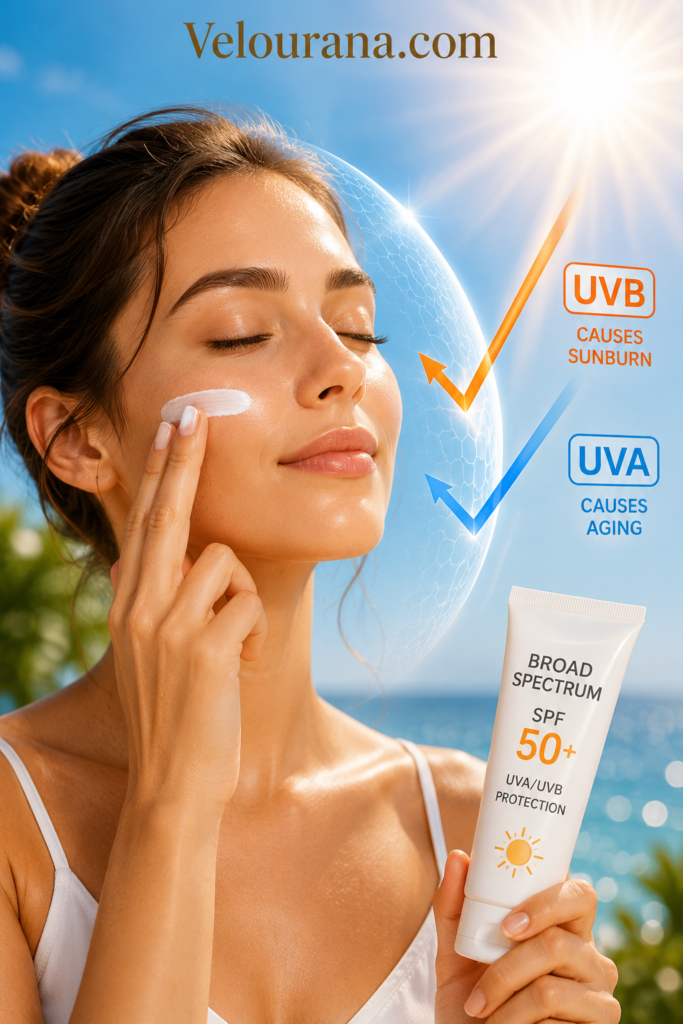
CATEGORY: Broad-Spectrum Protection
Sunscreen packaging can be surprisingly difficult to read.
One product displays SPF 30 in enormous numbers. Another highlights SPF 50+. A third uses a UVA symbol, another shows PA++++, and another simply says broad spectrum. Some bottles emphasize water resistance, some focus on invisible finish, and some are covered in claims about antioxidants, hydration, pollution defense, or sensitive skin.
All of these details can make sunscreen appear more complicated than it really is.
The key is to separate the protection information from the marketing language.
A sunscreen label should help you answer a few important questions:
How well does the product protect against UVB?
Does it also provide meaningful UVA protection?
Is it suitable for water exposure or heavy perspiration?
How should it be applied and reapplied?
Is the product still within its usable shelf life?
Once these questions become familiar, sunscreen shopping becomes much easier.
Start With the SPF Number
SPF stands for Sun Protection Factor.
It primarily reflects protection against UVB-associated sunburn under standardized testing conditions.
The SPF number is therefore important, but it does not tell you everything about the product.
It should be read together with information about UVA or broad-spectrum protection.
SPF Is Not a Timer
One of the most common sunscreen myths is that SPF tells you exactly how many minutes you can stay in the sun.
It does not.
Actual UV exposure changes throughout the day.
Application quantity varies.
Swimming, perspiration, towel drying, clothing, touching the face, and many other factors affect real-world protection.
SPF should therefore be understood as a tested protection factor rather than a countdown clock.
What SPF 15 Tells You
SPF 15 provides a certain tested level of UVB protection when applied under standardized conditions.
However, many dermatology and public-health recommendations favor higher SPF values for routine outdoor protection.
The appropriate choice depends on the regulatory guidance and circumstances in your region.
What SPF 30 Tells You
SPF 30 provides a high level of UVB protection when applied adequately.
It is commonly recommended as a practical minimum for everyday sun protection in many guidelines.
However, SPF 30 still needs to be applied correctly and reapplied appropriately.
A good SPF number cannot compensate for very thin or uneven application.
What SPF 50 Tells You
SPF 50 provides greater tested UVB protection than SPF 30.
The numerical difference should not be interpreted as meaning that SPF 50 allows someone to remain in the sun nearly twice as long.
The purpose of higher SPF is stronger UVB protection, not permission for longer exposure.
What SPF 50+ Means
Some markets use SPF 50+ for sunscreens exceeding a certain tested threshold.
The exact criteria depend on local regulation.
This label communicates a very high level of UVB protection, but it still does not mean complete UV blocking.
No sunscreen provides absolute protection.
Broad Spectrum Is the Next Thing to Check
Once you have identified the SPF, look for information about UVA coverage.
This may appear as the words broad spectrum or through another regulated labeling system.
The exact format varies by country.
The goal is the same: confirming that the sunscreen addresses both UVA and UVB.
Why Broad Spectrum Matters
UVB is strongly associated with sunburn.
UVA penetrates more deeply and contributes substantially to photoaging and cumulative skin damage.
Both types of radiation matter.
A sunscreen strategy that focuses only on UVB would therefore be incomplete.
Broad Spectrum and SPF Should Be Read Together
Think of the SPF value and broad-spectrum claim as two parts of the same protection story.
SPF tells you primarily about UVB.
Broad-spectrum or UVA labeling tells you that UVA has also been addressed.
The ideal sunscreen should provide an appropriate level of both.
The UVA Circle Symbol
In European sunscreen labeling, you may see the letters UVA inside a circle.
This symbol indicates that the product meets the applicable standard relating UVA protection to the sunscreen's SPF.
It is a useful sign to look for alongside the SPF number.
PA Ratings
Many Asian sunscreens use the PA system to communicate UVA protection.
You may see PA+, PA++, PA+++, or PA++++.
A greater number of plus signs generally indicates a higher tested level of UVA protection under that system.
This information complements the SPF number rather than replacing it.
Different Labels Do Not Necessarily Mean Different Quality
A European sunscreen may display a UVA circle.
A Japanese or Korean sunscreen may use PA++++.
A product in another market may simply state broad spectrum.
These differences often reflect local regulatory systems rather than fundamental differences in whether UVA protection exists.
Learn the labeling system used where the product is sold.
Look for Water Resistance
If you plan to swim, exercise, or perspire heavily, water resistance becomes important.
Water-resistant sunscreen has been tested to maintain specified protection during defined water exposure.
The packaging should indicate the relevant duration or claim according to local standards.
Water Resistant Does Not Mean Waterproof
No sunscreen should be assumed to stay completely unchanged after swimming.
Water resistance is limited.
Reapplication is still required according to the product directions.
This is especially important after swimming and towel drying.
Check the Reapplication Instructions
The sunscreen label should explain when to reapply.
Common situations include prolonged outdoor exposure, swimming, sweating, and towel drying.
Follow the actual product instructions rather than relying on a single universal rule for every sunscreen.
Check When to Apply Before Exposure
Some sunscreen labels instruct users to apply a certain amount of time before sun exposure.
Others provide different wording.
Follow the manufacturer's directions.
Protection works best when application is planned before exposure rather than after the skin has already spent significant time in sunlight.
Read the Intended Use
Some sunscreens are specifically intended for the face.
Others are body products.
Some are formulated for sports or water activities.
Some are designed for children.
Some are tinted.
Some combine sunscreen with moisturizer or makeup.
The intended use can help determine whether the texture and packaging suit your needs.
Face Sunscreen Labels
Facial sunscreens often emphasize cosmetic features.
You may see claims such as matte finish, invisible finish, glow, hydration, oil control, primer effect, or makeup-friendly texture.
These qualities can make a product more enjoyable to use.
However, they are secondary to the protection information.
Start with SPF and UVA protection first.
Body Sunscreen Labels
Body sunscreens may focus more heavily on water resistance, family use, easy spreading, or larger packaging.
Again, check the protection information first.
A beautiful scent or pleasant texture does not matter if the sunscreen does not provide the level of protection you need.
What Does "Invisible" Mean?
Invisible usually refers to cosmetic appearance.
The product may be designed to minimize white residue or visible cast.
This can be especially important for deeper skin tones.
It does not mean the sunscreen is physically absent or that less product should be applied.
What Does "Non-Greasy" Mean?
Non-greasy is a texture claim.
It may make the sunscreen more comfortable for oily skin or hot weather.
However, there is no universal definition of exactly how non-greasy a product will feel.
Personal experience matters.
What Does "Matte" Mean?
A matte sunscreen is designed to reduce shine or leave a less glossy finish.
This can be attractive for oily or combination skin.
Do not apply a smaller quantity simply to preserve the matte effect.
Adequate coverage remains essential.
What Does "Hydrating" Mean?
Hydrating sunscreen may contain humectants or moisturizing ingredients.
For some skin types, it can replace a separate daytime moisturizer.
For others, additional moisturizer may still be needed.
Hydration claims do not alter the sunscreen's primary role as UV protection.
What Does "For Sensitive Skin" Mean?
Sensitive-skin claims vary by manufacturer and market.
The product may exclude certain fragrances or use a formulation designed to reduce common sources of irritation.
However, individual sensitivity is highly personal.
Read the ingredient list if you know that particular ingredients cause problems.
What Does "Dermatologically Tested" Mean?
This phrase can sound very reassuring, but it does not provide detailed information by itself about how a product will behave on every individual.
It generally indicates that some form of dermatological testing has been performed.
The exact methodology may vary.
It should not replace personal tolerance or medical advice when significant skin conditions are present.
What Does "Hypoallergenic" Mean?
Hypoallergenic generally suggests that a product is formulated with the intention of reducing allergy risk.
It does not guarantee that no individual can react.
People with known allergies should still inspect ingredients carefully.
Fragrance-Free Versus Unscented
Fragrance-free usually indicates that added fragrance materials are absent.
Unscented may sometimes mean that the product has little noticeable odor, but this does not always mean no fragrance-related ingredients are present.
If fragrance matters to you, check the label and ingredient list carefully.
Mineral Sunscreen Labels
Mineral sunscreens typically use zinc oxide, titanium dioxide, or both as UV filters.
The package may also describe the product as mineral or physical sunscreen.
The important question remains whether the final formulation provides appropriate broad-spectrum protection.
Chemical Sunscreen Labels
Products using organic UV filters may sometimes be described as chemical sunscreens.
The word chemical can sound alarming, but it is simply a common consumer description for a category of UV filters.
Different filters absorb different wavelengths.
Formulators combine them to create the required protection profile.
Hybrid Sunscreens
Hybrid formulations combine mineral and organic UV filters.
They may offer a balance of cosmetic feel and protection characteristics.
Again, evaluate the final tested product rather than focusing only on the filter category.
Check the Active Ingredients Where Applicable
Some markets list sunscreen UV filters separately as active ingredients.
This can help consumers identify the protective agents in the formula.
In other regulatory systems, ingredient labeling may follow a different format.
You do not need to become a cosmetic chemist to choose sunscreen.
The tested broad-spectrum claim is more useful than trying to calculate protection from individual filter names.
Filter Names Can Vary
The same or similar filters may be known by different names depending on region and labeling convention.
This can make online sunscreen discussions confusing.
Consumers should avoid assuming that unfamiliar terminology automatically means a product is inferior.
The Formula Matters More Than One Filter
A sunscreen is not simply a list of UV filters.
Film formation, stability, concentration, texture, interactions between ingredients, and overall formulation affect performance.
The final tested product is what matters.
Do Not Judge Protection by Texture
A very lightweight fluid may provide excellent protection.
A thick cream may also provide excellent protection.
Texture tells you how a product feels.
It does not directly tell you how protective it is.
Do Not Judge Protection by Price
Expensive sunscreen is not automatically more protective.
Lower-priced sunscreen is not automatically inferior.
Protection is determined by formulation and testing.
Price may reflect branding, packaging, texture, fragrance, distribution, or other factors.
Do Not Judge Protection by Packaging Color
Blue packaging, yellow packaging, medical-looking packaging, luxury packaging, and minimalist packaging are all marketing choices.
The label information matters more.
Expiration Date
Check whether the sunscreen includes an expiration date.
Sunscreen should be used within its intended shelf life.
A product stored for years should not automatically be assumed to perform exactly as when new.
Period After Opening
Many cosmetics show a small open-jar symbol with a number such as 12M or 24M.
This indicates the recommended period of use after opening.
Sunscreen should be treated carefully because its protective function depends on formulation stability.
Storage Instructions
Read storage guidance.
Extreme heat can be a concern for cosmetic formulations.
Avoid unnecessarily leaving sunscreen in very hot locations for prolonged periods.
A parked car in summer can become particularly hot.
Batch or Lot Information
Legitimate cosmetic products often include batch or lot information.
This supports manufacturing traceability.
It can also be useful if a product recall or quality issue arises.
Buy From Reliable Sources
A perfect-looking label is meaningless if the product is counterfeit.
Purchase sunscreen from trustworthy retailers and authorized suppliers where possible.
This is especially important when buying premium or imported sunscreens online.
Counterfeit Sunscreen Is More Than a Cosmetic Problem
A fake moisturizer may be disappointing.
A fake sunscreen can create false confidence about UV protection.
Because protection cannot be judged by appearance, authenticity matters enormously.
Check Language and Regulatory Information
Imported sunscreen may include labels or stickers required for sale in a particular region.
Be cautious when packaging contains obvious inconsistencies, poor-quality printing, missing required information, or suspicious claims.
These signs do not prove counterfeiting, but they deserve attention.
Very Extreme Claims Deserve Skepticism
Claims such as total sun protection, permanent protection, waterproof forever, or complete UV blocking should be treated cautiously.
No sunscreen creates absolute protection under all conditions.
Responsible labels reflect real limitations.
What "Reef Safe" Means
Reef-safe or reef-friendly claims appear on some sunscreen packaging.
These terms are not always standardized uniformly across markets.
Consumers interested in environmental considerations should look beyond a simple marketing phrase and investigate the specific formulation and relevant local regulations.
What "Ocean Friendly" Means
Ocean-friendly claims are similarly broad.
The term can represent different environmental initiatives or ingredient choices.
It does not communicate SPF or UVA performance.
Treat it as a separate consideration from sun protection.
What "Antioxidant Protection" Means
Some sunscreens contain antioxidants or botanical ingredients.
These may complement the cosmetic formulation.
They do not replace UV filters.
Broad-spectrum protection must still come from the sunscreen's tested UV-protective system.
What "Pollution Protection" Means
Anti-pollution claims have become common in skincare.
These may relate to film-forming ingredients, antioxidants, or other formulation features.
Again, they are additional claims.
They should not distract from SPF and UVA protection.
What "Blue Light Protection" Means
Some sunscreens and tinted products make claims related to visible light or blue light.
This can be relevant for certain pigmentation concerns and specific formulations.
However, it is a separate issue from standard UVA and UVB protection.
Start with broad-spectrum UV protection before evaluating additional claims.
Tinted Sunscreen
Tinted sunscreens contain pigments that can reduce visible white cast and provide cosmetic coverage.
Iron oxides in some tinted formulations may also be relevant to visible-light protection, particularly for pigmentation concerns.
The sunscreen should still provide appropriate UV protection.
Foundation With SPF
Foundation can display an SPF number.
This does not automatically mean it should replace sunscreen.
People often apply foundation in much smaller quantities than the amount required to achieve the labeled SPF.
Use dedicated sunscreen beneath makeup when appropriate.
BB Cream and CC Cream With SPF
These products can provide multiple cosmetic functions.
If they are used as the sole sunscreen, adequate quantity and broad-spectrum protection become important.
In practice, many users apply them thinly for appearance rather than thickly enough for reliable protection.
Moisturizer With SPF
A moisturizer with appropriate tested broad-spectrum SPF can function as sunscreen when applied in sufficient quantity.
The key is the tested protection and application amount, not whether the package calls the product a moisturizer.
Day Cream With SPF
The same principle applies to day creams.
Check the SPF.
Check UVA or broad-spectrum protection.
Use an adequate amount.
The product category matters less than its tested protection.
Sunscreen for Children
Children's sunscreen labels may use different marketing language or formulations.
Protection needs also vary with age.
Parents should follow pediatric and public-health recommendations appropriate to the child's age and circumstances.
Shade, clothing, and hats are especially important.
Sunscreen for Babies
Very young babies require particular sun-protection strategies.
Direct sun avoidance, shade, and protective clothing often play a central role.
Parents should follow pediatric guidance rather than assuming that ordinary adult sunscreen practices apply identically to infants.
Sport Sunscreen
Sport sunscreen usually emphasizes water resistance, sweat resistance, or durability.
These features can be useful during outdoor exercise.
However, reapplication is still necessary according to instructions.
Beach Sunscreen
A product marketed for the beach may emphasize water resistance and large-format application.
The word beach itself does not provide protection.
Check the actual SPF, broad-spectrum information, and water-resistance claim.
Everyday Sunscreen
Daily facial sunscreen often prioritizes cosmetic elegance.
These products may have lighter textures and work well under makeup.
They can still provide high protection if properly formulated and applied.
Read the Application Directions
This may be the most ignored part of the package.
Many consumers spend considerable time comparing ingredients but never read how the sunscreen should actually be used.
Application directions are fundamental to achieving the labeled protection.
Apply Enough Product
Inadequate quantity is one of the most common real-world sunscreen problems.
If the label provides specific guidance, follow it.
Ensure all exposed areas receive complete coverage.
Apply Evenly
An adequate total amount can still perform poorly if distributed unevenly.
Pay attention to the hairline, sides of the face, jaw, ears, and neck.
Reapply When Directed
The label may specify reapplication intervals and conditions.
Follow them.
Do not assume that a single application in the morning remains perfect after an entire active day.
Read the Water-Resistance Duration
Some products specify a duration such as 40 or 80 minutes under relevant testing systems.
That does not mean protection suddenly disappears at exactly that moment.
It means the product has been tested according to defined conditions.
Follow the instructions for reapplication.
After Swimming
Reapply according to directions.
Do not assume water resistance eliminates this requirement.
After Sweating
Heavy perspiration can affect sunscreen coverage.
Outdoor exercise may require more frequent attention.
After Towel Drying
Towels physically remove sunscreen.
Reapply after drying if continued exposure is expected.
After Washing Hands
Sunscreen on the hands may be removed during hand washing.
If you remain outdoors, reapply as appropriate.
Pay Attention to Exposure Time
The label does not replace common sense.
If you plan to spend hours outside during high UV conditions, combine sunscreen with shade and clothing.
Protection is stronger when multiple strategies work together.
The UV Index Is Useful Context
The sunscreen label tells you about the product.
The UV Index tells you about environmental UV conditions.
Using both pieces of information can improve sun-protection decisions.
Sunscreen Should Be One Part of a Broader Strategy
Use shade.
Wear protective clothing.
Use a broad-brimmed hat.
Wear UV-protective sunglasses.
Limit unnecessary exposure during intense UV conditions.
Sunscreen protects exposed areas that cannot or will not be covered.
Do Not Assume SPF 100 Means Total Protection
Very high SPF can provide very high UVB protection.
It still does not block every UV photon.
It also does not eliminate UVA concerns unless broad-spectrum protection is present.
The basic rules of application and reapplication remain.
High SPF Can Be Useful
The fact that no sunscreen is perfect does not mean high SPF is pointless.
Higher SPF can provide additional UVB protection and may help compensate somewhat for imperfect real-world application.
The key is to avoid interpreting higher numbers as permission for unlimited exposure.
Broad-Spectrum Protection Should Be Non-Negotiable
A sunscreen with high SPF but inadequate UVA protection does not provide the balanced protection most people should seek.
Look for both.
This becomes easy once you know where to look on the label.
A Simple Sunscreen Label Checklist
First, identify SPF.
Second, confirm broad-spectrum or UVA protection.
Third, check water resistance if your activity requires it.
Fourth, read application and reapplication directions.
Fifth, check expiration and storage information.
These five steps cover most practical sunscreen decisions.
Do Not Get Distracted by Twenty Marketing Claims
Brands may compete by adding increasingly elaborate language to sunscreen packaging.
Hydrating.
Brightening.
Mattifying.
Anti-pollution.
Antioxidant.
Invisible.
Primer.
Glow.
Sensitive.
All of these may be useful.
None should distract from the core protection information.
Choose Texture After Protection
Once you have confirmed suitable broad-spectrum protection, then compare texture.
If your skin is oily, choose something lightweight.
If your skin is dry, choose something moisturizing.
If white cast is a concern, consider transparent or tinted options.
If your eyes are sensitive, look for a formulation you tolerate well.
The Best Label Is the One You Understand
A sunscreen does not need complicated terminology to be good.
A straightforward label that clearly communicates SPF, UVA protection, water resistance, and usage instructions may be more useful than packaging covered in scientific-sounding claims.
Read the Back as Carefully as the Front
The front of the bottle is designed to sell the product.
The back is often where the useful instructions live.
Take the extra minute to read it.
Keep Sunscreen Education Practical
You do not need to memorize every UV filter.
You do not need to become an expert in photochemistry.
You do not need to compare fifty sunscreens every morning.
You need to understand the basic protection information and use the product correctly.
Broad Spectrum Is the Essential Phrase
Among all the claims on sunscreen packaging, broad-spectrum protection deserves special attention.
It tells you that UVA has been considered alongside UVB.
That transforms sunscreen from simple burn prevention into more complete ultraviolet protection.
SPF and Broad Spectrum Work Together
SPF without UVA information is incomplete.
UVA information without an appropriate SPF is also incomplete.
The two belong together.
Read Before You Buy
Before placing sunscreen in your basket, spend a few seconds with the label.
Is the SPF suitable?
Is UVA protection clearly communicated?
Does the water-resistance level match your activity?
Can you tolerate the texture?
Are the usage instructions practical for you?
These questions are more valuable than choosing based on packaging alone.
Read Again Before You Use
Once the sunscreen is home, read the application instructions.
Knowing how the product should be applied is just as important as knowing which one to buy.
The Final Goal Is Correct Use
The perfect label is meaningless if the sunscreen is applied too thinly.
The best filters are useless if the product is left at home.
Excellent UVA protection does little if the face is covered but the shoulders are forgotten.
Sun protection succeeds through correct and consistent use.
Broad-Spectrum Label Reading Made Simple
Sunscreen packaging becomes much less confusing once you know what matters.
Find the SPF.
Confirm UVA or broad-spectrum protection.
Check whether water resistance is necessary.
Read application and reapplication guidance.
Check storage and expiration information.
Then choose the texture and cosmetic finish you enjoy.
Everything else is secondary.
A sunscreen label should help you understand protection, not intimidate you with terminology. Once the distinction between SPF and UVA coverage becomes familiar, choosing a broad-spectrum product becomes one of the simplest decisions in a skincare routine.
Protection does not need to be complicated.
It needs to be understood, applied correctly, and used consistently.
The End
Velourana.
 Discover More From Our Family of Websites
 ZodiacBearing (Astrology, Tarot, Numerology, Angel Numbers & Spiritual Guidance)
 Velourana (Beauty, Makeup, Hair Care, Skincare & Beauty Tips)
 HavenBearing (Home, Living, Organization, Décor & Everyday Inspiration)
 PawBearing (Pet Care, Dog Breeds, Animal Health, Training & Pet Products)
 PsyCatherine (Notes From the Journal of a Psychologist on Real Life)

