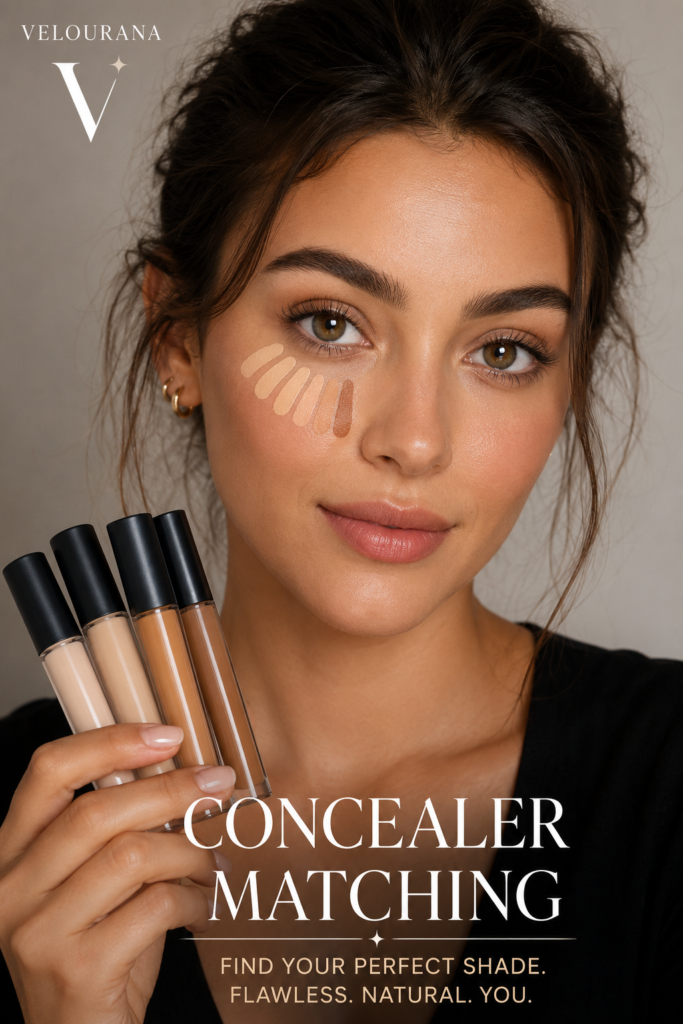
CATEGORY: Concealer Matching
Foundation and concealer are often purchased as though they were separate products, but once they are worn together they become part of the same color system.
This is why a concealer can look perfect on bare skin and still appear wrong after foundation is applied.
The foundation may slightly warm the complexion.
It may neutralize redness.
It may deepen the face.
It may make the skin look more golden, more neutral or more even.
The concealer then sits on top of that altered base rather than directly beside untreated skin.
If the two products are not coordinated, the result can become visibly divided.
The under-eye area may look too pale.
Blemishes may appear as small dots.
The center of the face may become much lighter than the perimeter.
A concealer with a different undertone may create yellow, pink or orange patches even though each product looked acceptable individually.
Successful concealer matching therefore requires more than finding a concealer that resembles your natural complexion.
You also need to consider the foundation you wear with it.
The goal is not necessarily for both products to be identical.
The goal is for them to communicate visually.
Foundation Creates the Color Environment
Once foundation is applied, it changes the color environment surrounding the concealer.
This may be subtle.
A foundation that is a very accurate match might alter almost nothing.
But even small differences become important with highly pigmented concealer.
Suppose your natural skin is neutral-golden.
You wear a foundation that is slightly more golden because it balances facial redness.
Your concealer may be an exact match to your bare skin.
When placed over the foundation, however, it now looks a little cooler.
The concealer did not change.
The context changed.
This is why matching complexion products should be done with the full makeup routine in mind.
Your Concealer Does Not Have to Match Your Foundation Exactly
This is one of the most important points.
Concealer and foundation can coordinate without being identical.
A spot concealer usually needs to be very close to the surrounding foundation shade because its job is camouflage.
An under-eye concealer may intentionally be slightly lighter.
A corrective concealer may contain more peach or warmth.
A highlighting concealer may be brighter still.
These differences can all work beautifully if the transitions are controlled.
Problems arise when the difference is accidental rather than intentional.
Decide the Role of Each Concealer Shade
Before matching concealer to foundation, define the role.
Are you covering blemishes?
Brightening beneath the eyes?
Concealing pigmentation?
Correcting discoloration?
Highlighting the center of the face?
Each role requires a different relationship with foundation.
For blemishes, closeness is important.
For the under-eye area, slight brightness may be desirable.
For color correction, undertone may deliberately differ.
For highlighting, contrast is part of the technique.
Once the purpose is clear, matching becomes much more logical.
Spot Concealer Should Usually Follow the Foundation
If you wear foundation first, the surrounding base becomes the color your spot concealer needs to match.
This is especially true with medium or full-coverage foundation.
The foundation has already created a more uniform complexion.
A blemish concealer that matches bare skin but not the foundation may become visible.
Apply your normal foundation.
Let it settle.
Then test concealer directly on top.
A good spot match should disappear into the base with minimal blending.
Foundation First Can Reduce the Amount of Concealer Needed
Another advantage of applying foundation before spot concealer is that the foundation may already cover much of the discoloration.
Instead of placing heavy concealer over every blemish before knowing how much coverage is necessary, you can see what remains after foundation.
This often reduces product usage.
Less concealer generally means fewer visible texture differences and a lower chance of creating obvious patches.
Under-Eye Concealer Can Be Slightly Lighter
The under-eye area is one of the few places where a controlled difference in depth is often intentional.
A concealer slightly lighter than foundation can create brightness.
The key is proportionality.
The brighter shade should still belong to the same overall complexion.
If the difference becomes too large, the under-eye area can look disconnected.
Instead of appearing rested, the face may look divided into pale under-eyes and deeper cheeks.
Natural-looking brightness usually comes from a modest shift.
Undertone Should Remain Compatible
A lighter concealer is not automatically a good brightening shade.
It also needs an undertone that works with the foundation.
Suppose your foundation is medium neutral-olive.
You choose a lighter concealer that is strongly peach.
The depth may be appropriate for brightening, but the undertone can create obvious orange contrast.
Similarly, a golden foundation paired with a cool-pink concealer may create a visible color change under the eyes.
When moving lighter, preserve undertone compatibility as much as possible.
Same Depth, Different Undertone Can Look More Wrong Than Different Depth
People often focus on brightness differences while ignoring undertone.
But a concealer that is only slightly lighter with the correct undertone can look very harmonious.
A concealer at exactly the same depth with the wrong undertone may look more obvious.
Color direction can matter as much as lightness.
Always evaluate whether the product becomes yellow, orange, pink or gray relative to the foundation.
Foundation Can Hide Your Natural Undertone
A foundation that is not a perfect undertone match can complicate concealer selection.
Perhaps you wear a foundation that is slightly warmer than your natural skin because you prefer the appearance.
The concealer then needs to work with the chosen foundation rather than an abstract idea of your undertone.
This does not mean you should deliberately buy the wrong concealer.
It means complexion products should be evaluated together.
If your foundation changes the visible base, your concealer needs to coordinate with the finished effect.
If Foundation Is Too Warm, Concealer May Look Pink
A neutral concealer can appear pink beside a foundation that is strongly golden or orange.
This does not necessarily mean the concealer is too cool.
The foundation may be creating the contrast.
Before replacing the concealer, compare both products with your bare neck and jaw.
It is possible that the foundation itself is the less accurate match.
If Foundation Is Too Cool, Concealer May Look Yellow
The opposite can happen.
A golden-neutral concealer may look unusually yellow beside a cool or rosy foundation.
Again, the concealer may be correct relative to your natural skin while the foundation creates the mismatch.
The solution should target the actual source of the color conflict.
Foundation Oxidation Can Change the Relationship
Foundation may darken or warm after application.
If concealer remains stable while foundation changes, the two products can drift apart during wear.
A concealer that looked perfect at 8 a.m. may look lighter by midday because the surrounding foundation has deepened.
This is another reason to test complexion products after dry-down rather than only when fresh.
Concealer Oxidation Can Create the Reverse Problem
The concealer may be the product that changes.
A spot concealer can begin as an exact match and later become darker or warmer than the foundation.
The result is a visible patch.
If this happens consistently, choose based on the dried shade or use a more stable formula.
Matching Both Products After They Set
The most useful comparison is not foundation versus fresh concealer.
It is settled foundation versus settled concealer.
Apply both as you normally would.
Wait until they reach their typical finish.
Then compare.
This is the color relationship you will actually wear.
Same-Brand Foundation and Concealer Can Simplify Matching
Using complexion products from the same brand can sometimes make matching easier because the company may design undertone families to coordinate.
A foundation labeled medium neutral and a concealer from the corresponding neutral range may be logical starting points.
Some brands also provide direct shade-pairing recommendations.
These can be useful.
However, same-brand products are not automatically perfect matches.
Different formulas may use slightly different pigments or shade structures.
Always test the actual products.
Cross-Brand Matching Requires More Attention
When foundation and concealer come from different brands, undertone terminology can become confusing.
One company’s neutral may be another company’s warm-neutral.
A shade described as golden may look peachier than expected.
Use the foundation as a visual reference rather than relying only on words.
Compare actual swatches whenever possible.
Your Foundation Shade Is a Better Reference Than Your Shade Name
Suppose your foundation shade is called “Sand.”
The word itself tells you very little.
Another brand may use “Sand” for a completely different depth and undertone.
What matters is the actual color.
Use shade names as labels, not as universal descriptions.
Match Concealer to the Finished Base for Blemishes
This principle is worth repeating because it solves many spot-concealing problems.
If you wear foundation, apply it.
Let it settle.
Then choose the concealer that disappears into that finished base.
Do not insist on matching the concealer to untreated skin if the untreated skin will not be visible in the final look.
Concealer-Only Days Need a Different Match
If you sometimes wear foundation and sometimes wear only concealer, one shade may behave differently across those situations.
A spot concealer matched to foundation may look slightly wrong against bare skin if the foundation changes your complexion noticeably.
This is where a very accurate skin match becomes useful.
Alternatively, a flexible medium-coverage concealer may adapt more easily than a highly opaque formula.
Full-Coverage Foundation Requires Precision
The more uniform the foundation, the more obvious an incorrect concealer can become.
A full-coverage foundation creates a consistent color field.
Any yellow, pink, orange or pale patch stands out.
This makes undertone and depth accuracy especially important.
Sheer Foundation Allows More Natural Variation
A sheer foundation lets more natural skin show through.
This can make minor concealer differences slightly more forgiving.
However, it also means spot concealer is sitting next to a more varied complexion.
For very precise camouflage, the concealer still needs to work with both the foundation tint and the skin underneath.
No Foundation Can Be the Hardest Match of All
Concealer worn alone is directly adjacent to bare skin.
There is no base to blend the transition.
For this reason, a true skin match is critical for blemishes and dark spots.
Under-eye concealer can still be slightly brighter, but the transition needs to remain subtle.
Brightening Should Be Evaluated Across the Whole Face
A lighter concealer may look attractive when viewed only beneath the eye.
Step back.
Look at the entire face.
Does the center of the face now look much lighter than the perimeter?
Does the under-eye brightness make the forehead or jaw appear unusually deep?
Does the foundation still look balanced?
A good concealer match should enhance facial harmony rather than create isolated zones.
The Classic Bright Triangle Can Create Strong Contrast
Applying a large triangle of very light concealer beneath each eye became popular in high-coverage makeup techniques.
This can create a dramatic lifted effect.
It can also produce a visibly two-tone complexion when the shade difference is significant.
There is nothing inherently wrong with that if the result is intentional.
But for natural makeup, a smaller amount of slightly lighter concealer is often more seamless.
Strategic Placement Requires Less Shade Contrast
You do not need an extremely light shade to create brightness if you place it precisely.
A small amount near the inner corner can lift a shadowed area.
A touch along the deepest tear trough can reduce visual depth.
A small highlight at the outer corner can change facial balance.
Strategic placement can achieve brightness while keeping the concealer closer to foundation depth.
Color Correction Can Reduce the Need for Lighter Concealer
If dark circles remain visible, many people respond by choosing increasingly pale concealer.
The actual problem may be underlying color.
A suitable peach, salmon, orange or other corrective tone can neutralize discoloration first.
The final concealer can then stay closer to foundation depth and still look bright.
This often produces a more natural result.
Foundation Can Also Provide Some Color Correction
Certain foundations have enough coverage and undertone balance to reduce redness or pigmentation before concealer is applied.
If your foundation already neutralizes much of the problem, additional correction may be unnecessary.
Evaluate what remains visible after foundation before adding extra layers.
Corrector, Foundation and Concealer Form a Three-Layer Color System
When all three are used, their colors interact.
The corrector changes the discoloration.
Foundation changes the overall complexion.
Concealer adds targeted coverage or brightness.
Using too much of any one layer can alter the final color.
A strong orange corrector may show through neutral concealer.
A very warm foundation can shift the appearance of both products.
Think of the layers together.
Applying Concealer Before Foundation Changes the Match
Some people prefer concealer first.
This can work, especially with color correction.
However, foundation placed over concealer can modify its appearance.
A bright concealer may become more subtle.
A corrector may become better integrated.
The final match should therefore be judged after both products are applied, regardless of order.
Foundation Over Spot Concealer Can Soften an Imperfect Edge
Applying a small amount of foundation over the perimeter of spot concealer can help integrate the area.
This is useful when the shade is close but not perfectly invisible.
Avoid covering the center so heavily that the original discoloration reappears.
The goal is to unify the edges.
Concealer Over Foundation Preserves Maximum Coverage
Applying concealer last allows the product to retain more opacity.
This is useful for blemishes and pigmentation.
But because the concealer remains more visible, its shade needs to be especially accurate.
The more exposed the concealer pigment, the more important matching becomes.
Matte Foundation and Radiant Concealer Can Look Different Even When the Color Matches
Finish creates another form of contrast.
A radiant concealer can catch light and appear brighter than a matte foundation.
This may be desirable under the eyes.
Over blemishes, however, a shiny patch can emphasize texture.
A matte concealer on very luminous foundation can create the opposite problem.
Color harmony includes finish as well as pigment.
Matching Finish for Spot Concealing
For blemishes, try to keep the finish reasonably close to the surrounding base.
If the foundation is natural-matte, a similarly balanced concealer may disappear more easily.
If the foundation is luminous, an ultra-dry concealer can create a visible patch.
Powder can help modify finish, but beginning with compatible textures makes the process easier.
Under-Eye Finish Can Intentionally Differ
The under-eye area often benefits from slightly more radiance than the rest of the face.
A luminous concealer can reflect light and create brightness without requiring a dramatically lighter shade.
This can be especially useful when you want natural illumination.
Powder Can Alter the Foundation-Concealer Relationship
Setting products introduce another color layer.
A yellow powder can warm concealer.
A brightening powder can lighten the under-eye area.
A translucent powder can sometimes appear pale on deeper skin.
If foundation and concealer match beautifully before powder but look disconnected afterward, investigate the powder.
Bronzer Can Change How Bright Concealer Appears
After bronzer is applied, the outer face becomes deeper and warmer.
This can make the center-face concealer appear brighter by comparison.
A concealer that initially seemed subtle may suddenly look more dramatic.
This is another reason final makeup should be evaluated as a whole.
Contour Can Increase Contrast Too
Contour deepens selected areas.
If combined with bright concealer, the difference can become substantial.
This may be intentional in sculpted makeup.
For a natural look, keep both contour and brightening moderate.
Blush Can Help Reconnect the Complexion
Blush adds color across the transition between under-eye concealer and the outer face.
This can visually integrate complexion zones.
However, blush should not be used to hide a severe shade mismatch.
The foundation and concealer should already be reasonably harmonious.
The Center of the Face Is Naturally Often Lighter
Many faces are not uniform in depth.
The forehead, cheeks and jaw may differ slightly.
The center of the face can naturally appear lighter.
This means some concealer brightness can look believable because it follows existing facial variation.
The problem begins when the difference becomes so strong that it looks artificial rather than anatomical.
Match to Your Desired Finished Complexion
There is no rule that says foundation must exactly reproduce bare skin.
Some people deliberately choose a base that reduces redness or creates a slightly warmer appearance.
If that is your chosen finished complexion, concealer should work within it.
Makeup is evaluated by the final result.
The Neck Is Still an Important Reference
Even when foundation and concealer match each other, they should not create a face disconnected from the neck.
Look at the overall relationship.
If both complexion products are substantially too warm or too light, their internal coordination does not make the total result correct.
Harmony should extend beyond the face.
The Chest Can Help With Overall Balance
When the neck is significantly lighter or deeper than the chest, the upper chest can provide additional context.
You are not trying to make every area identical.
You are trying to avoid obvious discontinuity.
Foundation Shade Errors Can Be Mistaken for Concealer Errors
Suppose your under-eye concealer suddenly seems too pink.
You purchase a warmer one.
Now it looks orange.
The real issue might be that the foundation is overly yellow.
Always evaluate both products before repeatedly changing concealer.
Concealer Shade Errors Can Also Make Foundation Look Wrong
A very bright concealer can make correctly matched foundation appear too dark.
A strongly golden concealer can make neutral foundation appear cool.
Color perception is relational.
One incorrect product can make another correct product look wrong.
Compare Each Product to Bare Skin Separately
If you are troubleshooting, place a small foundation swatch beside bare skin.
Then place the concealer separately.
This reveals which product is creating the mismatch.
Testing only the combined look can make diagnosis difficult.
Then Compare Them Together
After checking them independently, wear them together.
A product can match skin individually yet still conflict with another product.
Both tests matter.
Fair Skin Needs Small Depth Differences
On fair skin, even modest brightening can look significant.
If foundation is already very light, there may be little room to move lighter before concealer becomes stark.
Use undertone and finish to create freshness instead of relying exclusively on lightness.
Medium Skin Can Support Controlled Brightness
Medium complexions often have more room for a subtle under-eye depth shift.
However, undertone remains critical.
A neutral foundation with an orange-bright concealer can look disconnected even when the brightness level is attractive.
Olive Skin Needs Undertone Continuity
Olive foundation paired with peach-heavy concealer frequently creates visible contrast.
If you want brightness, search for lighter olive, neutral-olive or muted neutral shades rather than abandoning the undertone family.
Deep Skin Should Preserve Richness
A very pale concealer can make deep foundation appear disproportionately dark.
This creates a mask-like center-face contrast.
A modestly lighter concealer with appropriate correction can provide brightness without losing the richness of the complexion.
Rich Skin Often Benefits From Correction Before Brightening
If under-eye darkness is pronounced, correcting it first allows the concealer to remain closer to foundation depth.
This can reduce grayness and preserve harmony.
Summer Foundation May Require Summer Concealer
If your foundation shade changes seasonally, concealer may need to change too.
A winter brightening shade can become excessively pale next to a summer foundation.
Keep seasonal relationships in mind.
Mixing Foundation Shades Can Affect Concealer Matching
If you routinely mix foundations to create a custom shade, use the finished mixture as your concealer reference.
Do not try to match concealer to one component of the blend.
Mixing Concealer Shades Can Create Better Coordination
Two concealers from the same formula can be mixed to create an exact relationship with foundation.
One can match depth.
Another can add brightness.
This is useful when the available range has a gap between shades.
Mixing a Spot Shade and Brightening Shade Gives Flexibility
A practical system is to own one concealer close to foundation depth and another slightly lighter.
Use the first on blemishes.
Use the second under the eyes.
Mix them when you want intermediate brightness.
This is often more versatile than trying to force one shade into every role.
Same Undertone, Different Depth Is Usually Easier to Manage
If possible, keep both shades within a similar undertone family.
For example, neutral-olive exact match and neutral-olive brightener.
This preserves color harmony while giving you depth flexibility.
If the Lighter Shade Changes Undertone, Test Carefully
Some ranges do not maintain undertone consistently as shades become lighter.
A light neutral may actually be peachier than the medium neutral.
Do not assume neighboring shade names guarantee undertone continuity.
Foundation Coverage Level Changes Concealer Strategy
With sheer foundation, concealer may perform much of the correction.
With full coverage, concealer may be needed only selectively.
The more work foundation already does, the less concealer you may need.
Heavy Concealer Can Make Even a Good Match Look Wrong
Thickness changes texture and opacity.
A perfectly matched concealer applied heavily can create a visible patch simply because the finish becomes different.
Use the minimum amount necessary.
Sheering Out a Slightly Bright Concealer Can Improve Harmony
If under-eye concealer is slightly brighter than desired, using less product can allow the foundation and natural skin underneath to influence the final color.
This may be enough to restore balance.
Do Not Spread Spot Concealer to Blend a Bad Shade
If spot concealer is visibly mismatched, blending it over a wider area does not truly solve the problem.
It simply creates a larger area of mismatched color.
Use a better shade.
Blend Boundaries, Not Entire Applications
For precise concealing, keep coverage where it is needed and soften only the edges.
This protects both coverage and color accuracy.
Concealer Matching Can Be More Important Than Foundation Matching in Small Areas
A minor foundation mismatch is distributed across the face.
A minor concealer mismatch can be concentrated into one small spot.
That concentration makes it more noticeable.
This is why blemish concealer often requires extremely careful matching.
Under-Eye Brightness Should Follow Facial Structure
A lighter concealer can look more natural when placed where light would naturally fall.
The inner eye, tear trough and high point of the cheek can all interact with brightness.
Applying the same pale color indiscriminately can flatten the face.
Highlighting the Entire Center Face Requires More Coordination
Some makeup styles use concealer on the forehead, nose, chin and under-eye area.
If the shade is significantly lighter than foundation, the center of the face can become a separate color zone.
For dramatic makeup this may be intentional.
For natural makeup, keep the contrast controlled.
Foundation and Concealer Should Be Checked in Daylight
Artificial lighting can hide undertone conflict.
A golden foundation and pink concealer may look acceptable under warm indoor light.
Natural daylight can reveal the separation immediately.
Always perform a daylight check when possible.
Check the Transition, Not Just Each Color
Look specifically at the border between concealer and foundation.
Does the edge disappear?
Can you see where one product ends and the other begins?
A seamless transition is one of the best indicators of compatibility.
Step Back From the Mirror
Close-up inspection can make tiny differences seem enormous.
Normal conversational distance reveals whether the overall complexion looks unified.
Use both perspectives.
Close-up shows technical blending.
Distance shows visual harmony.
Photography Can Reveal Two-Tone Makeup
Cameras sometimes make depth differences more obvious.
A bright under-eye may photograph much lighter than it looks in person.
Flash can amplify certain powders.
If photography matters, test your full foundation-concealer-powder combination under the relevant lighting.
But Cameras Can Also Distort the Match
Automatic exposure and filters can alter the apparent difference.
Do not let one photograph override what you consistently see in natural light.
Your Foundation May Change Throughout the Day
Oil, humidity and wear can make foundation look different after several hours.
If concealer and foundation separate in color later, evaluate which one changed.
The solution may involve formula compatibility rather than shade selection alone.
Longevity Is Part of Color Matching
A combination that matches perfectly for ten minutes but separates after two hours is not truly successful for your routine.
The best pairing remains visually harmonious during realistic wear.
Build a Foundation-Concealer Pairing Record
When you find a combination that works, write it down.
Record the exact foundation and concealer shades.
Note whether the concealer is for spots or under-eyes.
If you change foundation later, reassess the concealer rather than assuming the old pairing will remain perfect.
A New Foundation Can Make an Old Concealer Suddenly Look Wrong
This is common.
The concealer has not changed.
The surrounding color has.
Whenever you switch foundation undertone or depth, re-evaluate your concealer collection.
A New Concealer Can Make You Question a Good Foundation
The opposite happens too.
If your trusted foundation suddenly seems too yellow after introducing a cool concealer, compare both independently before changing the foundation.
Do Not Match by Brand Marketing Alone
A brand may describe a concealer as the ideal companion to a foundation.
That does not mean every shade pairing will work for every person.
Use the recommendation as a starting point.
The Best Pairing Depends on Your Makeup Style
Natural makeup requires closer integration.
Glamorous high-contrast makeup permits larger depth differences.
Editorial makeup may deliberately use extreme contrast.
There is no single correct foundation-concealer relationship independent of style.
The important point is intentionality.
Natural Makeup Favors Small Differences
If your goal is skin that looks naturally even, keep spot concealer close to foundation depth and under-eye concealer only slightly brighter.
Use correction where necessary rather than extreme lightness.
Dramatic Makeup Can Use Larger Differences
If you deliberately want a sculpted, highlighted complexion, a brighter concealer can be part of the design.
Still, undertone harmony remains important.
Strong contrast looks more polished when the color families coordinate.
Foundation Matching and Concealer Matching Should Not Be Separate Shopping Decisions
When purchasing a new foundation, consider whether your existing concealers will work with it.
When purchasing a concealer, consider the foundation you normally wear.
This prevents accumulating products that are individually attractive but incompatible together.
The Ideal Pair Looks Intentional at Every Distance
Close up, the textures should blend.
At normal distance, the complexion should look balanced.
In daylight, the undertones should remain harmonious.
After several hours, the depth relationship should still make sense.
This is the standard for a successful foundation-concealer pairing.
A Simple Matching Method
Apply your foundation as usual.
Allow it to settle.
Use your exact-match concealer on one blemish or facial area.
The edge should disappear.
Apply your proposed under-eye concealer beneath one eye.
Step back.
If it brightens without creating a pale stripe, the depth relationship is likely appropriate.
Then check undertone.
Does the concealer look yellow, orange, pink or gray beside the foundation?
If not, the color relationship is working.
Your Foundation Is the Background, Concealer Is the Detail
This is a useful way to think about complexion makeup.
Foundation establishes the broad color field.
Concealer adds targeted detail.
The detail should either blend into the background or intentionally modify it.
When that relationship is understood, shade matching becomes much easier.
Avoid the Two-Tone Trap
The two-tone complexion usually appears when foundation and concealer are matched independently without considering their final relationship.
The foundation sits at one depth and undertone.
The concealer creates another.
The face becomes divided.
Avoiding this does not require identical products.
It requires coordinated ones.
Match spot concealer closely to your finished base.
Use under-eye brightness sparingly and deliberately.
Preserve undertone harmony.
Consider color correction before reaching for a dramatically lighter shade.
Check both products after dry-down.
Evaluate them with your normal powder, bronzer and blush.
And always judge the full face, not only the area where the concealer was applied.
The Goal Is Continuity
The most beautiful foundation and concealer combinations create continuity.
You may see brightness.
You may see dimension.
You may see a more even complexion.
But you should not see separate blocks of color competing with one another.
A blemish should disappear into the foundation.
An under-eye highlight should flow into the cheek.
The center of the face should remain related to the perimeter.
The neck should still belong to the same person.
That continuity is what makes complexion makeup look polished.
Foundation does not need to erase every variation.
Concealer does not need to be identical to foundation.
They simply need to work together.
When depth, undertone, coverage and finish are coordinated, the products stop looking like separate layers and begin to look like one coherent complexion.
The End
Velourana
 Discover More From Our Family of Websites
 ZodiacBearing (Astrology, Tarot, Numerology, Angel Numbers & Spiritual Guidance)
 Velourana (Beauty, Makeup, Hair Care, Skincare & Beauty Tips)
 HavenBearing (Home, Living, Organization, Décor & Everyday Inspiration)
 PawBearing (Pet Care, Dog Breeds, Animal Health, Training & Pet Products)
 PsyCatherine (Notes From the Journal of a Psychologist on Real Life)