
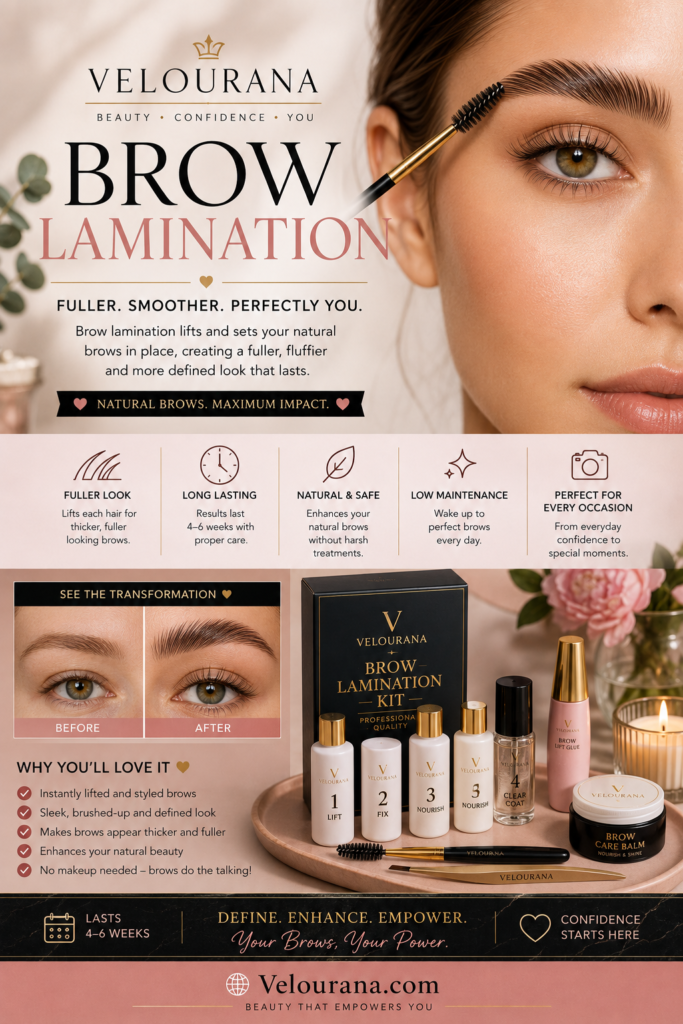
CATEGORY: Brow Lamination
Sparse eyebrows can be frustrating because the problem is rarely as simple as having “too little hair.” Two people can have brows that appear equally thin while having completely different underlying situations. One may genuinely have very few brow hairs, while another may have a reasonable amount of hair that lies flat, overlaps, grows downward, or clusters in ways that make the brow look narrower than it really is.
This distinction is particularly important when considering brow lamination.
Brow lamination can produce an impressive increase in visible fullness, but it does not create new hairs. Its strength lies in changing the direction and arrangement of existing brow hairs so that they occupy the available space more effectively.
For the right sparse brow, this can make a substantial difference.
For another, the improvement may be modest.
Understanding which type of sparseness you have is therefore more useful than simply asking whether brow lamination “works for thin eyebrows.” The better question is whether the hairs you already possess can be repositioned to create the appearance you want.
Not All Sparse Brows Are Actually Low-Density Brows
When we look at an eyebrow, we tend to judge density by how much skin is visible between the hairs. That visual impression can be misleading.
Imagine a brow containing numerous relatively long hairs that grow almost horizontally. Several may overlap one another through the centre of the brow. Although there are plenty of individual hairs, they occupy a narrow strip.
From a normal viewing distance, the brow looks thin.
If those hairs are separated and angled upward and outward, they begin covering more of the surrounding area. Suddenly the upper portion of the brow looks fuller, small gaps appear reduced, and the entire eyebrow gains visual width.
The number of hairs has not changed.
Their distribution has.
This is one of the situations in which brow lamination can be especially effective.
By contrast, imagine a brow where an area contains almost no hair follicles producing visible hairs. There is nothing substantial to reposition across that section. Lamination may improve the appearance of the surrounding hairs, but it cannot populate genuinely bare skin.
Recognising this difference helps prevent unrealistic expectations.
How Lamination Creates the Illusion of Density
The visual effect of brow lamination depends partly on surface coverage.
Untreated brow hairs follow their natural growth patterns. Some point upward, others downward, and others sideways. They can cross one another or lie almost directly on top of neighbouring hairs.
Lamination temporarily makes those hairs easier to direct.
Once arranged more strategically, individual hairs become visible rather than disappearing into overlapping clusters.
Think of ten narrow lines stacked almost directly over one another. They occupy relatively little space. Spread those same ten lines across a wider area and they suddenly create much greater coverage.
Brow hairs work in a similar way.
This is why lamination can make a brow look significantly denser without adding anything to it.
The effect can be particularly useful along the upper brow line, where upward or diagonal positioning creates a broader silhouette. It can also help around the arch, where crossing or downward-growing hairs sometimes reveal more skin than necessary.
The technique is essentially using the natural hair more efficiently.
Hair Length Can Matter as Much as Hair Quantity
Long brow hairs are sometimes considered inconvenient because they can become unruly. For lamination, however, length can be extremely useful.
A longer hair covers more space.
If there is a small gap between two areas of growth, a nearby long hair may be capable of lying naturally across part of that space once its direction becomes easier to control.
This does not mean brow hairs should be used like a comb-over.
Trying to stretch a few hairs across a large empty area usually produces an obvious and unstable result.
But small irregularities can sometimes be softened surprisingly well.
This is also why aggressive trimming before or after lamination can be counterproductive for sparse brows. A hair that appears excessively long when brushed vertically may provide valuable coverage when positioned diagonally.
Removing that length may expose the very gap that the lamination could otherwise have softened.
For sparse brows, every useful hair matters.
Where Sparseness Occurs Changes the Result
A sparse brow should not be treated as one uniform problem because different areas perform different visual functions.
The inner brow establishes the beginning of the shape.
The central body creates most of the apparent density.
The arch contributes structure.
The tail completes the brow and influences how long and lifted the eye area appears.
Lamination can affect each area differently.
If the inner brow contains enough hair but looks thin because the hairs lie sideways, gentle upward positioning can create considerable improvement.
If the central body contains scattered gaps but also has long surrounding hairs, strategic direction may reduce their visibility.
If the tail is almost completely missing, however, there may be too little hair for lamination to reconstruct it convincingly.
The location of the sparseness therefore matters as much as its severity.
Sparse Inner Brows
Some people naturally have lighter or less dense hair near the bridge of the nose.
This can actually work beautifully with a soft brow style because natural eyebrows rarely need a solid, rectangular beginning.
Lamination may help by separating the available inner hairs and giving them gentle upward lift. Instead of attempting to create a dense block, the treatment can emphasise a feathered beginning.
If additional definition is desired, a few carefully placed pencil strokes can supplement the natural hairs.
The combination often looks more convincing than filling the entire area with uniform colour.
The aim should not necessarily be to eliminate every visible patch of skin. Some skin showing between hairs contributes to realistic brow texture.
Sparse Areas Through the Body of the Brow
Gaps through the central portion of the eyebrow can be more noticeable because this area normally carries substantial visual weight.
Here, lamination may be particularly useful if the surrounding hairs have enough length.
By changing their direction, those hairs can occupy some of the visible space without looking artificially stretched.
The improvement may be enough that only minimal makeup is required afterward.
However, the positioning should remain believable.
If every surrounding hair is forced unnaturally toward one empty spot, the brow may look distorted. A better result distributes hairs across the entire area so that no single strand appears responsible for concealing a gap.
The illusion works because the brow looks generally fuller, not because one missing section has been disguised at any cost.
Sparse Brow Tails Are More Challenging
The tail is often where the limitations of brow lamination become most apparent.
Some people naturally have short or fine tails. Others have lost density through years of aggressive tweezing or other factors.
If several usable hairs remain, lamination can make them easier to align and may create a cleaner, more substantial taper.
But if the area is largely hairless, the treatment cannot extend the eyebrow beyond the physical hair that exists.
This is where makeup may remain important.
A fine brow pencil can create small strokes that visually continue the tail while the laminated natural hairs provide texture through the rest of the brow.
Used together, the result can be more convincing than relying on either technique alone.
Brow Lamination Is Not Brow Regrowth
Because laminated brows can appear considerably fuller in before-and-after photographs, it is easy to misunderstand what has happened.
The treatment has not stimulated immediate hair growth.
It has not increased the number of follicles.
It has not permanently thickened each individual hair.
The fuller appearance comes primarily from styling and directional control.
This is an important distinction for anyone whose main concern is actual hair loss or a significant unexplained change in eyebrow density.
A cosmetic grooming treatment addresses appearance. It should not be confused with investigating the underlying reason for a substantial or unusual change in hair growth.
If the problem is simply naturally fine or irregular brows, lamination may provide a useful cosmetic solution. If there has been a notable unexplained change, cosmetic camouflage and understanding the cause are separate matters.
The Role of Brow Tinting
Tinting can significantly influence how sparse brows appear because not every existing brow hair is equally visible.
A person may have numerous fine or pale hairs that almost disappear against the skin.
Lamination can reposition them, but if they remain difficult to see, their contribution to apparent density will still be limited.
An appropriately selected professional tint may make those hairs more visible.
Suddenly the brow appears to contain more hair, even though the actual number of hairs has not changed.
This can combine powerfully with lamination: one treatment improves distribution while the other improves visibility.
But tinting should still be personalised.
A very dark tint on naturally delicate brows can produce an unexpectedly heavy appearance. The objective for sparse brows is usually believable density, not simply maximum darkness.
Why Brow Makeup Often Works Better After Lamination
Sparse-brow makeup is most convincing when cosmetic strokes integrate with real hair.
Before lamination, the natural hairs may be concentrated in narrow areas, forcing pencil or powder to do much of the visual work.
After lamination, those hairs can cover more territory.
This gives makeup a better foundation.
Instead of drawing an entire eyebrow, you may only need to fill isolated spaces.
A fine pencil can imitate a few missing hairs.
Powder can create subtle shadow behind naturally positioned hairs.
A lightly tinted styling product can add definition without completely covering the natural texture.
This selective approach often produces greater dimension than heavily colouring the whole brow.
The real hairs remain the dominant feature, while makeup acts as support.
Why Overfilling Can Ruin the Effect
A common mistake is continuing exactly the same makeup routine after lamination.
Suppose someone previously used a dark pencil to outline both borders of the eyebrow, filled the interior with powder, and added a strong gel because the natural brow appeared thin.
After lamination, the brow may already be wider and visually denser.
Applying the same amount of colour can transform a soft improvement into an excessively heavy brow.
The treatment should therefore be allowed to change the makeup routine.
Brush the laminated hairs into position first.
Then step back.
Look at the entire face rather than examining the eyebrow from a few centimetres away.
Only after seeing the actual remaining gaps should additional product be applied.
Sparse brows do not need every millimetre of visible skin covered to look attractive.
The Importance of Preserving Existing Hair
People who consider their brows sparse sometimes become surprisingly aggressive about removing hairs that do not fit the desired outline.
This can create a cycle.
A few hairs seem inconvenient, so they are removed. The brow then looks thinner, requiring more makeup. More hairs are removed to sharpen the drawn shape, making the natural brow progressively less substantial.
Lamination offers an opportunity to reverse that philosophy.
Instead of immediately removing a hair because it grows in an awkward direction, ask whether changing its direction could make it useful.
A downward-growing hair may contribute beautifully to the upper brow once redirected.
A long hair that crosses its neighbours may provide valuable coverage when separated.
Even a hair slightly outside the expected line may integrate naturally once the rest of the brow has been styled.
For sparse brows especially, preservation deserves priority.
Be Conservative With Trimming
Trimming can create neatness, but sparse brows require particular caution.
When laminated hairs are brushed straight upward, some may extend well beyond the desired shape. Cutting them all along a uniform boundary can seem logical.
But those hairs may later be worn diagonally.
Their extra length then becomes useful.
If they have already been shortened aggressively, gaps may become visible and the brow may lose softness.
Any trimming should therefore be considered in relation to the intended finished style rather than the most extreme position the hairs can reach.
A sparse brow usually benefits from maintaining as much healthy, usable length as practical.
Can Lamination Make Very Thin Brows Look Thick?
Sometimes the answer is surprisingly close to yes, but only under particular circumstances.
A brow may look extremely thin while containing long, overlapping hairs. Once those hairs are separated, the visible transformation can be substantial.
Another brow may have approximately the same apparent width but contain far fewer hairs.
Its transformation will be more limited.
This is why before-and-after photographs from other clients cannot predict your result.
What matters is not merely the starting silhouette.
The number, length, thickness, colour, direction, and distribution of the individual hairs all influence how much additional apparent fullness can be created.
When Lamination Alone May Be Enough
Some sparse-looking brows need surprisingly little beyond directional correction.
If the brow has adequate hairs throughout its length but they lie flat or overlap, lamination may provide most of the desired improvement.
Afterward, the person may find that the brows need only brushing and perhaps a small amount of styling product.
This can be particularly liberating for someone accustomed to spending considerable time constructing a fuller shape with makeup every morning.
The result also has a different visual quality from a heavily filled brow.
Because the fullness comes from real hairs, natural variations in colour, shadow, and texture remain visible.
That dimensionality is difficult to reproduce entirely with cosmetics.
When Lamination Should Be Combined With Other Grooming Techniques
There is nothing unsuccessful about a lamination that still requires some makeup.
Treatments do not need to solve every brow concern independently.
A person with good density at the front and centre but a sparse tail may use lamination to improve the majority of the brow and pencil only where necessary.
Someone with pale hairs may combine lamination with appropriate tinting.
A person with minor gaps may use fine cosmetic strokes between the repositioned natural hairs.
The most natural result often comes from combining several subtle interventions rather than demanding that one technique perform an impossible transformation.
Avoiding an Artificial “Cover-Up” Effect
When sparse brows are laminated, there can be a temptation to maximise every available hair by spreading it as far as possible.
This may technically cover more skin but can look unnatural.
The objective is not simply coverage.
It is believable distribution.
Real brows contain small variations in density. They are not perfectly opaque bands of hair. Allowing some subtle skin visibility between individual strands can make the overall eyebrow appear more authentic.
A good result should still make sense when viewed closely.
If a few extremely long hairs have been stretched across an otherwise empty area, movement or changes in styling may reveal the strategy immediately.
A softer arrangement supported by selective makeup is often more convincing.
The Condition of Sparse Brow Hair Matters
When every hair contributes significantly to the finished shape, maintaining its condition becomes especially important.
Overprocessed or brittle hairs can break, reducing the density that the treatment is intended to emphasise.
For this reason, professional assessment before repeated lamination is valuable.
Treatment frequency should not be determined only by the date of the previous appointment. The condition of the hairs matters.
If they appear compromised, simply repeating chemical processing because the styling effect has faded may not be the best approach.
Professional aftercare instructions should also be followed carefully.
The goal is not merely to achieve fuller-looking brows immediately after an appointment. It is to preserve attractive natural hairs over time.
Set Realistic Expectations Before the Appointment
A good consultation should include an honest discussion of what the existing brow hair can support.
If you have a particular result in mind, show the professional what you like about it.
Perhaps it is the softness.
Perhaps it is the width.
Perhaps it is the feathered front.
The technician can then assess whether your natural hair has enough length and density to create a similar characteristic, even if the exact brow cannot be reproduced.
This is more useful than requesting somebody else’s complete shape.
Every eyebrow begins with different raw material.
Judge Sparse Brows From a Normal Distance
Magnifying mirrors can make almost every eyebrow look imperfect.
Individual gaps become enormous. Slight differences between the two brows seem dramatic. Tiny changes in hair direction suddenly appear important.
But eyebrows are part of a face.
Other people normally see them from conversational distance, not through magnification.
After lamination, step away from the mirror and assess the entire face.
Does the brow frame the eye better?
Does it appear fuller overall?
Is the shape balanced?
Does your attention go naturally toward the eyes rather than directly toward a particular gap?
These questions provide a more useful measure of success than whether every tiny patch of skin has disappeared.
The Best Result Uses Every Hair Intelligently
For sparse brows, brow lamination can be remarkably effective when the apparent thinness is caused partly by direction, overlap, or poor distribution.
Its strength lies in revealing what the brow already contains.
A hair that once disappeared beneath another can become part of the visible texture. A downward-growing strand can contribute to width. A long hair can soften a small gap. Fine hairs can become more noticeable when properly arranged and, where suitable, enhanced with professional tinting.
But the treatment has honest limits.
It cannot manufacture follicles, completely reconstruct large hairless areas, or guarantee the dense brows seen in another person’s photograph.
Understanding those limits does not make lamination less valuable.
It makes the treatment easier to use well.
The most convincing sparse-brow transformations do not attempt to hide reality beneath excessive styling. They maximise natural hair, preserve useful length, introduce additional definition only where necessary, and allow some natural variation to remain.
When there is enough existing hair to work with, lamination can turn a brow that merely looks sparse into one that appears considerably fuller, softer, and more structured.
And when there is not enough hair to achieve everything desired, lamination can still perform an important role: making the natural portion of the eyebrow look its best so that any additional cosmetic correction can remain subtle.
That is ultimately the most realistic promise of brow lamination for sparse brows—not the creation of hair that does not exist, but a far more intelligent use of the hair that does.
The End
Velourana
 Discover More From Our Family of Websites
 ZodiacBearing (Astrology, Tarot, Numerology, Angel Numbers & Spiritual Guidance)
 Velourana (Beauty, Makeup, Hair Care, Skincare & Beauty Tips)
 HavenBearing (Home, Living, Organization, Décor & Everyday Inspiration)
 PawBearing (Pet Care, Dog Breeds, Animal Health, Training & Pet Products)
 PsyCatherine (Notes From the Journal of a Psychologist on Real Life)

