
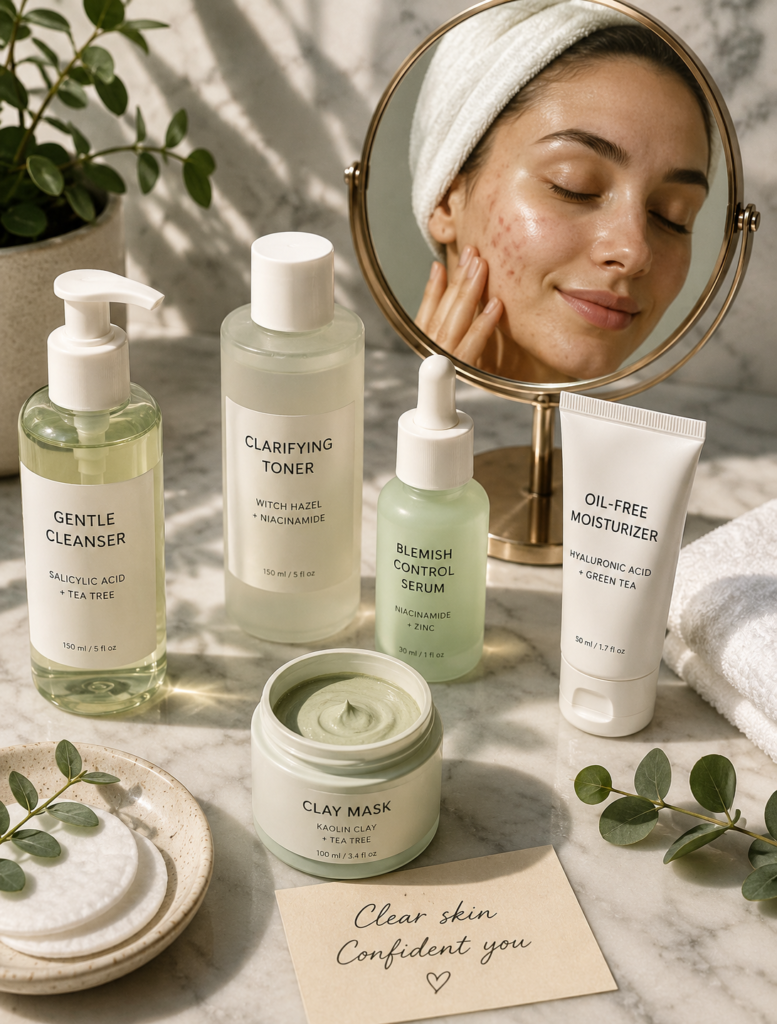
CATEGORY: Acne-Prone Skin
Sensitive, acne-prone skin presents one of the most difficult balancing acts in skincare. Breakouts encourage treatment, but the treatments commonly used for acne can themselves cause dryness, redness, peeling, or stinging. The natural response is often to alternate between two extremes: aggressively treating the acne until the skin becomes uncomfortable, then stopping everything and concentrating on repair until breakouts return.
A more effective strategy is usually to treat acne while respecting the skin’s tolerance from the beginning.
Sensitivity does not make acne untreatable. It simply means that the routine needs to be designed with greater attention to concentration, frequency, formulation, and the total number of potentially irritating products being used at the same time.
The objective is not to prove that your skin can tolerate the strongest possible routine.
The objective is to find the least disruptive routine capable of producing meaningful improvement.
What Does Sensitive Skin Actually Mean?
“Sensitive skin” is a broad description rather than one single diagnosis.
Some people naturally experience greater reactivity to skincare products. Others develop temporary sensitivity because their routine has become too aggressive. Environmental conditions, underlying skin conditions, medications, and individual allergies can also influence how the skin responds.
In everyday skincare, sensitivity may appear as burning, stinging, redness, itching, tightness, or unusual discomfort after products are applied.
The important distinction is between expected mild adjustment to certain active treatments and significant irritation.
A slight increase in dryness when introducing an acne treatment can occur.
Persistent burning is not something to celebrate.
Skincare culture sometimes encourages the belief that discomfort proves an active ingredient is powerful.
It does not.
Irritation is a biological response, not a quality certificate.
The Skin Barrier and Why It Matters
The outermost layer of the epidermis, the stratum corneum, plays an essential role in limiting water loss and protecting the body from the external environment.
In skincare language, this protective function is often referred to as the skin barrier.
When the barrier is functioning comfortably, the skin is generally better able to tolerate ordinary cleansing, environmental exposure, and appropriate treatments.
When it becomes disrupted, products that previously felt harmless may suddenly sting. The face can feel tight even when it looks oily. Flaking may appear around the nose, mouth, or chin. Redness can become more noticeable.
For someone with acne, this creates a difficult situation.
Treatment is still needed, but irritated skin becomes increasingly difficult to treat.
Protecting barrier function is therefore not separate from acne management.
It helps make acne management sustainable.
How Acne Routines Become Too Aggressive
Over-treatment often develops gradually.
A person begins with a cleanser and moisturizer.
Then acne appears.
They add salicylic acid.
A week later, a benzoyl-peroxide product is introduced.
Blackheads remain, so an exfoliating toner is added.
Social media recommends retinoids, so one of those joins the routine.
Then the skin becomes dry, prompting an exfoliating mask to “remove the flakes.”
Each individual decision has a certain logic.
Together, they can create a routine that the skin cannot tolerate.
This is why sensitive acne-prone skin benefits from viewing the routine as a complete system rather than judging every product individually.
Start With the Foundation
Before concentrating on active acne ingredients, establish a simple foundation.
A gentle cleanser removes what needs to be removed without creating unnecessary friction.
A suitable moisturizer supports comfort.
Broad-spectrum sunscreen provides daily ultraviolet protection.
These products may seem less exciting than acne treatments, but they create the environment in which treatment can be used more consistently.
If even the basic routine causes burning or persistent irritation, adding stronger active products is unlikely to simplify the situation.
The foundation should feel boring in the best possible way: predictable, comfortable, and reliable.
Cleansing Sensitive Acne-Prone Skin
Cleansing should not become the most aggressive part of the routine.
Use lukewarm rather than very hot water.
Massage gently with the fingertips rather than scrubbing with abrasive tools.
Avoid the assumption that more foam equals greater cleanliness.
A cleanser’s purpose is to remove surface debris, excess oil, sweat, makeup, and sunscreen.
It does not need to create a dramatically tight sensation afterward.
For some sensitive people, a heavily medicated cleanser used alongside leave-on acne treatments may contribute unnecessary additional irritation.
Others may tolerate an active cleanser very well.
The correct choice depends on the total routine.
The key question is not whether the cleanser contains a fashionable ingredient.
It is whether the cleansing step supports or undermines everything that follows.
Introducing Salicylic Acid Carefully
Salicylic acid can be useful for acne-prone skin, particularly when blackheads and whiteheads are prominent.
For sensitive skin, however, frequency matters.
There is no prize for progressing immediately to daily use if the skin cannot tolerate it.
A gradual introduction allows you to observe the response.
This is particularly important if other exfoliating ingredients are already present.
Read labels carefully.
A cleanser may contain salicylic acid.
The toner may contain another exfoliating acid.
The serum may contain yet another.
Someone can accidentally build a highly exfoliating routine without realizing it because each product is marketed for a different purpose.
Sensitive skin notices the total exposure, not the marketing categories.
Benzoyl Peroxide Without the All-or-Nothing Approach
Benzoyl peroxide can be valuable for inflammatory acne, but dryness and irritation are common concerns.
Sensitive skin may benefit from a more measured approach rather than beginning with the strongest product available.
Formulation and concentration influence tolerability, as does frequency.
Some people assume that if a lower concentration is useful, a much higher concentration must be dramatically better.
Skincare does not always follow that logic.
Increasing irritation can make consistent treatment more difficult and may lead someone to abandon a useful ingredient entirely.
The goal is enough treatment to help acne without creating a second problem that becomes equally difficult to manage.
Retinoids and the Adjustment Period
Topical retinoids are important in acne treatment because they help prevent pores from becoming clogged and can support long-term management.
They are also well known for potentially causing dryness and irritation when first introduced.
For sensitive skin, patience becomes essential.
The person who begins aggressively may experience peeling, redness, and discomfort, stop treatment completely, recover, restart aggressively, and repeat the cycle.
A gradual strategy can be easier to sustain.
Moisturizer may also be used strategically according to the product and professional guidance to improve tolerability.
The broader lesson is that treatment does not have to feel intense to be effective.
Moisturizer Is Part of the Treatment Strategy
Moisturizer can seem psychologically incompatible with acne.
People worry that applying something creamy to blemish-prone skin will trap oil and create more clogged pores.
But acne treatments commonly produce dryness.
A non-comedogenic moisturizer can help compensate for that effect and support skin comfort.
For sensitive acne-prone skin, look for relatively straightforward formulations rather than assuming a moisturizer needs multiple active ingredients.
Sometimes a moisturizer’s greatest strength is that it simply moisturizes.
Ingredients such as glycerin, hyaluronic acid, and ceramides are frequently used in barrier-supporting products.
Texture should match personal preference.
A lightweight lotion may suit oily skin, while someone experiencing significant treatment-related dryness may prefer something more substantial.
The skin’s needs can also change seasonally.
Fragrance and Sensitive Skin
Fragrance is not automatically harmful to every person’s skin.
Many people use fragranced cosmetics without difficulty.
However, fragrance can be a source of irritation or allergic contact reactions in susceptible individuals.
Someone who already knows their skin reacts easily may prefer fragrance-free products, particularly in foundational products used over the entire face every day.
This is different from claiming that fragrance is universally “toxic.”
Skincare advice becomes more useful when it avoids turning ingredients into moral categories.
The relevant question is whether a formulation is appropriate for the individual using it.
Why More Exfoliation Is Usually Not the Answer
When sensitive acne-prone skin becomes flaky, there is a strong temptation to exfoliate the flakes away.
This can create a destructive cycle.
An acne treatment causes dryness.
Dryness creates visible flaking.
An exfoliating scrub or acid is added to remove the flakes.
The skin becomes more irritated.
More flaking develops.
The person exfoliates again.
Instead of repeatedly removing the visible evidence of irritation, address why the irritation is occurring.
The active treatment may need to be used less frequently.
The routine may contain too many exfoliating products.
Moisturization may be inadequate.
The cleanser may be too harsh.
The solution often involves reducing stress on the skin rather than adding another active step.
Patch Testing and Controlled Introduction
Sensitive skin benefits from controlled experimentation.
Before covering the entire face with an unfamiliar product, testing it on a small area can sometimes reveal obvious intolerance.
Patch testing cannot guarantee that a product will never cause problems, and formal allergy patch testing performed by a dermatologist is different from simply trying a cosmetic product on a small area.
Still, gradual introduction has practical value.
More importantly, avoid introducing several new products simultaneously.
If a new cleanser, serum, moisturizer, exfoliant, and sunscreen all arrive on Monday and the skin is irritated by Friday, identifying the cause becomes unnecessarily difficult.
Change one major variable at a time whenever possible.
What to Do When the Skin Suddenly Starts Burning
A routine that previously felt comfortable can sometimes become painful after active products accumulate.
If ordinary products suddenly sting, the skin may be significantly irritated.
This is not the ideal moment to add another exfoliating serum.
Simplifying the routine temporarily can make sense.
Focus on gentle cleansing, moisturization, and appropriate sun protection while avoiding unnecessary irritating products.
If the reaction is severe, persistent, swollen, blistering, or otherwise concerning, professional medical advice is appropriate.
Not every reaction should be self-treated as a damaged “skin barrier.”
Dermatitis, allergies, infections, and other conditions can sometimes resemble ordinary cosmetic irritation.
Sensitive Skin and Sunscreen
Sun protection remains important, particularly when acne treatments increase skin sensitivity.
However, finding a sunscreen that sensitive, acne-prone skin tolerates can require experimentation.
Some people prefer mineral filters.
Others tolerate organic chemical filters perfectly well and prefer their lighter textures.
Neither category is universally superior for every sensitive person.
The best sunscreen is one that provides appropriate broad-spectrum protection, suits the skin, works with the rest of the routine, and is comfortable enough for consistent application.
A technically excellent sunscreen that causes persistent irritation is not the right sunscreen for that individual.
Post-Acne Marks and the Temptation to Treat Everything
Sensitive acne-prone skin often develops another challenge after active breakouts improve: visible marks remain.
At this point, the person may add strong exfoliating acids, brightening serums, retinoids, and multiple pigmentation treatments simultaneously.
The original acne routine becomes a discoloration routine layered on top of an already sensitive complexion.
This can restart irritation.
Post-acne discoloration often requires patience.
Ingredients such as azelaic acid may be useful because they can overlap with both acne and pigmentation concerns, but treatment still needs to respect tolerance.
Trying to correct every concern at maximum speed can slow the entire process.
Distinguishing Irritation From an Acne Flare
When skin becomes bumpy after a new product, people sometimes immediately call it “purging.”
That explanation can encourage continued use of something the skin does not tolerate.
Purging is associated with certain ingredients that influence cell turnover, but not every breakout or rash after introducing a product qualifies.
If the skin becomes intensely itchy, swollen, painfully red, or develops unusual widespread bumps, assuming the reaction is a normal adjustment can be a mistake.
Pay attention to the type of reaction, not just the timing.
When in doubt—particularly if symptoms are significant—professional assessment is safer than attempting to diagnose the reaction through skincare terminology alone.
The Value of a Skincare Diary
Sensitive skin can be difficult to understand because reactions may seem inconsistent.
A simple skincare diary can help.
Record which products are being used, how frequently active ingredients are applied, and when unusual irritation or breakouts occur.
Environmental factors can also be noted if relevant.
After several weeks, patterns may become clearer.
Perhaps irritation repeatedly follows consecutive nights of a particular active.
Perhaps breakouts worsen when a certain hair product is used.
Perhaps the skin becomes significantly drier during colder weather.
Memory is unreliable.
A simple record can turn vague impressions into useful information.
When Professional Treatment Makes More Sense
Sensitive skin can encourage people to avoid dermatologic treatment because they fear prescription medications will be too harsh.
But professional treatment can actually reduce unnecessary experimentation.
A dermatologist can evaluate the type and severity of acne, consider the sensitivity, and design treatment accordingly.
This is particularly important for deep, painful, persistent, or scarring acne.
Continuously purchasing supposedly gentle cosmetic treatments while permanent scars are developing is not necessarily the cautious option.
Effective treatment delivered appropriately can be more protective in the long term.
Building a Routine That Can Survive Six Months
A useful way to evaluate an acne routine is to imagine following it for six months.
Could you realistically maintain it?
Does it require so many alternating products that you regularly forget what should be used?
Does the skin spend half the week irritated?
Are you continually stopping treatment to recover?
If so, the routine may be theoretically impressive but practically weak.
Sensitive acne-prone skin often responds best to consistency.
A modest routine that can be maintained for months has an important advantage over an aggressive routine that lasts ten days.
Treat the Acne Without Fighting the Skin
The central mistake in sensitive acne care is treating the skin itself as the enemy.
Acne is the condition being managed.
The skin is the tissue that must tolerate the management.
That distinction changes everything.
Cleanse gently rather than repeatedly stripping oil.
Introduce active ingredients strategically.
Use moisturizer without assuming hydration causes acne.
Protect the skin from ultraviolet exposure.
Avoid piling exfoliation on top of treatment-related irritation.
And recognize when the severity of acne deserves professional care.
Sensitive and acne-prone skin may require more patience, but patience does not mean doing nothing.
It means choosing interventions carefully enough that treatment can continue.
The strongest routine is not necessarily the one that creates the most dramatic sensation.
It is the one that steadily addresses breakouts while allowing the skin to remain comfortable, protected, and resilient enough for the process to continue.
 Discover More From Our Family of Websites
 ZodiacBearing (Astrology, Tarot, Numerology, Angel Numbers & Spiritual Guidance)
 Velourana (Beauty, Makeup, Hair Care, Skincare & Beauty Tips)
 HavenBearing (Home, Living, Organization, Décor & Everyday Inspiration)
 PawBearing (Pet Care, Dog Breeds, Animal Health, Training & Pet Products)
 PsyCatherine (Notes From the Journal of a Psychologist on Real Life)

